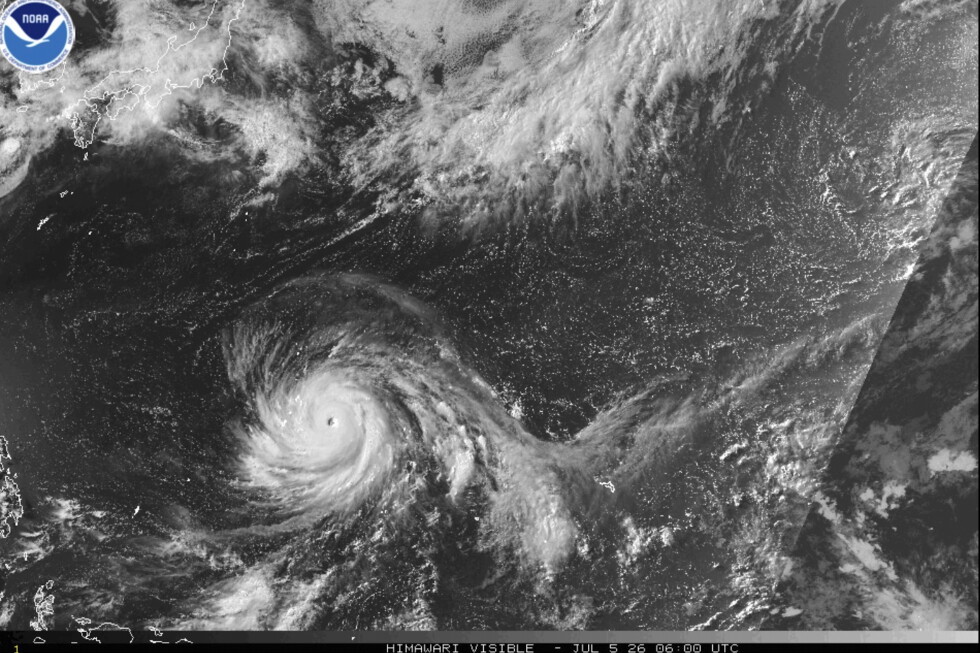
On Monday local time, a powerful Category 5 super typhoon named Bavi slammed into Rota, a small U.S.-owned island in the western Pacific that is part of the Northern Mariana Islands, located northeast of Guam. The weather event brought catastrophic, life-threatening conditions to the region, including 180-mile-per-hour sustained winds and gusts reaching as high as 215 miles per hour, alongside torrential downpours that have forced widespread shelter-in-place orders across the archipelago.
The U.S. National Weather Service (NWS) confirmed that the storm began moving across Rota, home to fewer than 2,000 residents, early Monday. Alongside the extreme wind warning that remained in full effect for Rota, official typhoon warnings were extended to neighboring Guam, Tinian and Saipan, while other smaller surrounding islands remained under tropical storm watches and warnings. The entire region is still in the process of rebuilding and recovering from the impact of Super Typhoon Sinlaku, another powerful cyclone that hit the same area in April this year, which was previously recorded as the strongest tropical storm of 2024 to hit the Pacific.
Edwin Montvila, an NWS meteorologist, emphasized the imminent danger the storm poses to human life. Officials have urged all residents across affected areas to move to reinforced interior rooms of their homes or shelters immediately, and to stay far away from windows and exterior walls. “Entering outside can result in death from flying projectiles. Utility poles and associated power lines will be down,” Montvila explained, stressing that all residents should stay indoors and avoid unnecessary travel at all costs.
While Bavi was moving at a relatively fast forward speed on Monday morning, giving forecasters hope that its most severe impacts would be short-lived, Montvila noted that the storm’s large size means tropical storm-level conditions, including heavy flooding rains, could persist across the islands through at least Monday night. The storm also proved difficult to track in the hours leading up to landfall: Montvila reported that Bavi’s path was “a bit erratic” overnight, shifting north and south repeatedly as it moved west toward the Northern Mariana Islands.
Guam Governor Lou Leon Guerrero released a social media video Sunday urging all residents on the island to shelter in place and avoid road travel. “Here we are experiencing another severe force of winds on our island, but as we know, we are always ready and prepared in our planning and our protection of our people,” she stated.
Local long-term residents expressed a mix of caution and experience with the frequent Pacific typhoon season. The Rev. Francis Hezel, a Guam-based priest based in Dededo, reported hearing winds howling outside his home for hours starting before dawn on Monday. He noted that most homes on Guam are built from reinforced concrete, which he hopes will limit widespread structural damage, though he acknowledged the high risk of multi-day power outages that have followed recent severe storms. He added that long-term residents are accustomed to preparing for typhoon season, and suggested that officials could moderate warnings to avoid unnecessary public anxiety, framing the event as more of a major inconvenience than an unprecedented catastrophe for the region.