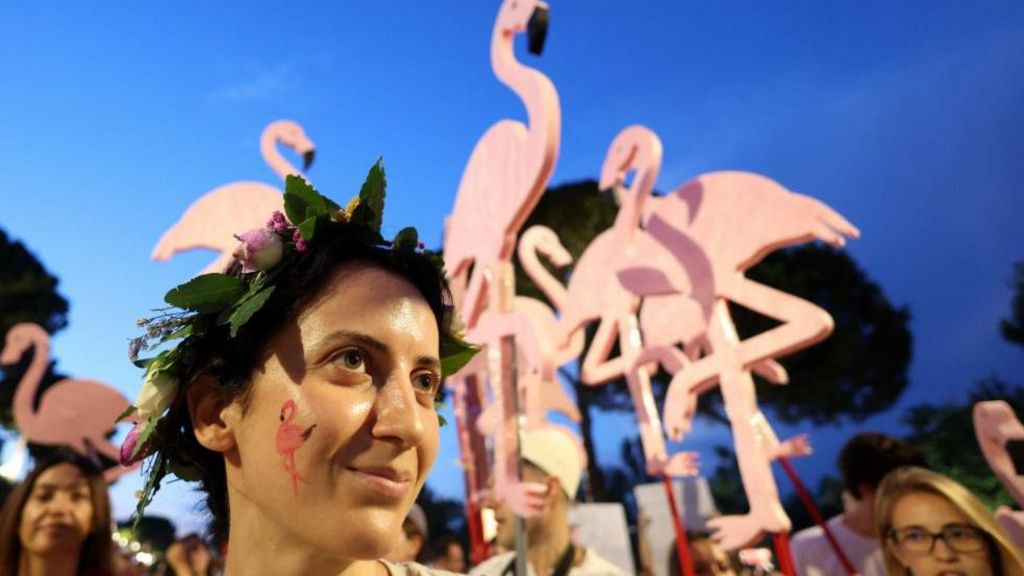
What began as a small grassroots movement to protect a fragile wetland habitat and its iconic pink flamingo population has erupted into a national political upheaval that has shaken Albania’s 13-year ruling government, with protesters now demanding the resignation of Prime Minister Edi Rama over allegations of systemic corruption and neglected public welfare.
The unrest traces its origins to Narta Lagoon, a protected coastal ecosystem near the southern city of Vlora that serves as a critical migratory stop and breeding ground for Albania’s unique flamingo population. The project that ignited public anger is a planned luxury coastal resort, led by a group of international investors that includes Jared Kushner, son-in-law of former U.S. President Donald Trump. The Albanian government has already granted the development group privileged “special investor” status, despite the fact that no formal environmental impact assessment has been completed and final planning approval remains pending. Still, activists have documented the appearance of fencing and heavy construction machinery on the proposed site, triggering early local pushback.
The movement gained national traction a month ago, after a viral social media video showed private security guards hired for the project assaulting a local environmental demonstrator. Prime Minister Rama has since confirmed the incident occurred, but the violence did little to quell anger—instead, it galvanized broader public discontent that had been simmering for years. What started as a defense of flamingos quickly expanded to encompass a wide range of public grievances: underfunded schools, understaffed hospitals, stagnant job opportunities, soaring living costs, and widespread disillusionment with the direction of the country’s rapid development.
Gathering nightly outside Rama’s office in the capital Tirana, demonstrators now carry flamingo symbols as the emblem of their broader movement, labeled by participants as the “Flamingo Revolution.” For many protesters, the fight is as much about their future in Albania as it is about protecting wildlife. “I’m here for our schools, I’m here for our hospitals, I’m here for our infrastructure,” Helena, a young protester, told the BBC. “I want to stay in my country, and I don’t want to leave.”
Critics of the government, including prominent dissident and writer Fatos Lubonja—who spent 17 years in a forced labor camp under communist dictator Enver Hoxha—allege that the country’s decade-long building boom and tourism expansion is driven by corrupt ties between state officials, oligarchs, and organized crime, acting as a front for large-scale money laundering. Standing near Tirana’s central Skanderbeg Square, ringed by new glass-and-steel skyscrapers, Lubonja said: “If you see all these skyscrapers, it comes out that this is a plan by organised crime, plus oligarchs, plus functionaries of the state. We want to push justice to investigate.”
Rama, whose Socialist Party has held power for 13 years, has overseen significant transformation in Albania during his tenure. Tirana’s skyline has been completely remade with internationally designed towers, tourism has boomed to account for more than 20% of national GDP, and the country has made rapid progress toward European Union accession—on track to complete accession negotiations by the end of 2027, faster than any other Western Balkan candidate besides Montenegro, which has been negotiating for a decade longer.
Speaking from his office ahead of a recent night of protests, Rama framed the ongoing demonstrations as evidence of a healthy functioning democracy, dismissing widespread anger as a normal part of democratic discourse. Still, the scandal facing his government runs deep: several of Rama’s closest political allies, including his former deputy prime minister and the current mayor of Tirana, are already under investigation by Albania’s specialized anti-corruption prosecution body SPAK. When asked about concerns over his own integrity, Rama said he supports an independent judiciary that “doesn’t look left, doesn’t look right, but looks straight.” He added that the Socialist Party’s biggest contribution to the country would be allowing anti-corruption investigations to proceed without interference, even when they target party members.
The depth of the current rift within the ruling party has been highlighted by the high-profile departure of Marjana Koceku, the youngest member of Albania’s parliament. Rama personally selected the 25-year-old environmental activist as a candidate in 2025’s national elections, hoping to capitalize on her reputation as a leading climate advocate in northern Albania. But Koceku has now resigned from the Socialist Party, saying she could no longer pretend the status quo was acceptable. “Beyond these beautiful facades that look so nice and shiny, the reality is not the same,” she said. “[Rama] doesn’t inspire people anymore, and I think that this brought him to a huge crisis of legitimacy. More and more people are realizing that every day.”
As the standoff between protesters and the government continues, with neither side backing down, the pink flamingo is likely to remain a defining sight on the streets of Tirana for the foreseeable future.