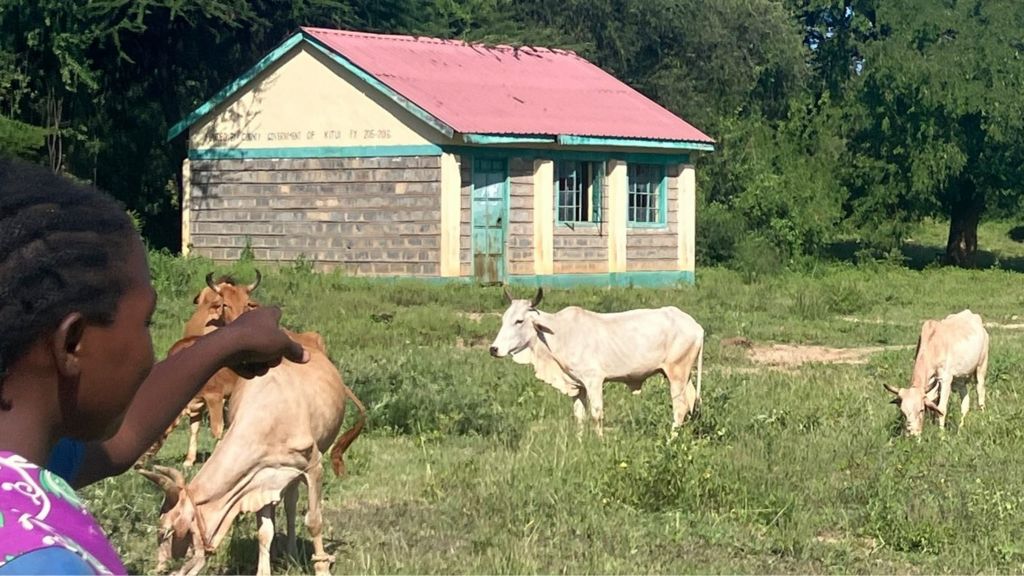
On a morning that would normally hum with the chatter of playing children and the scratch of pencils on paper, Kaliluni Primary School, a remote rural learning institution in southern Kenya, hosts only grazing cows. These animals wander between cracked, half-hanging classroom doors, which gape open to reveal neat rows of unoccupied wooden chairs. Three years ago, more than 200 students filled this small campus with noise and energy. Today, just five children remain enrolled – and on the day a BBC reporting team visited, even those five and their school’s only remaining teacher were nowhere to be found.
Leaving the crumbling, overgrown school compound, where tattered textbooks lie scattered across dusty classroom floors, reporters spotted 12-year-old Maureen Mwisiwa in her starched blue school uniform, walking slowly and dejectedly toward her home. Maureen told the BBC she had shown up to Kaliluni every day for a week, only to find herself completely alone with no classes to attend. “I feel bad missing lessons all those days while pupils in other schools are still in class,” she explained.
Her mother, Josephine Muasya, is one of the last remaining parents with a child enrolled at the school, and she is preparing to transfer Maureen to a distant campus where most of the girl’s former classmates have already relocated. The new school sits 8 kilometers (5 miles) away across unmaintained, rocky roads. With no public transit service in this isolated region of Kitui County, more than 200 kilometers east of Kenya’s capital Nairobi, children cut across steep, uneven terrain to shorten their commute. Even with the shortcut, Maureen will walk for more than an hour each way, compared to the 10-minute trip she took to reach Kaliluni.
Muasya says she once held out hope that the national government would intervene to revive her local school, sending additional trained teachers and upgraded facilities to meet the requirements of Kenya’s new national curriculum. Today, that hope is gone. The curriculum Muasya refers to is the Competency-Based Education (CBE) system, a sweeping national education overhaul rolled out in 2017 designed to replace Kenya’s old exam-heavy model with a more creative, practical, skills-focused approach to learning.
While the reform was intended to reduce educational inequality across the country, it has triggered an unforeseen crisis for Kenya’s most under-resourced rural primary schools. Kaliluni Primary is just one of more than 2,000 rural schools across the East African nation now facing permanent closure after catastrophic enrollment collapses.
Under the previous education framework, primary school spanned eight grades, with students moving to senior secondary school around age 14. The CBE system restructures basic education to end primary school after grade six, adding a new three-year junior secondary stage for grades seven through nine, which places greater emphasis on science and hands-on technical subjects. The government ruled that existing primary schools would absorb these new junior secondary grades, pushing the transition to senior school to age 15.
But the restructuring created an immediate, unmanageable burden for low-resource rural schools, which suddenly needed additional classrooms, fully equipped science laboratories, subject-specialized trained teachers, and updated learning materials to comply with the new requirements.
“Infrastructure gaps are acute. Many rural schools lack basic facilities such as laboratories, yet learners are expected to pursue science and technical pathways,” Mark Kasyoki, a Kenyan education expert, told the BBC. He warned that the CBE curriculum, which was designed to close equality gaps in Kenyan education by making quality learning free for all students, could end up widening those gaps if implementation challenges are not addressed as a matter of urgency.
Kitui County has been one of the hardest-hit regions. Sooma Primary School permanently closed its doors in 2023 after enrollment dropped to just six students. The following year, Manooni Primary shut down after only three children registered for the new term. There were no closing ceremonies, no goodbye gatherings under the giant shade trees that anchor most rural schoolyards. Students simply left one by one, quietly relocating to better-resourced schools farther from their homes.
Tabitha Katingu, a Kitui County mother who transferred both of her children to a new school 3 kilometers from her home after their local campus shut down, says the CBE reform was supposed to lift up low-income rural communities, not undermine their access to education. “The CBE curriculum should strengthen schools, especially for low-income communities, not weaken them. We want the best for our children. If a school has not enough trained teachers and other required facilities – why would we waste time there?” she said.
The transition crisis has also left rural teachers frustrated and disillusioned. “The challenge is not that teachers are unwilling to embrace CBE. It’s that many of us have not been adequately prepared for it. The training has been inconsistent, especially in rural schools,” one Kitui-based teacher explained.
Not all local residents blame the school closure crisis entirely on the curriculum overhaul. Some point to broader demographic shifts reshaping rural Kenya: falling national fertility rates have led to fewer school-age children in small villages, while working-age adults increasingly relocate to urban centers for better employment opportunities, taking their children with them.
“Young people want to marry, but life is hard. Everything is expensive, and many fear they cannot provide for a family. That is why there are fewer children growing up in our villages nowadays,” Sarah Mumbua, a long-time resident of Kilukuya village, told the BBC. National statistics show roughly 70% of Kenyans still lived in rural areas in 2023, but UN-Habitat projects that more than half of the country’s population will live in urban areas by 2050 as migration continues.
The enrollment decline is not limited to primary schools: government data shows 2,700 of Kenya’s 9,605 public secondary schools, most in remote rural regions, now enroll fewer than the 150 students deemed the minimum for viable operations. Local media reported earlier this year that 10 rural secondary schools were closed after teachers arrived for the new term to find zero students had registered for classes.
In January 2026, the government celebrated a major milestone for the CBE reform: 1.1 million pioneer grade 10 students, the first full cohort to complete the entire new curriculum, transitioned to senior secondary school. But even as officials marked the occasion, they acknowledged the growing crisis in rural areas.
Education Minister Julius Ogamba confirmed earlier this year that 2,145 under-enrolled public primary schools will be either closed or merged with neighboring campuses to optimize limited government resources. He also announced a nationwide school viability audit, noting that the government has set a minimum enrollment threshold of 45 students for a public primary school to remain open. “It makes no sense to have a school with just 10 students when you need a headmaster, a classroom, a watchman and a teacher. It doesn’t make sense. This tells us that we need to face reality. We now need to change course and ensure that our schools have all the necessary facilities and the right number of students,” he said.
But the wave of rural school closures has created a new crisis for surviving regional schools, which are now facing crippling overcrowding as they struggle to absorb hundreds of displaced students. Dr. Emmanuel Manyasa, CEO of Usawa Agenda, a Kenyan non-profit education research organization, warns that rapid mass closures carry long-term risks for the entire regional education system.
“CBE is a good curriculum but we’re failing in the implementation. We skipped critical early stages like a cost and implementation plan. We have been just crisis-managing the transition, which is not sustainable,” Dr. Manyasa told the BBC.
Bernard Musyoki, a 36-year-old teacher who worked for seven years in a rural Machakos County school (a region neighboring Kitui), saw the impact of closures firsthand. His small community school, which had fewer than 20 students enrolled, was merged into a larger regional campus, and Musyoki transferred to the new overcrowded facility. He says policymakers have swung from one extreme to another, leaving children in larger schools stuck in overcrowded classrooms that lack sufficient resources.
Musyoki argues the government should reverse course on mass closures, instead capping class sizes and distributing teachers and resources more evenly across rural institutions to ensure the CBE reform benefits all students, regardless of where they live. “Every child, whether they are in a small rural school or a large one, deserves equal access to teachers, classrooms and learning materials,” he said.