This weekend, the 202X FIFA World Cup delivers one of its most anticipated knockout round matches: England’s Three Lions will square off against host nation Mexico at the iconic Estadio Azteca in Mexico City on Sunday, a clash that poses stiffer challenges than any opponent the squad has faced in the tournament to date.
Beyond the on-pitch quality of El Tri, England must contend with unique obstacles that only a hostile away match in the Mexican capital can bring: the high altitude that alters pacing and endurance, a raucous, pro-home crowd that will create a cacophonous intimidating atmosphere, and the intangible edge of host nation gamesmanship that has become a staple of World Cup football at Azteca. Even with all these pressures, the match is poised to be unmissable, high-stakes football theatre.
Hosting the World Cup brings a legendary, well-documented advantage for the home nation, and Mexico boasts one of the most formidable home records in international football at Azteca. Six times in men’s World Cup history, the host nation has lifted the trophy, with France’s 1998 win marking the most recent host victory. But for England, there is tangible precedent for hope: some of the tournament’s most iconic upsets have seen home sides fall to visiting underdogs. This report examines the history of host nation advantage throughout World Cup history, to frame what England might expect on Sunday.
The first two editions of the men’s World Cup both ended in host nation triumph, starting with Uruguay in 1930 and followed by Italy’s 1934 win on home soil. That Italian victory gained lasting infamy, however, after fascist dictator Benito Mussolini co-opted the tournament as a political propaganda tool, with widespread speculation that his influence compromised match officiating. Writing nearly 80 years after the tournament, Italian author Marco Impiglia noted that “The fascist regime made a political abuse of the event. It was a questionable win and it raised many doubts at the time.” Notably, just four years later Italy made history by becoming the first nation to win a World Cup on foreign soil, claiming the title in France.
No discussion of home team heartbreak is complete without Brazil’s 1950 Maracanazo. While Brazil has claimed a record five World Cup titles, it has never won gold when hosting the tournament. In 1950, the tournament used a final round-robin group format instead of a single championship match, meaning Brazil only needed a draw against Uruguay to secure the trophy. Playing in front of an estimated 200,000 fans at Rio de Janeiro’s legendary Maracanã Stadium, Brazil suffered a shocking 2-1 defeat. Alcides Ghiggia, the Uruguayan player who scored the historic winning goal, later joked that only three people had ever silenced the Maracanã: “The Pope, Frank Sinatra and me.” When Brazil hosted the tournament again in 2014, this history of home disappointment repeated itself in even more humiliating fashion: the home side suffered a lopsided 7-1 semifinal defeat to Germany, with the visitors scoring a flurry of early goals that drained all suspense from the match before halftime.
England’s only men’s World Cup title came as hosts in 1966, a win that remains wrapped in controversy decades later. In the Wembley final against West Germany, Geoff Hurst’s extra-time shot bounced off the crossbar and down onto the goal line. With goal-line technology still decades from existing, match officials could not confirm definitively whether the whole ball crossed the line. Officials ultimately awarded the goal, putting England up 3-2, before Hurst completed his hat trick late in extra time to seal a 4-2 final score.
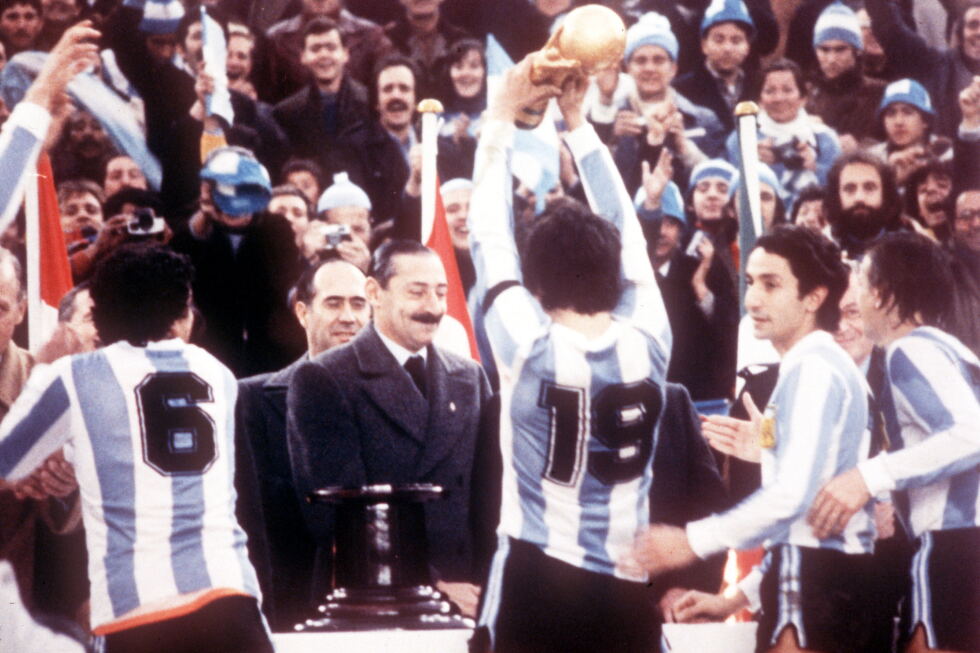
In 1978, the Netherlands suffered a bitter second consecutive final loss to a host nation. Four years after falling 2-1 to hosts West Germany in the 1974 final, the Dutch traveled to Buenos Aires to face Argentina in front of a frenzied home crowd. The Argentines delayed their entry onto the pitch by several minutes, leaving the Dutch alone on the field to face the jeers of thousands of hostile fans, and a public dispute broke out over whether Dutch player Rene van de Kerkhof would be allowed to play with a protective cast on his arm. Argentina claimed a 3-1 extra-time win, but the result was clouded by longstanding conspiracy theories: Argentina needed a six-goal win over Peru in its final second-round group match to advance to the final, and its 6-0 victory sparked widespread speculation of match fixing.
The 1990 World Cup in Italy produced one of the most unusual tests of home nation loyalty, when Argentina faced host Italy in a semifinal in Naples. Argentina legend Diego Maradona was a beloved star for local club Napoli, and he attempted to capitalize on long-simmering tensions between southern and northern Italy to sway local fans to his side. Speaking to outlet Corriere dello Sport, Maradona said: “After so much racism, only now they scurry to remember that Naples is part of Italy. Now that they have slapped the Neapolitans in every possible way, someone tells them they are Italians, that only Italy counts. It is incredible, absurd, offensive.” While local fans ultimately still cheered for the Italian national side, Argentina made history as the first team all tournament to score against Italy, securing a 1-1 draw before eliminating the Azzurri in a penalty shootout. Argentina went on to face West Germany in the Rome final, where they received a hostile reception from home fans and lost the title.
The most recent World Cup win by a host nation remains France’s 1998 victory. Les Bleus had failed to qualify for both the 1990 and 1994 tournaments, but the home field advantage propelled them to their first ever World Cup title, defeating defending champion Brazil in the final to deny the South American side a repeat championship.
The 2002 co-hosted tournament by Japan and South Korea produced another controversial host nation run, as South Korea advanced further than any Asian men’s team in World Cup history, reaching the semifinals. But the Korean run was marred by outrage from fans of eliminated sides Italy and Spain, who both argued that biased officiating favored the host. After Italy lost to South Korea in extra time in the round of 16, FIFA reported receiving hundreds of thousands of complaints from irate Italian fans. In the quarterfinals against Spain, multiple Spanish goals were ruled offside, and South Korea advanced on penalties. Then-FIFA president Sepp Blatter denied any organized conspiracy to favor the host, but acknowledged that multiple incorrect officiating calls had been made during the matches.
As England prepares to step onto the Azteca pitch Sunday, this long history of host advantage, upset and controversy sets the stage for what is already being called one of the most gripping matches of this year’s tournament.