CAIRO – Egyptian authorities announced two groundbreaking, well-preserved archaeological discoveries on Saturday, a move that comes as the country pins renewed economic hopes on its heritage tourism industry, a key driver of foreign revenue for the cash-strapped nation.
The first and most significant find is a largely intact Byzantine-era residential city uncovered in the Western Desert’s Dakhla Oasis, a site already on UNESCO’s Tentative List, just one step removed from formal World Heritage Site designation. According to Egypt’s Ministry of Tourism and Antiquities, the settlement offers unprecedented insight into daily life, urban planning, and commercial activity in 4th-century Egypt, when the region fell under Byzantine imperial rule.
Hisham el-Leithy, secretary general of Egypt’s Supreme Council of Antiquities, explained that the excavated settlement follows a grid layout: wide north-south main roads intersect with smaller east-west streets to create public plazas and open community spaces. At the northern head of the settlement, overlooking the city’s primary thoroughfares, sits a fully mapped basilica church dating to the mid-4th century, flanked by the stone remains of two watchtowers built to guard the settlement’s outer edges.
Mahmoud Massoud, head of the archaeological mission leading the Dakhla Oasis excavation, noted the city was constructed with heavy defensive infrastructure, including thick fortified perimeter walls. Inside the walls, archaeologists have uncovered dozens of residential structures, many featuring large reception halls and distinctive vaulted roofing. One standout discovery is the home of Tisous, a documented church deacon whose dwelling dates to the second half of the 4th century. Researchers believe the home functioned as an informal house church before the larger central basilica was completed.
Excavations have also yielded a range of everyday artifacts that paint a vivid picture of the city’s daily routines: well-preserved bread ovens, communal kitchens, and stone grinding tools used for food preparation have all been documented. The mission has also uncovered a large collection of bronze coins minted with portraits of Byzantine emperors, alongside Latin inscriptions and early Christian religious symbols. A separate cache of gold dates to the reign of Roman emperor Constantius II, who ruled from 337 to 361 CE.
Diaa Zahran, head of the Ministry’s Islamic, Coptic and Jewish Antiquities department, added that roughly 200 inscribed pottery fragments known as ostraca have also been recovered. These fragments, commonly used as a cheap writing material in antiquity, bear inscriptions recording commercial transactions, personal correspondence, and other small details of daily life that are rarely preserved in the archaeological record.
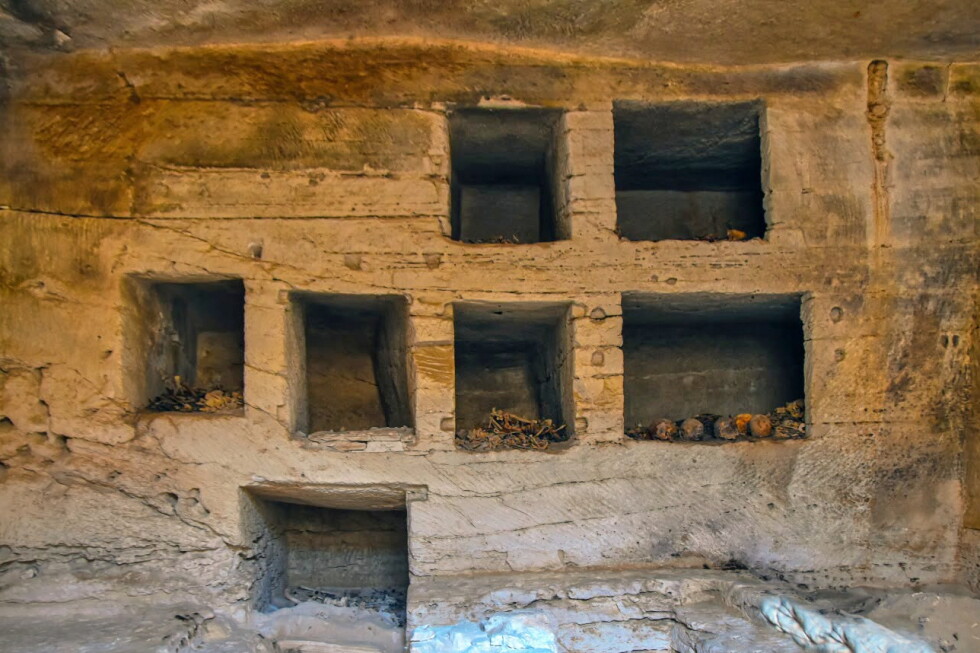
In a separate announcement, the ministry confirmed a second major discovery at the Marina el-Alamein archaeological site, located roughly 62 miles west of the Mediterranean coastal city of Alexandria. The site, first excavated in 1986, is believed to be the remains of Leukaspis, a thriving Greco-Roman port city founded in the 2nd century BCE that remained active through the 4th century CE. The new find adds 18 previously undocumented tombs to the site, bringing the total number of excavated burial sites there to 48.
Of the newly found tombs, 11 are cut deep into bedrock, averaging 8 meters in depth, while seven are built above ground from cut limestone. Artifacts recovered from the tombs include ceramic vessels, transport amphorae, oil lamps, dining plates, ritual altars, and limestone washing basins. Eman Abdel-Khaliq, head of the Marina el-Alamein excavation, said the mission also uncovered a 2.5-meter-long granite sarcophagus holding human remains that are currently undergoing analysis. Near the sarcophagus, researchers found the partial remains of a plaster sphinx statue.
A particularly notable funerary find was four small gold pieces placed inside the mouths of some deceased individuals, a tradition archaeologists refer to as the “golden tongue,” tied to widespread ancient Mediterranean funerary religious beliefs of the era.
For Egypt, the announcement of these finds is about more than advancing historical knowledge: alongside the Suez Canal, tourism is one of the country’s largest sources of foreign currency, a critical economic pillar for a nation facing persistent foreign currency shortages. After decades of disruption from political instability following the 2011 uprising and widespread travel bans during the COVID-19 pandemic, Egypt’s tourism sector has been steadily rebounding. Official government data shows 2025 drew a record 19 million international visitors, a 21% increase from 2024, with 6.1 million tourists visiting in the first four months of 2026, up from 5.7 million in the same period the previous year. Antiquities tourism is a core draw for international visitors, and the government hopes high-profile new discoveries will accelerate this recovery.