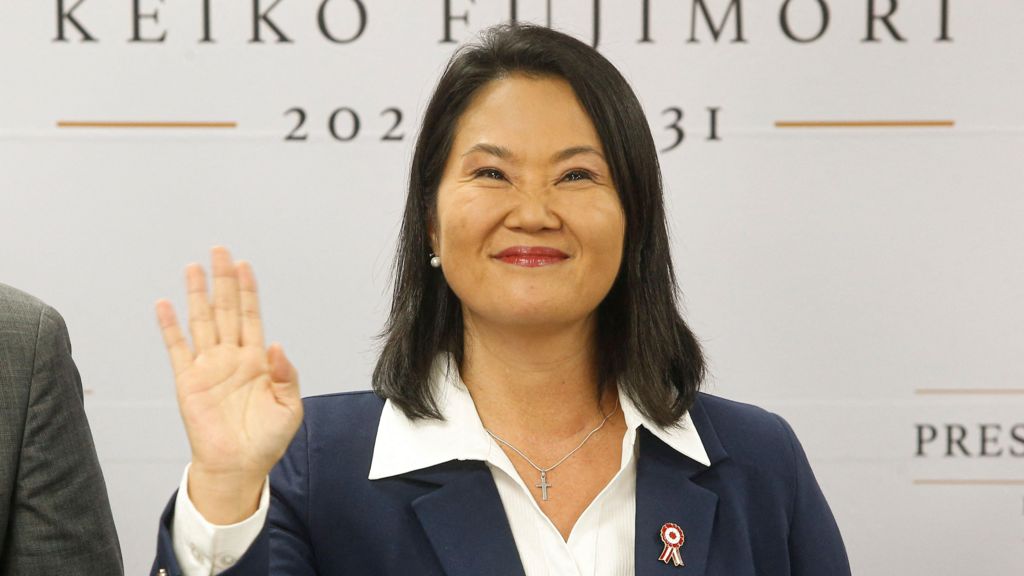
Nearly a month after Peruvian voters cast their ballots in a contentious runoff election, right-wing candidate Keiko Fujimori has been officially certified as the winner of the nation’s top office, capping off her fourth bid for the presidency and marking a continued ideological shift across Latin America.
Peru’s National Jury of Elections confirmed Friday that Fujimori, 51, edged out left-wing rival Roberto Sánchez by an extremely thin margin, taking 50.135% of the vote to Sánchez’s 49.865% — a gap of fewer than 50,000 votes total from the June 7 runoff. This long-awaited result comes after three previous failed presidential runs for Fujimori, the daughter of disgraced authoritarian former President Alberto Fujimori, who remains imprisoned for crimes against humanity committed during his decade-long rule, including extrajudicial killings and forced mass sterilisations.
Throughout the 2026 campaign, Fujimori centered her platform on addressing Peru’s growing public safety crisis, promising a harsh military-led crackdown on organized crime that has driven a surge in extortion and violent crime across the country in recent years. She has also pledged to court foreign private investment to stimulate stagnant economic growth, and to immediately deport undocumented immigrants who commit crimes on Peruvian soil. In her first remarks following the certification, Fujimori framed her incoming presidency as a humble, duty-driven project, acknowledging the narrow mandate by noting that the transition period would be focused on listening and cross-dialogue to prepare for a smooth handover of power. Her inauguration is scheduled for July 28.
Her defeat of Sánchez, a 57-year-old former foreign trade minister who ran on a platform of sweeping progressive economic reform, did not come without controversy. Sánchez has claimed the election was “seriously compromised,” arguing that Fujimori’s strong performance among overseas Peruvian voters indicates systemic irregularities. Immediately following Friday’s official proclamation of results, his party filed an appeal with electoral authorities, calling for the entire runoff to be nullified.
Fujimori’s victory coincides with the narrow election win of fellow right-wing candidate Abelardo de la Espriella in neighboring Colombia, solidifying a growing ideological turn toward the right across Latin America that has unfolded over the past several years. De la Espriella, who also campaigned on a pledge to crack down on organized crime, will take office just days after Fujimori. He joins a growing bloc of right-wing Latin American leaders — including El Salvador’s Nayib Bukele and Ecuador’s Daniel Noboa — that have aligned themselves with U.S. President Donald Trump, who has prioritized engagement with the region during his second term.
This shift leaves Brazil’s left-wing President Luiz Inácio Lula da Silva as the most prominent remaining left-wing head of state in the region, as he faces a tough reelection fight later this year against the son of convicted former right-wing President Jair Bolsonaro. For Peru itself, Fujimori’s inauguration will extend the nation’s period of rapid political turnover: she will become the ninth Peruvian president to hold office in just 10 years, amid ongoing instability that has defined the country’s politics for more than a decade.