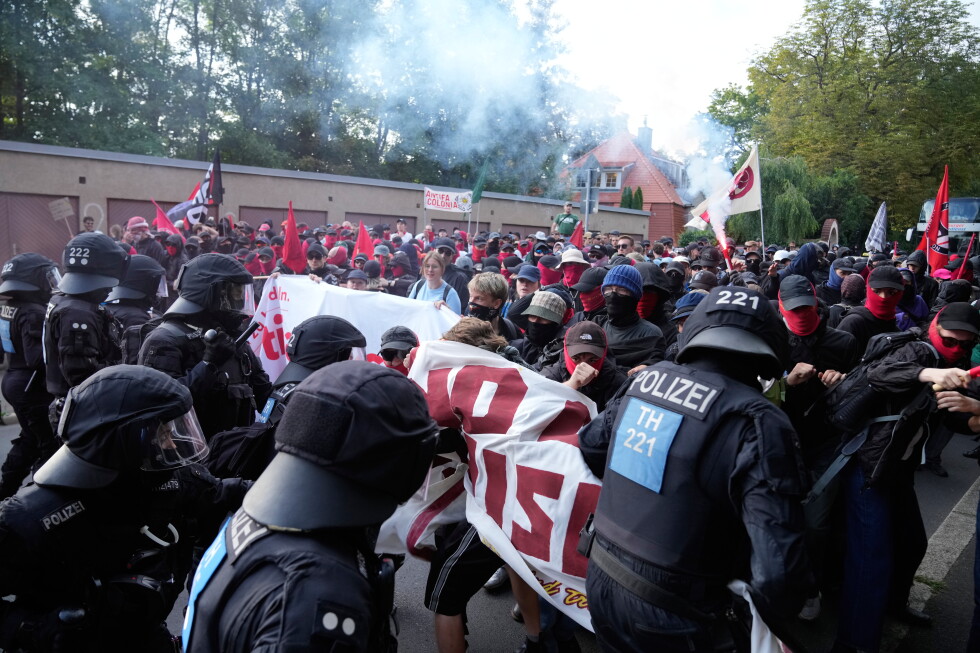
ERFURT, Germany – Thousands of demonstrators gathered in this eastern German city on Saturday to mobilize against the national convention of Germany’s far-right Alternative for Germany (AfD), with scattered confrontations breaking out between some protesters and riot-equipped police officers outside the venue.
The biennial party gathering, called to formally reelect the AfD’s national leadership, is a critical moment for the party: current co-leaders Alice Weidel and Tino Chrupalla, who have steered the party collectively for four years, are seeking extended terms, and party organizers are pushing to present a unified front to voters and observers across the country.
As Germany’s largest national opposition party, the AfD has remained one of the most polarizing political forces in modern German politics, a divide laid bare by the large-scale demonstrations that converged on Erfurt this weekend. Adding fuel to existing controversy, the convention’s date falls exactly 100 years after a foundational Nazi Party gathering held just miles away, an event that cemented Adolf Hitler’s total control over Germany’s fascist movement. Political opponents and leading historians argue that the overlapping timing carries ominous symbolic weight, a claim the AfD has flatly rejected.
Mainstream German political parties have maintained a longstanding “firewall” policy that rules out any formal or informal cooperation with the far-right party. But that has not slowed the AfD’s growing political momentum. The party has successfully leveraged widespread public dissatisfaction with the current national government, which has faced repeated criticism over its slow progress on reforms to revitalize Germany’s sluggish economy. Beyond its signature anti-migration platform that drove its initial rise to prominence in the mid-2010s, the AfD has refined its strategy to tap into voter frustration on a wide range of policy issues, expanding its appeal across segments of the German electorate.
The party is now setting its sights on a historic breakthrough in upcoming regional elections. For the September 6 state vote in eastern Germany’s Saxony-Anhalt, AfD leadership has set a goal of winning 40 percent or more of the popular vote. If the party hits that target, it could either secure an absolute legislative majority on its own or court defectors from other mainstream parties to form a governing coalition – a result that would put the AfD in position to claim its first-ever state governorship in German history. Weidel has framed coming electoral contests as transformative for the party, recently stating that “2026 is a year of destiny for AfD.”