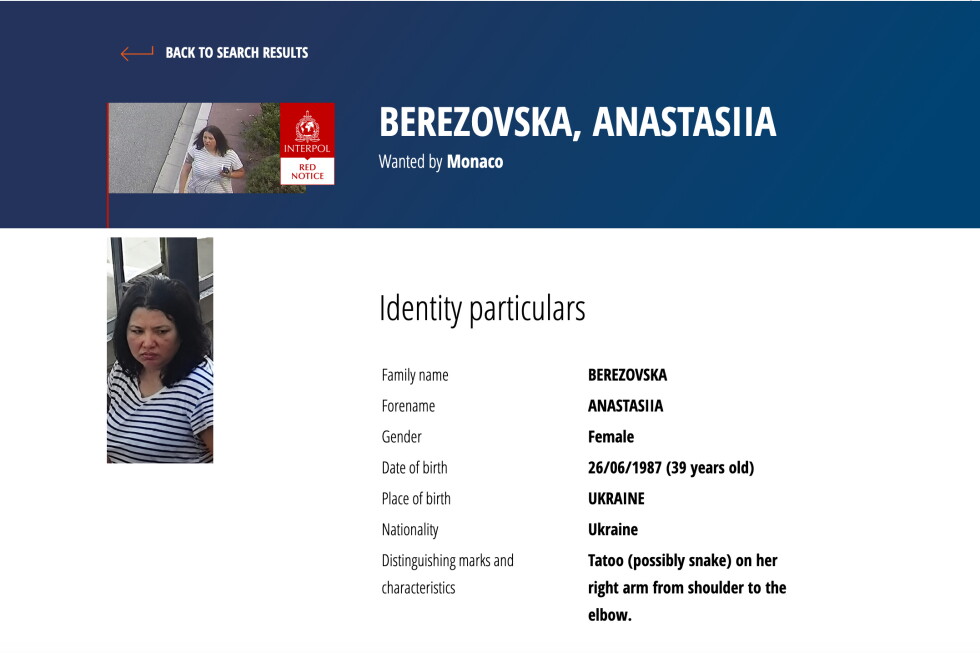
PARIS – In a major update to the investigation into a deadly targeted bombing in Monaco last week, international police agency Interpol has publicly named a 39-year-old Ukrainian woman as the primary suspect and issued an urgent global Red Notice calling for her immediate arrest. The woman, identified as Anastasiia Berezovska, remains at large more than a week after the explosion that rocked a residential building in the small Mediterranean principality.
The blast, which detonated at the entrance of a Monaco apartment building on Monday, wounded five people total. Three members of a single family were directly targeted in the attack, local authorities confirmed, among them prominent Ukrainian construction magnate Vadym Yermolaiev, multiple independent media outlets have reported. Yermolaiev, who gave up his Ukrainian citizenship roughly 10 years ago, was placed under Ukrainian sanctions in 2023 over his well-documented business and political ties to Russia. Alongside the tycoon, a woman and a young child were also injured in the explosion. As of Friday, one victim remained in critical, life-threatening condition, while two additional bystanders suffered minor injuries in the attack, Monaco’s prosecution team confirmed.
Initial witness reports and early CCTV analysis led investigators to misidentify the suspect as a heavyset man wearing dark long sleeves, pale shorts and a black bucket hat. But a re-examination of surveillance footage from the days leading up to the attack, combined with new witness testimony, shifted the investigation’s focus: the suspect was actually a woman disguised as a man, authorities confirmed at a joint press conference Friday. According to Interpol’s Red Notice filing, Berezovska was born in Ukraine, has dark hair, speaks fluent German, and bears a distinctive snake tattoo that stretches from her right shoulder down to her elbow. The notice includes two public photos of the suspect: in one, she is pictured on a public street holding an electronic device with a trailing cable in her left hand, wearing a white t-shirt with dark vertical stripes.
Monaco Deputy Prosecutor Morgan Raymond told reporters the explosive device was triggered remotely via a remote control, and residual fragments of the bomb have been sent to forensic experts across the border in France for detailed analysis. Berezovska is being sought on charges of attempted murder, unauthorized placement of an explosive device in a public space with criminal intent, and criminal conspiracy.
Investigators say the complexity of the explosive and the operational planning behind the attack strongly suggests Berezovska did not act alone. “The relative sophistication of the explosive device and the modus operandi suggest that the person who planted the device did not act alone,” Raymond told reporters. Two men were detained earlier this week for questioning as potential accomplices, but both have since been released without charge.
Authorities have already traced the suspect’s movements after the attack: she used a rented vehicle with German license plates to flee Monaco, traveling first from France into Italy before crossing through multiple other European countries to reach her last known country of residence. According to Raymond, Berezovska’s most recent confirmed address is in Germany, a nation that maintains robust, active judicial cooperation with Monaco on cross-border criminal cases.
The brazen attack has sent shockwaves through Monaco, one of the world’s smallest sovereign states and a global hub for high-net-worth individuals. Prince Albert II, Monaco’s ruling monarch, called the bombing “an odious act” and confirmed that all of the principality’s public security services have been mobilized to assist the investigation and prevent further attacks.
The bombing comes amid a growing pattern of targeted attacks linked to the ongoing war in Ukraine. While Ukraine has acknowledged carrying out targeted strikes against Russian-aligned figures during the conflict, most of these operations have been limited to Ukrainian or Russian territory. In December 2024, Ukraine’s security service claimed responsibility for the assassination of the head of Russia’s nuclear, biological and chemical military defense corps. Western intelligence agencies have also noted in recent months that Russia has significantly expanded its own global campaign of targeted killings against dissidents and opponents since launching its full-scale invasion of Ukraine in February 2022.