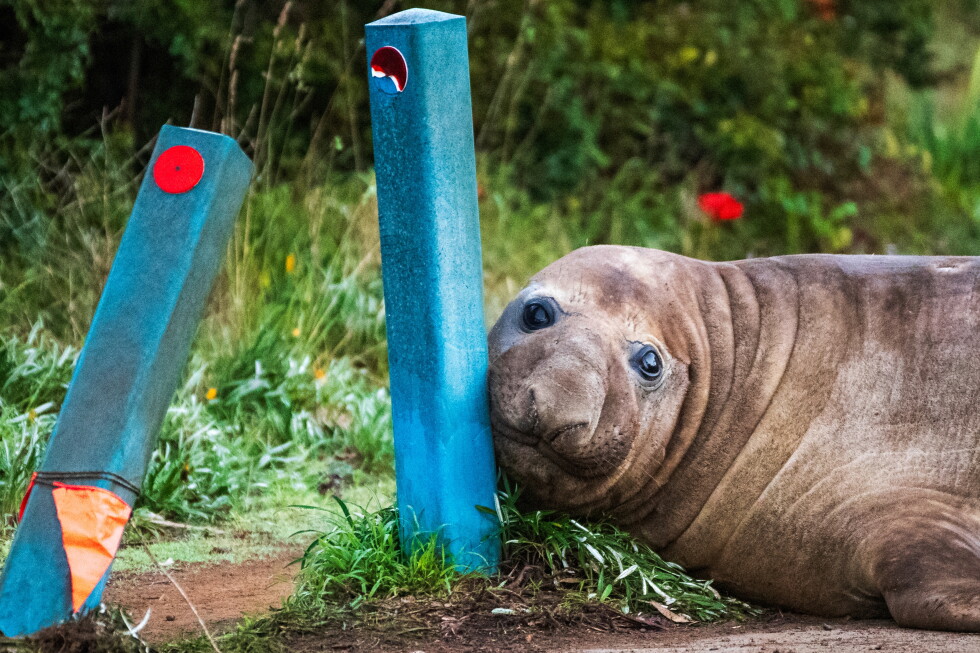
A thousand-kilogram, 5-year-old male elephant seal named Neil has made his biannual return to the southern Tasmanian coast where he was born, and this year his visit has thrown small beachside communities into disarray — while turning him into an unexpected global social media sensation. After spending months fattening up on open ocean feeding grounds, Neil hauled himself ashore in June for his annual resting and molting period, bringing his massive bulk (equivalent to the weight of a compact car) straight into populated urban areas, where his antics have left a trail of damaged infrastructure and captivated millions of online followers.
Neil’s list of local “offenses” reads like a small-town crime report: he has bent metal traffic bollards, crushed a public safety seal warning sign, flattened a fence when he tried to climb over it, and frequently sprawls across paved roads and public sidewalks, bringing local movement and commerce to a complete standstill. During this, his 12th recorded return to Tasmanian shores, he has added new misdeeds to his reputation: picking scuffles with parked cars and smashing through temporary barriers erected to keep him away from busy roadways. With no other juvenile male elephant seals in the region to practice with, Neil’s roughhousing is just natural instinct, according to marine biologists. Sophia Volzke, an elephant seal researcher at the University of Tasmania in Hobart, explained that young male elephant seals build strength and fighting technique for future adult dominance battles, where males compete for breeding opportunities by rearing up and crashing their chests against one another. With no partners his size around, parked cars and roadside infrastructure have become Neil’s training stands-in.
His mischievous, unapologetic behavior has earned him a cult following online, with more than 1.4 million followers on TikTok alone — a number more than double the entire human population of Tasmania. Many online fans have even embraced Neil as a tongue-in-cheek anti-authoritarian hero, celebrating his refusal to stick to designated wild spaces and ignore human rules. What makes Neil’s presence in Tasmania unusual is that he is the only mature male elephant seal that regularly hauls ashore on the state’s coasts. While breeding populations of elephant seals reside on Sub-Antarctic islands hundreds of kilometers south of Tasmania, Neil’s mother traveled from one of these groups to give birth to him on Tasmania’s shore. Female elephant seals have been spotted on Tasmanian beaches before, but they rarely grow larger than Neil was at age two, so they never cause the same level of disruption that comes with his current size.
Volzke noted that Neil’s return may also be a sign of a larger ecological shift: after human activity wiped out local elephant seal populations decades ago, the species may slowly be recolonizing its former habitat. “We do need to find a way to coexist,” she said.
But for local officials, Neil’s viral fame is a dangerous double-edged sword. They have issued urgent public warnings that the thousands of fans flocking to catch a glimpse of the massive seal are putting both human lives and Neil’s future at risk. At a press conference Thursday, Kris Carlyon, a wildlife official with Tasmania’s Department of Natural Resources and Environment, pleaded with followers to give Neil space and avoid sharing his exact current location with online audiences. Carlyon pointed to multiple already documented reckless incidents, where visitors have carried small infants within meters of Neil just to snap a viral photo for Instagram.
Carlyon warned that a single serious negative encounter between a reckless visitor and Neil could force wildlife officials to move Neil from his traditional habitat — or worse, referencing the 2023 case of Freya, a wild walrus that drew massive tourist crowds in Norway before officials euthanized her over growing public safety risks. “There is a risk here of essentially loving Neil to death,” Carlyon said. If Neil survives to reach sexual maturity around age 10, he could grow to 16 feet long and triple his current 1,000-kilogram weight, making future interactions even more high-stakes. Volzke added that roughly 90% of juvenile male elephant seals do not survive to breeding age, so Neil’s survival is already uncertain.
Local reactions to Neil’s visit are deeply mixed. Some residents, like Dale Creamer, who has not been personally inconvenienced by the seal’s occupation of public space, embrace his fame. “He’s one of our biggest exports at the moment,” Creamer said. “It’s Neil’s world and we’re just living in it.” As of Thursday, Neil has settled into a stretch of sidewalk near a bend in the coast, claiming a small puddle surrounded by toppled bollards as his personal resting spot, remaining unmoved even after rangers tried to usher him elsewhere. Fans have already fallen for his latest casual stunt: he has been spotted playfully nudging and canoodling with an orange traffic cone, a new bit of behavior that has already sent the internet into a fresh wave of delight. For now, the town waits, adjusts, and hopes that the giant seal’s celebrity does not end in tragedy.