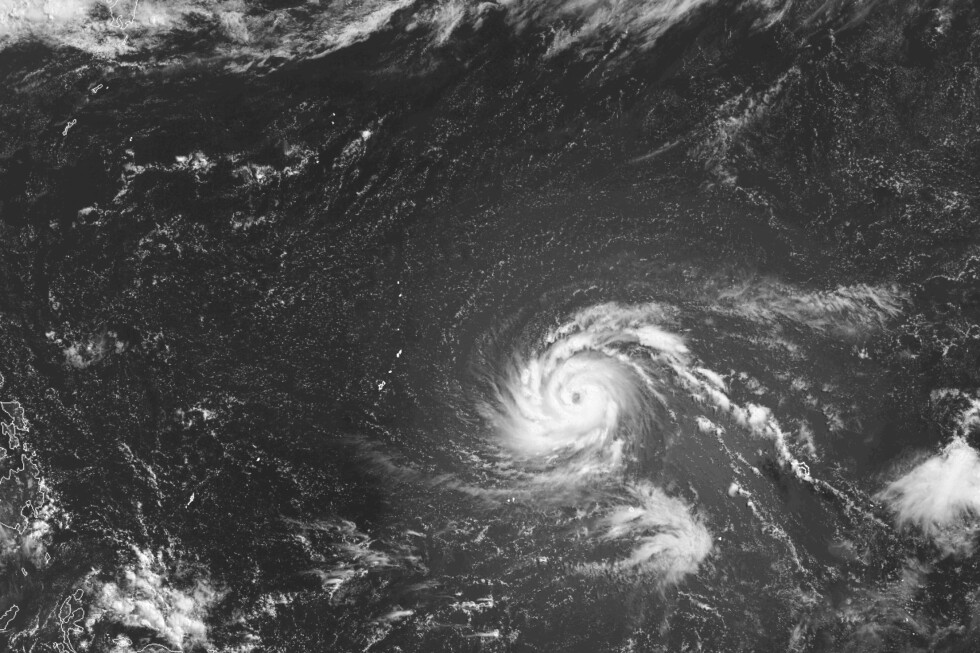
Residents across U.S. territories in the western Pacific entered a state of emergency preparation Friday as they brace for an approaching storm forecast to strengthen into a super typhoon, arriving just months after the region was battered by the most powerful tropical cyclone recorded on Earth this year. The U.S. Commonwealth of the Northern Mariana Islands is still picking up the pieces from April’s Super Typhoon Sinlaku, which brought destructive, gale-force winds and torrential, unrelenting rainfall that left lasting damage across the archipelago. As of Friday, full electrical service had not been restored across the islands, and dozens of residents whose homes were leveled by the storm continue to live in temporary tent shelters.
Edwin Propst, a former legislator who now serves in the Saipan governor’s office, called the timing of the new storm nothing short of catastrophic. “We’re getting ready to do this all over again,” he said Friday, as the first outer bands of the system began to approach the island. “The timing is terrible.”
Paul Stanko, senior meteorologist with the National Weather Service’s Guam office, told reporters that Typhoon Bavi was on track to intensify into a super typhoon by late Sunday or early Monday, when it is projected to make landfall in the Mariana Islands chain. The threshold for classification as a super typhoon is maximum sustained wind speeds of 150 miles per hour (241 kilometers per hour) or higher, a strength equivalent to an upper-tier Category 4 or Category 5 hurricane on the Saffir-Simpson scale, Stanko explained. As of Friday afternoon, Bavi was located 760 miles (1,223 kilometers) east of Guam, with measured sustained winds of 80 mph (129 kph), and continuing to gain strength as it moves west across the Pacific.
Stanko noted that a growing number of Guam residents have expressed a quiet hope that the island will absorb the full force of Bavi, sparing the still-recovering Northern Marianas from another catastrophic blow. “That’s what we’re actually hoping for because then Saipan wouldn’t get it as bad,” he said. Propst confirmed that this sentiment is widespread across the region, calling the gesture a reflection of close-knit island community values. “That’s so island-style,” he said. “God bless them for saying that.”
Guam, which lies west of the International Date Line, is nicknamed “Where America’s Day Begins” due to it being multiple hours ahead of Hawaii, Alaska, and the entire U.S. mainland. The island is also a key strategic outpost for the U.S. military, hosting two large active-duty bases.
Propst reported that residents across the region have already begun prepping for the storm: covering home and business windows with plywood, stockpiling drinking water and non-perishable food, and queuing for gasoline at filling stations — a repeat of the long lines that lasted for weeks after Sinlaku knocked out power to most fuel infrastructure.
The Rev. Francis Hezel, assistant pastor of Santa Barbara Catholic Church in Dededo, Guam, said he holds out hope that no island will suffer a direct hit. A long-time Guam resident who has weathered dozens of typhoons over decades, Hezel said he remains cautiously optimistic that Bavi will shift course before reaching populated areas. “Right now the pattern is heading towards us, but those patterns change,” he noted. Even so, he said, church staff and local residents have not cut corners on preparedness, adding that frequent typhoon drills have become a new way of life for the region. “This is getting to be the normal thing now, typhoon preparedness,” he said. “It’s happening more frequently.”
Climate scientists link the increasing frequency of intense Pacific typhoons in part to the current El Niño event, a natural ocean warming cycle that amplifies tropical cyclone activity across the eastern and central Pacific. Experts warn that this natural warming is compounded by human-caused climate change driven by fossil fuel emissions, which has already raised global average ocean and atmospheric temperatures, creating conditions that supercharge extreme weather events across the globe.
While Sinlaku did not claim any lives on land in the Northern Marianas, Propst said residents are still grieving six crew members who died when their cargo ship overturned during the storm. Search teams recovered the body of one crew member, but the U.S. Coast Guard ended a more than 100-hour search operation without locating the remaining five. Though recovery efforts after Sinlaku have made steady progress, Propst said the region is still not fully back on its feet. “A few more months would have been good,” he said of the time needed to fully rebuild.