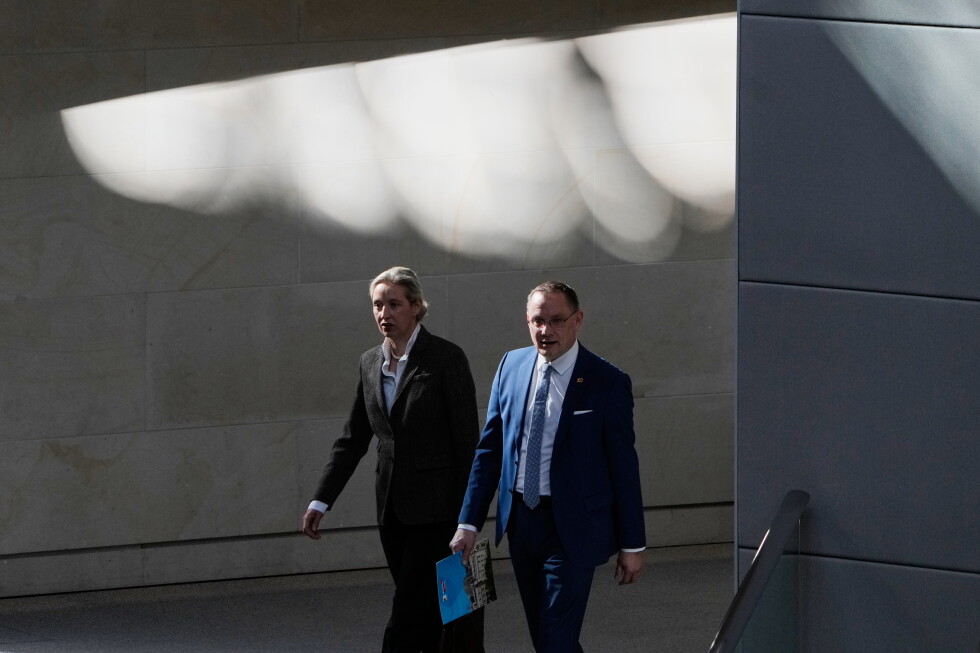
As Germany’s far-right Alternative for Germany (AfD) gathers for its national leadership convention this weekend in the eastern city of Erfurt, the nationalist party is entering one of its most politically consequential moments in modern German history. Riding a wave of deep public discontent with the country’s unpopular ruling coalition, which has struggled to deliver economic reform after years of stagnation, the AfD is positioning itself to seize its first state-level governorship in regional elections this fall, a breakthrough that would upend decades of post-World War II political norms in the country.
Buoyed by rising poll numbers that have pushed the party into first place nationally, the convention’s central order of business is consolidating party unity by extending the leadership terms of co-chairs Alice Weidel and Tino Chrupalla, who have helmed the party for four years. This gathering comes on the heels of a historic 2024 national election performance, where the AfD secured the strongest result for any far-right German party since 1945, taking second place nationally to become the country’s official largest opposition party. It has long dominated the political landscape of Germany’s formerly communist eastern states, where it is now on the cusp of unprecedented electoral gains.
Weidel has framed the 2026 national election as a “year of destiny” for the AfD, and the party has set an ambitious target of winning 40% or more of the vote in the September 6 Saxony-Anhalt state election. A result that strong would put the party within reach of an absolute majority, or allow it to lure defectors from mainstream parties to install its first state governor. Two weeks later, a second regional election in Mecklenburg-Western Pomerania also leaves the AfD optimistic for additional gains.
Political analysts note that the AfD is already knocking on the door of formal executive power. In 2023, the party won its first county administration leadership post in Thuringia, the state that hosts Erfurt, though no further local executive wins have followed as mainstream parties have rallied to block additional gains. Winning control of a full state government would mark a far more transformative milestone: Germany’s 16 regional governments hold extensive autonomy over key policy areas including public education and domestic security.
Critics have raised urgent alarms over the prospect of AfD rule in Saxony-Anhalt, warning that the party could move to replace large numbers of non-partisan civil servants with ideological loyalists, putting sensitive confidential information at risk of leaking to far-right networks or even the Russian government. “An AfD interior minister would be a security risk,” Gregor Maier, Thuringia’s center-left interior minister, told public broadcaster ARD. The party has pushed back forcefully against these concerns, arguing that it will demonstrate more effective governance than the long-dominant mainstream parties, which it claims are failing German voters. “We will prove that we can do it better, and that is exactly what the old parties are afraid of,” Chrupalla stated at a recent Berlin rally.
Still, even outside observers predict major internal hurdles if the party does win power. Albrecht von Lucke, a leading German political analyst and editor of *Blätter für deutsche und internationale Politik*, warned that governing successfully would pose a “huge challenge” for the AfD, marked by likely internal factional conflict. “A lot speaks for this not succeeding,” von Lucke noted.
The AfD’s rising political fortunes have been directly fueled by the deep unpopularity of Chancellor Friedrich Merz’s national coalition government, which took office 14 months ago on promises to revitalize Germany’s sluggish, stagnant economy – the largest in Europe. The coalition has embarked on a series of potentially painful structural reforms, but has yet to convince voters that its policies will deliver tangible improvements, leaving a wide opening for populist opposition.
Merz has pleaded for public patience, arguing that meaningful reform takes time. “It is unrealistic always just to lament decline, mope and wait for a big bang,” he told a recent industry gathering. “There isn’t going to be one. We are in a reform process … and we are moving forward in this process. We want to show that solutions are possible from the political center of this country, that we also recognize the problems correctly.”
Beyond its signature anti-migration platform that drove its initial rise in the mid-2010s, the AfD has refined its strategy to capitalize on widespread discontent across a range of policy issues. The party has aligned broadly with the policy approach of the former Trump administration in the U.S., has criticized ongoing conflict in Iran, and has repeatedly called for the lifting of Western sanctions on Russia while opposing all Western weapons deliveries to Ukraine. Chrupalla has criticized Merz’s hardline approach to Moscow, arguing “[Merz] thinks he has to escalate against Russia, like in the Cold War. He should be building bridges.”
The AfD remains a deeply polarizing force in German politics, and its Erfurt convention is expected to draw tens of thousands of counter-protesters this weekend. All mainstream German parties maintain a strict “firewall” policy, refusing to enter any formal coalition or cooperate with the AfD at any level of government.
The party is also locked in a long-running legal battle with Germany’s domestic intelligence agency, the Federal Office for the Protection of the Constitution (BfV). The BfV designated the AfD as a proven right-wing extremist organization in 2024, but suspended the official classification after the party filed a legal challenge. In February 2025, a Cologne court ruled that the agency could not use the designation while it reviews the AfD’s lawsuit in full.
A 2025 BfV report released earlier this week reaffirmed the agency’s assessment, finding no evidence that the party has softened its controversial ideological stances. “Many statements by the AfD and its representatives reflect an understanding of the nation that is based on ethnicity and ancestry and contradicts the understanding of the nation enshrined in Germany’s constitution,” the report stated. It specifically highlighted the party’s calls for “remigration” of millions of people living in Germany and repeated promotion of the far-right “great replacement” conspiracy theory that claims native Germans are being systematically replaced by non-European migrants.
The AfD continues to reject all accusations of extremism, arguing that the intelligence agency has been politically weaponized by mainstream parties to target the opposition. While some anti-far-right activists have called for the AfD to be formally banned nationwide, Germany’s supreme court has set an extremely high legal bar for banning political parties, and many opponents of the AfD warn that a failed ban attempt would only hand the party a major political victory. Merz and his center-right bloc have argued that the most effective response to the AfD’s rise is for the sitting government to deliver tangible improvements to the lives of ordinary German voters, rather than pursuing a legal ban.