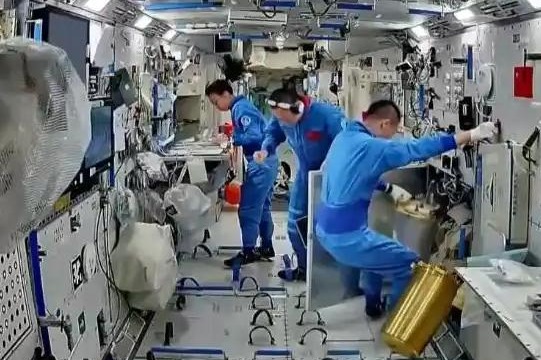
More than a month after docking at China’s Tiangong Space Station, the three-person Shenzhou XXIII crew has completed a diverse slate of cutting-edge scientific experiments spanning space medicine, neuroscience, robotics and microgravity physics, China’s manned space agency has confirmed. Led by mission commander and spaceflight engineer Colonel Zhu Yangzhu, with spacecraft pilot Colonel Zhang Zhiyuan and science payload specialist Lai Ka-ying completing the team, the astronauts have supported pioneering research designed to advance human understanding of long-duration spaceflight and improve future deep space mission capabilities.
In a series of collaborative medical procedures, the crew performed reciprocal ultrasound scans of multiple body regions including the neck, wrist, and abdomen. The biometric data collected during these scans is now being analyzed by terrestrial researchers to map how microgravity alters blood vessel structure, blood flow dynamics, and the adaptive remodeling of sensitive human muscle groups — insights critical for protecting astronaut health on months-long missions beyond low-Earth orbit.
The team also advanced in-orbit robotics research, conducting haptic interaction trials using the experimental robot Xiaohang. Early findings from these tests will be used to refine motion planning algorithms, a key step toward developing more capable, reliable autonomous robots that can assist astronauts with routine and complex tasks during future space expeditions.
Neuroscience research forms a core pillar of the mission’s scientific agenda. The Shenzhou XXIII crew used electroencephalogram recording equipment to run multiple experiments focused on visual-motor processing and how human behavioral responses shift under different space-based lighting conditions. Complementing this work, they deployed near-infrared functional brain imaging technology to collect high-resolution data on how long-duration space exposure alters the brain’s functional network organization, as well as the brain’s innate ability to self-adjust and adapt to the extreme environment of space.
Beyond life sciences, the crew installed and serviced several leading-edge microgravity physics experimental facilities, advancing global research into physical phenomena that can only be observed in weightless conditions. In a novel addition to the mission’s health research, the team also used a specialized diagnostic tool integrating traditional Chinese medicine diagnostic principles to collect physiological data. This data is expected to lay a solid foundation for developing more effective long-term astronaut health monitoring protocols for future missions.
When off-duty from scientific tasks, the crew made a small piece of culinary history: using a specially designed hot air oven, they prepared roasted pumpkin — a dish no space crew has cooked before. The novel meal follows the 2025 precedent set by Shenzhou XX and Shenzhou XXI crews, who cooked and enjoyed grilled chicken wings and steak, marking the first publicly broadcast space barbecue in human spaceflight history.
Liu Weibo, an engineer at the Astronaut Center of China, explained that China’s proprietary space oven is a world-first innovation: unlike earlier space cooking devices, it integrates fume extraction, food residue collection, even heating, and food securing systems all within a single closed chamber. While the United States sent an oven to the International Space Station in 2019 for an experiment that baked cookies in microgravity, those cookies were never consumed by crew and were returned to Earth solely for research, making China’s crew space cooking milestones unprecedented.
Launched on May 24, 2026, the Shenzhou XXIII mission reached Tiangong the following day. It marks China’s 17th overall manned space mission and the 11th crewed expedition to the Tiangong Space Station, continuing the country’s steady progress in building a permanent, research-focused outpost in low-Earth orbit.