Six years after the landmark U.S.-Mexico-Canada Agreement (USMCA) replaced the decades-old North American Free Trade Agreement (NAFTA) to reshape regional trade rules, a senior U.S. administration official has confirmed that Washington will not renew the trilateral pact in its current form. This decision blocks the deal from accessing the automatic 16-year extension outlined in the agreement’s original founding terms.
Under the USMCA’s official framework, all three member nations must unanimously approve an extension to lock in another 16-year term. If no unanimous agreement is reached, the agreement is set on an irreversible 10-year countdown to potential termination, bringing the earliest possible expiration date for the pact to 2036. Without a long-term extension confirmed, the three nations will now be required to hold annual negotiation meetings to revisit the terms of the deal.
The U.S. official emphasized that the administration deliberately chose against rubber-stamping an automatic renewal to force action on long-standing unresolved issues that Washington has prioritized. For months, U.S. trade negotiators have repeatedly raised concerns about three core sticking points: inconsistent enforcement of automotive rules of origin, insufficient access for U.S. exports to Canada’s dairy market, and loopholes that allow non-member nations like China to exploit the regional trade bloc by shipping goods through member countries.
The USMCA currently underpins roughly $2 trillion in annual cross-border trade across North America, touching every major sector from agriculture to automotive manufacturing. While the deal remains fully in effect for the time being, the lack of a finalized long-term commitment has injected fresh economic uncertainty across the continent, a risk that business advocacy groups have repeatedly warned against. The U.S. Chamber of Commerce has long noted that both manufacturing and agricultural sectors on both sides of the border depend on stable, predictable cross-border trade rules to plan long-term investments and supply chains.
The decision has split domestic U.S. industry groups, however. Domestic steel trade associations including the American Iron and Steel Institute and the Steel Manufacturers Association have publicly welcomed the shift, arguing that mandatory annual reviews give U.S. negotiators ongoing leverage to revise and fix problematic provisions of the deal that do not serve American industrial interests.
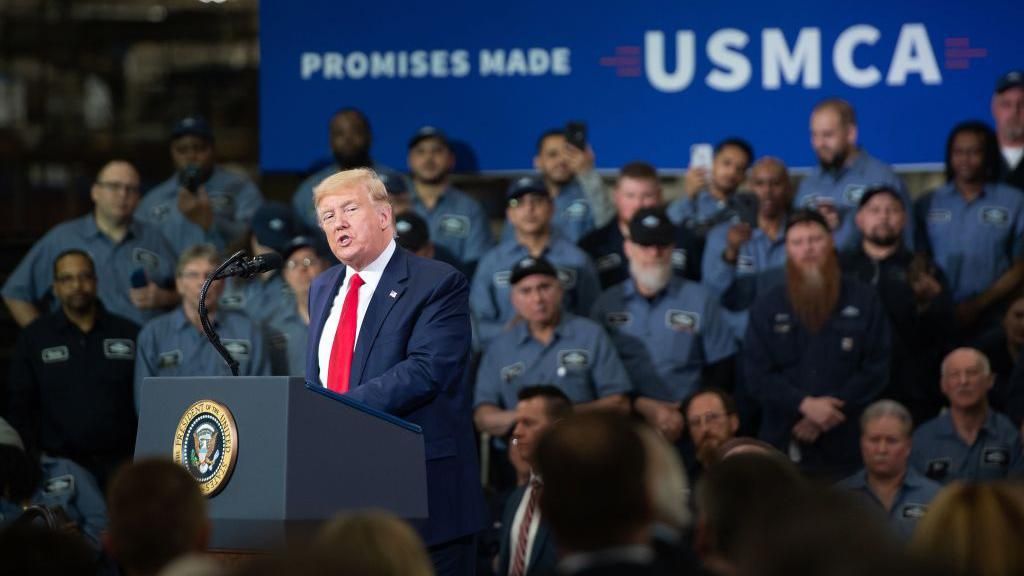
Originally negotiated during the first presidential term of Donald Trump, the USMCA entered into force in July 2020 as a major update to NAFTA, which had governed North American trade since 1994. The updated pact introduced new regulations for digital trade, strengthened protections for worker rights, and tightened rules for regional automotive manufacturing, requiring a larger share of vehicle parts to be produced within North America to qualify for tariff-free access. If the current terms are not revised and reapproved by all three members within the next decade, the landmark trade agreement will expire, reshaping the economic integration of the North American continent.