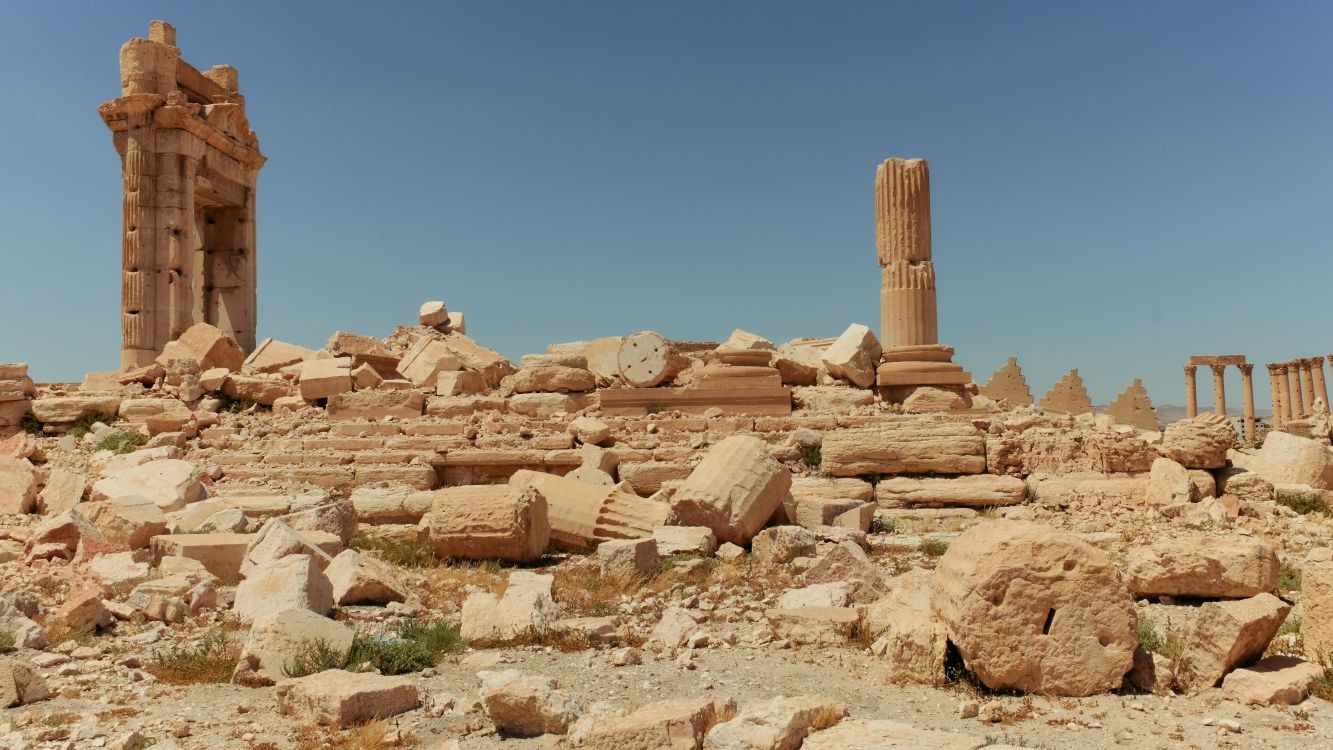
Nestled in Syria’s central desert, the ancient city of Palmyra has borne the full weight of more than a decade of civil conflict, its story woven together from centuries of cultural heritage and years of unspeakable brutality. When the Islamic State (IS) seized control of the city in 2015, Syria had already been torn apart by years of war. In the decade that followed, shifting control between IS and the Assad government, compounded by Russian military intervention, left layer upon layer of destruction: violence displaced tens of thousands, transformed ancient landscapes, and scarred a community that had thrived here for millennia.
It took 30 days for Palmyra’s residents to grasp the full brutality of the IS occupation. Within days of capturing the city, the militant group brought 20 local men to the iconic Roman Amphitheatre, one of Syria’s most revered cultural landmarks, and publicly executed them under the group’s black flag, turning a monument to ancient civilization into a stage for terror. The victims’ bodies were hung in the streets of modern Palmyra by their wrists, left to decompose in the desert heat for seven days.
Once IS consolidated its control, its attention turned to Palmyra’s 2,000-year-old ancient ruins. A designated UNESCO World Heritage Site, Palmyra has long stood as a symbol of the cultural and religious pluralism that once defined the Middle East. Its network of polytheistic temples, shrines, and artifacts predates the rise of Islam, making it a prime target for IS’s extremist iconoclastic ideology. In propaganda spectacles broadcast around the world, militants destroyed many of the site’s most recognizable landmarks, while looting hundreds of smaller artifacts to sell on the global antiquities black market for funding.
“They even burnt 2,000 year-old mummies because they weren’t Muslim,” explained Khalid, a Palmyran tour guide who lived through the occupation, his voice heavy with bitter irony. The famed Arch of Triumph was reduced to two standing columns; the central sanctuary of the Temple of Bel was completely leveled, only its outer enclosure wall remaining recognizable. Stone carvings of human figures were systematically chiseled away, their faces erased in line with the group’s extremist beliefs.
The damage was not limited to the ancient ruins. Palmyra’s millennia-old oasis, the source of water that turned the city into a prosperous Silk Road trading hub thousands of years ago, has also been transformed. Ahmad, a local resident who began working with tourists at the age of nine, remembers a tree-lined road where families would sit outside their homes inviting visitors in for tea. Today, that road sits exposed to the unforgiving desert sun, flanked by cleared rubble and scorched earth, a testament to successive waves of destruction.
Modern Palmyra fared no better than its ancient ruins. Homes and public buildings were systematically destroyed and looted during repeated military campaigns. “When I came back, the house was mined and everything had been stolen by regime forces, even the copper pipes,” members of the Saleh family told Middle East Eye.
Today, the scars of war have become an inescapable part of Palmyra’s identity, drawing a new breed of traveler alongside those who come for its ancient history. UNESCO has developed a formal recovery roadmap for the city, including conservation work for the ruins, improved visitor infrastructure, and livelihood support programs, building on earlier emergency safeguarding efforts. But many local residents and officials say a wide gap remains between international plans and on-the-ground reality. While global frameworks for reconstruction exist, tangible, visible support remains scarce, leaving most of the rebuilding work to the residents who have chosen to return.
“Palmyra is the hero, it’s the icon of Syria,” said Rami Nawaya, founder of Syrian Guides. “Now, it’s taken on another dimension, attracting the adventurers who are interested in the cultural dimension but also the conflict.” For local leaders working to revive the city’s once-thriving tourism industry, the top priority is not rebuilding the ancient ruins themselves, but restoring the basic infrastructure that allows visitors to experience the site and allows residents to return permanently: reopening hotels, restaurants and guesthouses, repairing roads, and restoring basic services.
For Palmyrans, tourism is one of the only viable paths to restoring the local economy. Before the war, the industry made up nearly half of the city’s total economic output, supporting thousands of jobs. After the fall of the Assad government in December 2024, visitor numbers began to slowly climb, but renewed regional instability following U.S. and Israeli military campaigns against Iran disrupted travel routes and derailed that early momentum.
Still, small signs of recovery are starting to emerge. In early June, the Silk Road Lodge welcomed its first guests, becoming one of the first new tourist facilities to open in Palmyra since the fall of the Assad government. Its owner, Radwan Abdullatif, returned to Syria after receiving asylum in Japan, helped by tourists he had met during his earlier work in Palmyra. “If we don’t fix Syria, other people won’t fix it for us. I advise everyone to come and fix the country, and Palmyra, hand by hand, so that the tourists will see, and come again,” Abdullatif said. He added that what local business owners need most from the government is not direct funding, but streamlined bureaucratic processes and easier access to permits to open and operate businesses.
Local organizations are also working to rebuild sustainable livelihoods for residents. The Caravan Foundation runs the Noor al-Badia women’s cooperative, which has trained 70 local women who lost their homes and family members during the war to make traditional handicrafts and textiles, providing many of them with their only source of household income. The cooperative’s success, however, depends entirely on tourist traffic to its tented shop at Bedouin Corner, a traditional camp and restaurant located beside the ancient ruins.
Outside of Syria, the country’s gradual reopening to travel has sparked debate over “dark tourism” and the ethics of visiting a post-conflict society. But for Palmyra’s residents rebuilding their lives, attracting any visitor matters far more than debating their motivations. “There are many tourists who entered Syria with the intention of visiting war zones, but ended up having meals with locals, visiting workshops, being introduced to other facets of the country,” Nawaya explained. The destruction cannot be erased or ignored, but it does not have to be the only story Palmyra tells.
In the absence of coverage from mainstream international media outlets that still label Syria a high-risk destination, independent travel creators and influencers have become one of the most powerful tools for promoting the country. Nick Maddock, a travel YouTuber who spent six months traveling across almost all of Syria’s governorates, says independent creators hold unique influence because audiences trust their perspectives more than official government tourism campaigns. “That trust goes a really long way in breaking down misconceptions in a way that many local folks cannot,” he said.
One largely overlooked part of Palmyra’s ongoing recovery is the fate of its long-time Bedouin communities, who have roamed the surrounding desert for generations. For these groups, reconstruction starts with making the desert landscape safe again, after years of conflict left it littered with landmines and unexploded ordnance (UXO). Their struggle mirrors that of many rural communities across Syria outside of the major population centers of Aleppo and Damascus: with limited state capacity and most international funding focused on urban areas where larger numbers of people are returning, rural recovery depends entirely on local residents’ limited resources: personal savings, remittances from relatives abroad, their own labor, and the constant risk to their own safety.
Repeated shifts in control of Palmyra made demining work particularly complex. Each faction that controlled the city used different tactics to lay explosive hazards, resulting in overlapping layers of contamination across large swathes of land. “This can result in overlapping contamination, including conventional landmines, IEDs, UXO, and abandoned munitions,” explained Mouiad Alnofaly, deputy programme manager at HALO, a leading international mine action organization working in Syria. “Each hazard presents different technical challenges and requires different clearance methodologies. Before any meaningful restoration, tourism or wider redevelopment can take place, explosive hazards must first be identified and removed.” The organization is currently seeking funding to expand its demining operations to Palmyra in the coming months.
Until that work is complete, local residents have no choice but to live with the daily risk of explosive devices. Local officials estimate that around 200 people have been killed or injured by mines and UXO in the Palmyra area since the end of major combat. “When people returned to the city, the houses were full of mines because they were used as weapon stores. Some looked like stones,” said Zahir al-Salim, deputy director of Palmyra. While the main archaeological site and primary access roads have been cleared and declared safe, large areas of agricultural land and the open desert remain dangerous. For Bedouins, whose traditional lifestyle depends on free movement across the desert, this contamination has been devastating, killing not only residents (including children playing in open areas) but also dozens of camels, a critical source of income and transport for the community.
Despite all it has endured, Palmyra endures. Every Friday evening at sunset, groups of local residents gather beside the ancient ruins: motorbikes pull up carrying families and water pipes for shisha, people spread blankets on the ground to shelter from the wind, and young men gather on the steps of the Roman Amphitheatre—once the stage for mass executions—to smoke and watch the sun set over the desert. Palmyra survived the IS occupation, survived a decade of war. Whether it can once again become a thriving home for its people depends on two critical things: sustained international support to clear explosives and rebuild infrastructure, and the return of tourists who can turn Palmyra’s ancient heritage into a living, sustainable livelihood for the community that calls it home.