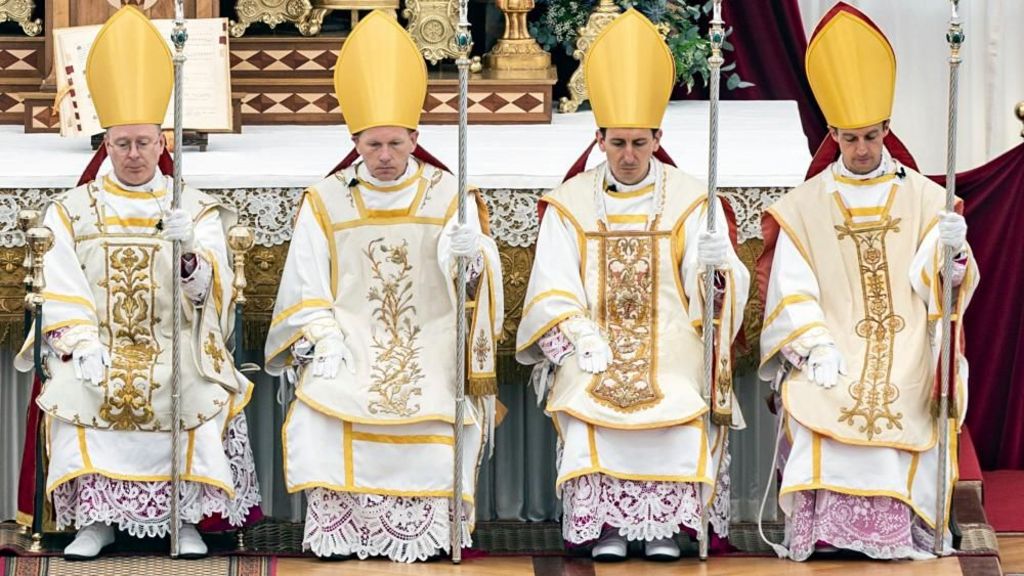
In the shadow of the snow-dusted Swiss Alps, thousands of pilgrims and worshippers crowded into the tiny village of Écône on Wednesday to witness a dramatic act of ecclesiastical defiance, as the conservative Society of Saint Pius X (SSPX) ordained four new bishops against an explicit, last-minute appeal from Pope Leo XIV.
The four new bishops — one from the United States, one from Switzerland, and two from France — have long been core members of the SSPX, a traditionalist faction more commonly known as the Lefebvrites, named after the group’s controversial founder, French Archbishop Marcel Lefebvre. For more than half a century, the SSPX has stood in open opposition to the sweeping modernizing reforms enacted by the Vatican during the Second Vatican Council in the 1960s and 1970s, rejecting changes ranging from allowing Mass to be celebrated in local congregational languages (instead of exclusively Latin) to the adoption of more egalitarian, accessible practices within the Church.
Earlier this week, Pope Leo issued an urgent public appeal to SSPX leadership calling on them to abandon the ordination, warning that proceeding with the ceremony would constitute a deliberate “schismatic act” capable of “tearing the seamless garment of Christ”. Despite the Pope’s warning — which carries profound spiritual weight for the world’s 1.4 billion Catholics, who recognize the Pope as God’s earthly representative — the ceremony moved forward as planned beneath overcast Alpine skies.
Roughly 15,000 attendees gathered to watch hundreds of robed clergy, bearing candles and wooden crosses and trailing plumes of incense, process through Écône’s narrow village streets to an open pasture where a massive ceremonial tent had been erected. Inside the space, the four bishop candidates prostrated themselves before an altar, their heads resting on red velvet cushions, as traditional organ music filled the tent. All ordination vows were recited in Latin, in keeping with the SSPX’s long-held traditions.
The standoff marks the latest escalation of a decades-long rift between the SSPX and the Vatican. The group’s last unauthorized episcopal ordination, held in 1988, resulted in immediate excommunication for all four new bishops. While Pope Benedict XVI lifted those excommunications in 2009 as part of an unsuccessful bid to reconcile the faction with the mainstream Church, religious observers widely expect Pope Leo XIV to formally exclude the newly ordained bishops from the Catholic Church in the coming days.
For many outside observers, the Vatican’s firm opposition may appear disproportionate, but theological experts note that ordaining bishops without papal approval is considered one of the most severe violations of Catholic Church unity, a core tenet of the faith. The rift extends far beyond the debate over Latin-language Mass: the SSPX, founded in 1970 by Lefebvre, rejects nearly all of the Vatican’s modern reforms, including outreach to other faith traditions, formal recognition of religious freedom for non-Catholics, and updated social policy stances. The group even retains the medieval practice of having priests celebrate Mass facing the altar (with their backs to the congregation) rather than facing worshippers, a change the Vatican mandated decades ago.
In remarks to the gathered crowd in Écône, SSPX Superior General Davide Pagliarani pushed back against accusations that the ordination was intended to widen the schism, arguing that the act was rooted in devotion to the papacy. “We do this precisely because we love the Pope as the vicar of Christ, as the head of the Church,” Pagliarani said. “We don’t want to see the Pope humiliated any longer, standing alongside false shepherds who represent false religions.”
The open defiance presents a tricky early test for Pope Leo, who has only recently taken the papal throne. While the SSPX remains a small faction globally, counting roughly 600,000 followers across dozens of countries, it maintains an enthusiastic and well-funded base, including a prominent following in the U.S. state of Kansas. The group demonstrated its organizational and financial capacity for Wednesday’s event, live-streaming the ordination on YouTube in seven languages and selling commemorative merchandise to attendees, including branded “Écône 2026” baseball caps and $92 gift packs of labeled Swiss wine, each bottle emblazoned with an illustration of a bishop’s mitre.
For now, Pope Leo has made his position clear: he considers the new bishops illegitimate, and their ordination a direct attack on Church unity. But analysts suggest the new pontiff may avoid harsher further action, wary that aggressive crackdown could galvanize support for the SSPX and turn a long-running rift into a formal, permanent schism within the global Church.