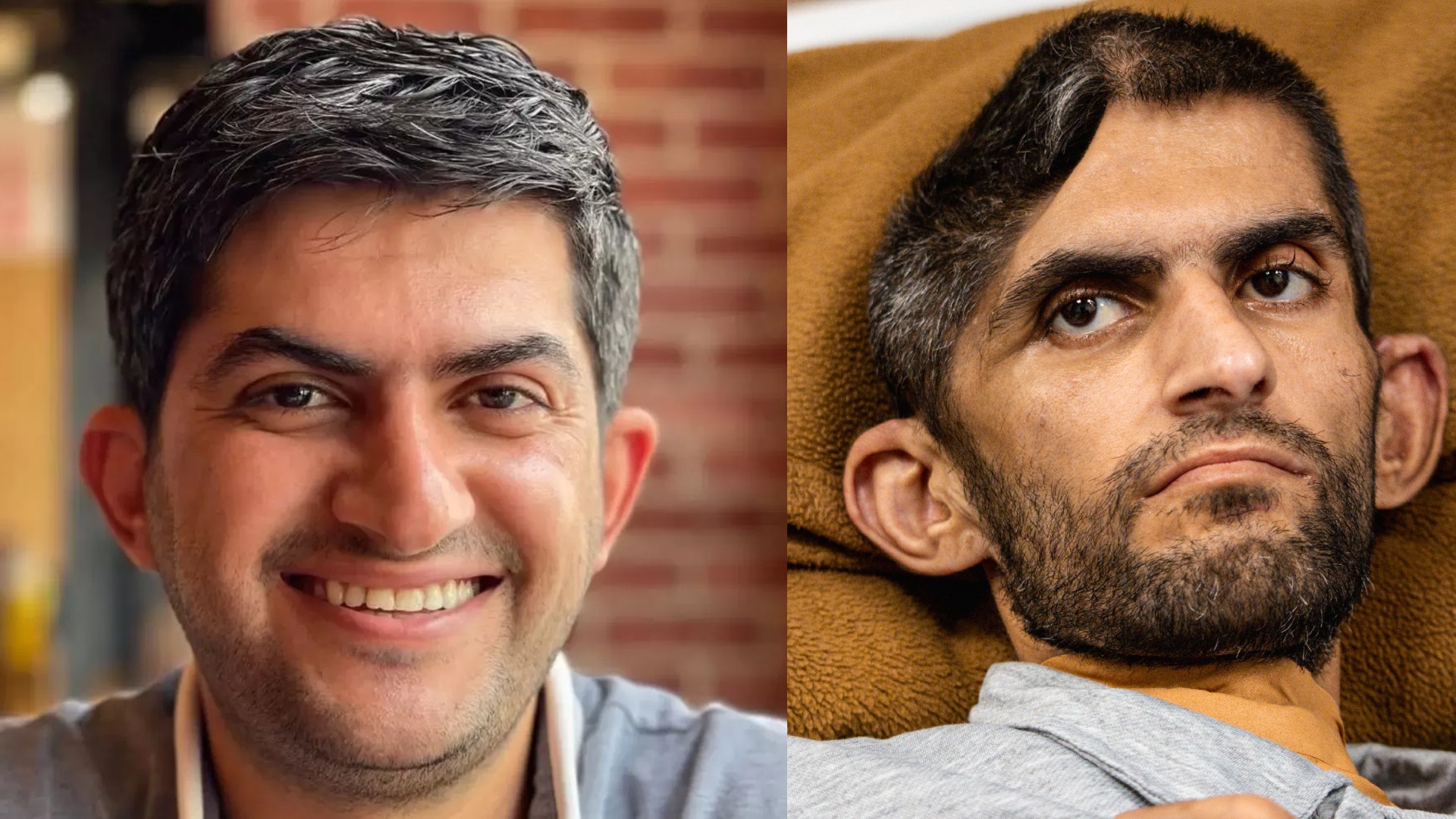
When Mujahid Bani Mufleh saw his own before-and-after photographs following six months of uncharged detention in Israeli custody, the transformation shocked even him. Today, five months after his release, the 36-year-old father of three and veteran Palestinian journalist from Beita, a town in the occupied West Bank near Nablus, remains hospitalized, fighting a long, uphill recovery that grew dire just days after he walked free.
Arrested at his family home on June 28, 2025, Bani Mufleh was held under Israel’s controversial administrative detention policy: a practice that allows authorities to imprison Palestinians indefinitely without charge or trial, relying on secret evidence that neither detainees nor their legal representatives are permitted to review. Before his arrest, he had only a pre-existing diagnosis of diabetes and was otherwise in good health. But what he encountered behind bars – systematic torture, repeated physical abuse, and deliberate medical neglect – shattered his health permanently.
Two days after his release on January 12, 2026, Bani Mufleh was rushed to the hospital with a severe brain hemorrhage that triggered a stroke, a medical crisis he attributes directly to the abuse he endured in custody. Surgeons performed emergency life-saving surgery, removing a portion of his skull to reduce dangerous pressure on his brain, and he spent two months in a coma. When he awoke, he emerged gaunt, frail, with hollowed features and sunken eyes, appearing years older than the man taken from his home half a year earlier.
“It hurts to look at photographs of the person I used to be,” Bani Mufleh shared from his hospital bed at Jenin’s Ibn Sina Hospital. “My defences collapsed under the weight of torture and humiliation. They wanted you to forget who you were.”
For his entire adult life, Bani Mufleh has worked as a journalist, and throughout his detention, he clung to one unshakable goal: once free, he would share the untold stories of the fellow prisoners trapped alongside him. Today, the torture and subsequent stroke have robbed him of the ability to report as he once did, turning him from a storyteller into the story itself. “I never forgot that I was a journalist,” he said. “Throughout my detention, I kept thinking that one day I would tell the stories of those who could no longer speak for themselves. But time never gave me that chance. Before I could write about the tortured, I suffered a stroke. And instead of writing their stories, I became the story.”
Even as he relearns basic skills – his speech is slow, punctuated by long pauses as he searches for forgotten words – Bani Mufleh has not abandoned that promise. The deaths of two detainees he was held with remain seared into his memory, and he is determined to honor them by sharing their fates. The first was Samir al-Rifai, a 50-year-old prisoner who could not survive the abuse he endured. After the pair were tortured together, prison guards stormed their cell and pepper-sprayed the entire space, leading al-Rifai to collapse. He was carried out and never returned; Bani Mufleh later learned he had died in custody.
The second was 20-year-old Ahmad Taza’zah, whose health rapidly declined after he was attacked during torture. “During torture, they unleashed a dog on him that tore into his face,” Bani Mufleh recalled. “The wounds became infected, and all he needed was a course of antibiotics. Instead, they left him suffering for days. He began vomiting constantly. Later, they took him into the prison yard. He never returned alive.”
Bani Mufleh’s experience is far from an isolated case. Since October 2023, Israeli forces have arrested more than 20,000 Palestinians across the occupied West Bank and Gaza Strip. Independent human rights organizations and international media investigations have documented widespread, systematic abuse of Palestinian detainees, including routine torture, deliberate starvation, denial of medical care, and sexual violence. At least 84 confirmed Palestinian detainees, including one child, have died in Israeli custody under these conditions, and rights groups warn the actual death toll is almost certainly higher.
Throughout his detention, Bani Mufleh clung to one memory from the outside world to get through the violence and loss: the face of his young son, Arab, the day of his arrest. “In prison, I kept trying to remember my son Arab’s face so I wouldn’t be consumed by the faces of those who died behind bars. But I could remember only one image of him – crying as Israeli soldiers arrested me in our home,” he said. “After they beat and tortured me, I looked at him while I lay on the floor. He was crying. That became the last image of him that stayed with me.”
For Bani Mufleh’s wife, Nuha al-Shurfa, and their three children, rebuilding life after his release has meant adapting to permanent change and celebrating small signs of progress. When Bani Mufleh came home, he had lost 25 kilograms during his detention, and received no meaningful treatment for his diabetes behind bars. “When Mujahed came home, it felt as though our family had come back to life,” al-Shurfa told Middle East Eye. “He returned severely weakened… Throughout his time in prison, despite being diabetic, he received no proper medical care. Seeing him improve, even little by little, gives us hope and the strength to keep going.”
Al-Shurfa added that her husband’s condition remains fragile five months after release. He still struggles to consume most fluids, even water, over fears it will worsen his condition and damage his lungs. “We know his recovery is far from over and that he still faces many challenges every day,” she said. “But having him with us again is something we are deeply grateful for, and we will stand by his side every step of the way.” For the family, recovery is measured in quiet, small victories: a few clear words spoken without effort, an unassisted step, a day with less pain than the last.
For Bani Mufleh, the harrowing experience of detention and recovery has reshaped his understanding of what matters most in daily life. “During my detention, I learned what real hunger feels like – waiting for meals that never felt enough, going to sleep with an aching stomach, and waking up with the same feeling,” he said. “I learned how a simple loaf of bread can become a dream, and how a sip of cold water can feel like a blessing from heaven.”
Recovery has taught him an equally humbling lesson, he added: “Throughout my recovery, I learned the meaning of helplessness – when getting out of bed becomes a battle, taking a single step feels like an achievement, breathing without pain becomes a wish, and a peaceful night’s sleep turns into a distant luxury. Those months taught me that life’s greatest blessings are not the big things we once imagined. They are the small, everyday moments we used to live without ever noticing.”
Even as physical challenges keep him from returning to full-time reporting, Bani Mufleh says sharing the stories of his fallen cellmates is now a core part of his own recovery – and he has no intention of breaking the promise he made behind bars.