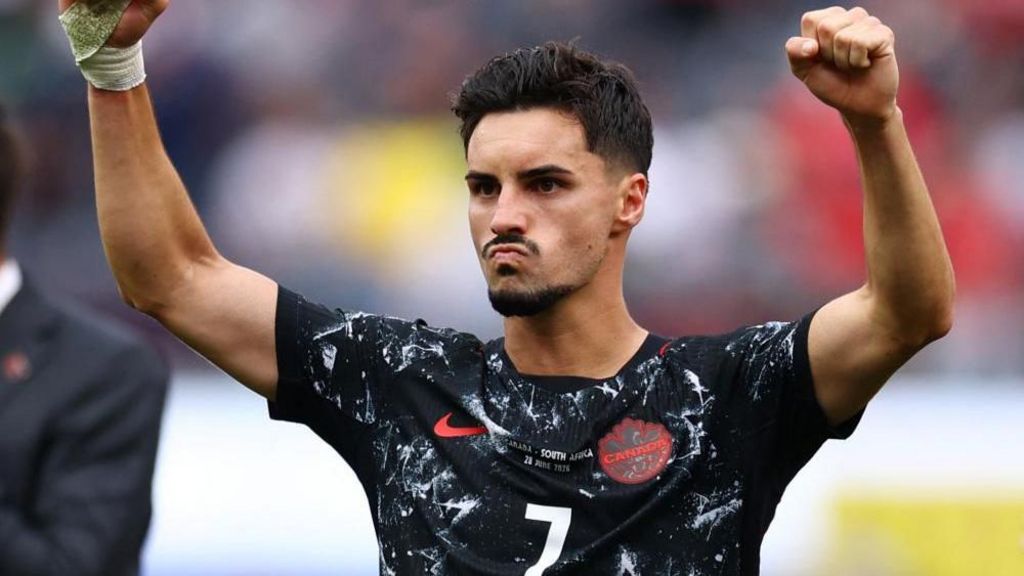
The 2026 FIFA World Cup round of 16 dream for Canada was sealed by one magical moment on matchday: a perfectly placed finish from midfielder Stephen Eustáquio that proved to be the only goal in Canada’s tight round-of-32 clash with South Africa. The result marked the first time in Canadian men’s football history that the national side advanced to the tournament’s knockout stage, and the milestone is inextricably tied to the decades-long journey of the Eustáquio family, an immigrant story woven into the fabric of Canada’s thriving Portuguese-Canadian community.
Watching the historic goal from his Toronto living room alongside Stephen’s older brother Mauro— a retired professional footballer and current head coach of local side Inter Toronto FC—Stephen’s cousin José Eustáquio could barely contain his emotion as he watched the play unfold. He broke down the strike in an interview, highlighting the precision and composure that turned a half-chance into a piece of Canadian sports history: “The chest control, the control of the ball, and a perfect shot into the corner. It couldn’t have been any better than that.”
The Eustáquio family’s connection to football stretches across generations and the Atlantic Ocean. Like hundreds of thousands of Portuguese immigrants who moved to Canada in the late 20th century in search of greater economic opportunity, Stephen’s parents Esmeralda and Armando left their coastal hometown of Nazaré, Portugal, and settled in the small Ontario town of Leamington in 1997. Armando, a fisherman by trade, found work on Lake Erie, while Esmeralda took a job at a nearby fish processing plant. From the moment Stephen—who was born shortly after the family settled in Canada—and Mauro were young, the couple prioritized enrolling their sons in local youth football programs, nurturing a passion for the sport that ran in the family’s blood.
José recalled the family’s long-held love for the game, remembering how generations of young relatives in Portugal would cobble together makeshift balls from old socks to play on cobblestone village streets when they had no equipment. As the two brothers began to show elite athletic promise, the family made the bold decision to move back to Portugal when Stephen was just seven years old, to give the pair access to top-tier youth training. Both went on to build impressive professional careers across clubs in Portugal and Canada, with Stephen rising through the ranks to play for Primeira Liga powerhouse FC Porto before joining Major League Soccer side Los Angeles FC earlier in 2026.
Though Stephen was eligible to represent both Portugal and Canada at the international level, the 22-year-old made the decision in 2019 to pledge his allegiance to his parents’ adopted home. In his announcement at the time, he shared simply: “I have big dreams when it comes to playing for Canada.” José explained that the choice grew from the family’s deep gratitude for the opportunities Canada gave them. “At the core of the family has always been the love and affection for what Canada had provided them, an opportunity for a better life, and so he was always proud of that,” José said.
This immigrant narrative is far from unique within Canada’s 2026 World Cup squad. The roster is a living reflection of the country’s cultural mosaic: it includes players born in Canada to immigrant parents, as well as athletes born in Nigeria, England, and the Ivory Coast. The team’s star, Alphonso Davies, was even born in a Ghanaian refugee camp before his family resettled in Canada. As policy analyst and columnist Aftab Ahmed wrote for Canadian publication The Line, “This group puts flesh and bone on the promise Canada has long projected to the world: families arriving, settling, working, struggling, raising children, and building excellence in communities across the country.”
For immigrant communities across Canada, football has long served as a unique unifying force, especially in a country where ice hockey has historically dominated the national sports culture. Manuel DaCosta, a Portuguese-Canadian business owner who immigrated to Canada 56 years ago, noted that football gives immigrant communities a way to stay connected to their cultural roots while building bonds in their new home. “If you take away soccer and politics, the Portuguese don’t have much to talk about,” he joked. Beyond community connection, football is also far more accessible to working-class immigrant families than ice hockey, which requires costly equipment and training fees that put it out of reach for many new arrivals.
That accessibility and community spirit inspired José to co-found Toronto’s Sporting FC academy back in 2011, the first official satellite academy of the famous Portuguese club located outside of Portugal. The academy offers both competitive and recreational youth football programs, rooted in José’s own childhood love of the game. “Canada has allowed us an opportunity to dream, and we dream through our children,” he said. He added that Stephen’s historic goal will be a transformative inspiration for young Portuguese-Canadian athletes across the country: “They’re going to wake up this morning wanting to be the next Stephen Eustáquio and have a dream like he did.”
The historic moment comes amid unspoken grief for the Eustáquio family. Stephen lost his mother Esmeralda to brain cancer in April 2023, and his father Armando passed away a year later from a heart attack. The double loss has weighed heavily on Stephen and the entire family. After the final whistle, José observed the raw emotion on his cousin’s face as he walked around the pitch: “You could see when Stephen was walking around the field post game, and he was very emotional… we knew that he was having thoughts of his parents.”
Sunday’s match remained locked in a scoreless deadlock deep into the second half, pushing Canada head coach Jesse Marsch to make a critical substitution: he brought star Alphonso Davies off the bench for the final 15 minutes, marking Davies’ first appearance of the tournament after recovering from a hamstring injury. Davies injected immediate energy and momentum into the Canadian attack, but it was Eustáquio who stepped up to write history.
After the match, Marsch praised the midfielder’s perseverance and character, saying: “In a group of incredible human beings, maybe Steph is the most deserving to have a moment like that. Really happy for him, and I think from somewhere his parents are looking down, and they saw that.”