Against a backdrop of plummeting global standing sparked by its military actions in Gaza, Lebanon and Iran, Israel has been pursuing new diplomatic partnerships with self-declared breakaway regions across the globe in a bid to shore up international recognition and weaken coordinated global pushback against its policies. The newest such alliance is taking shape with Republika Srpska, the Serb-led separatist entity in Bosnia and Herzegovina, according to regional and international analysts who spoke to Middle East Eye.
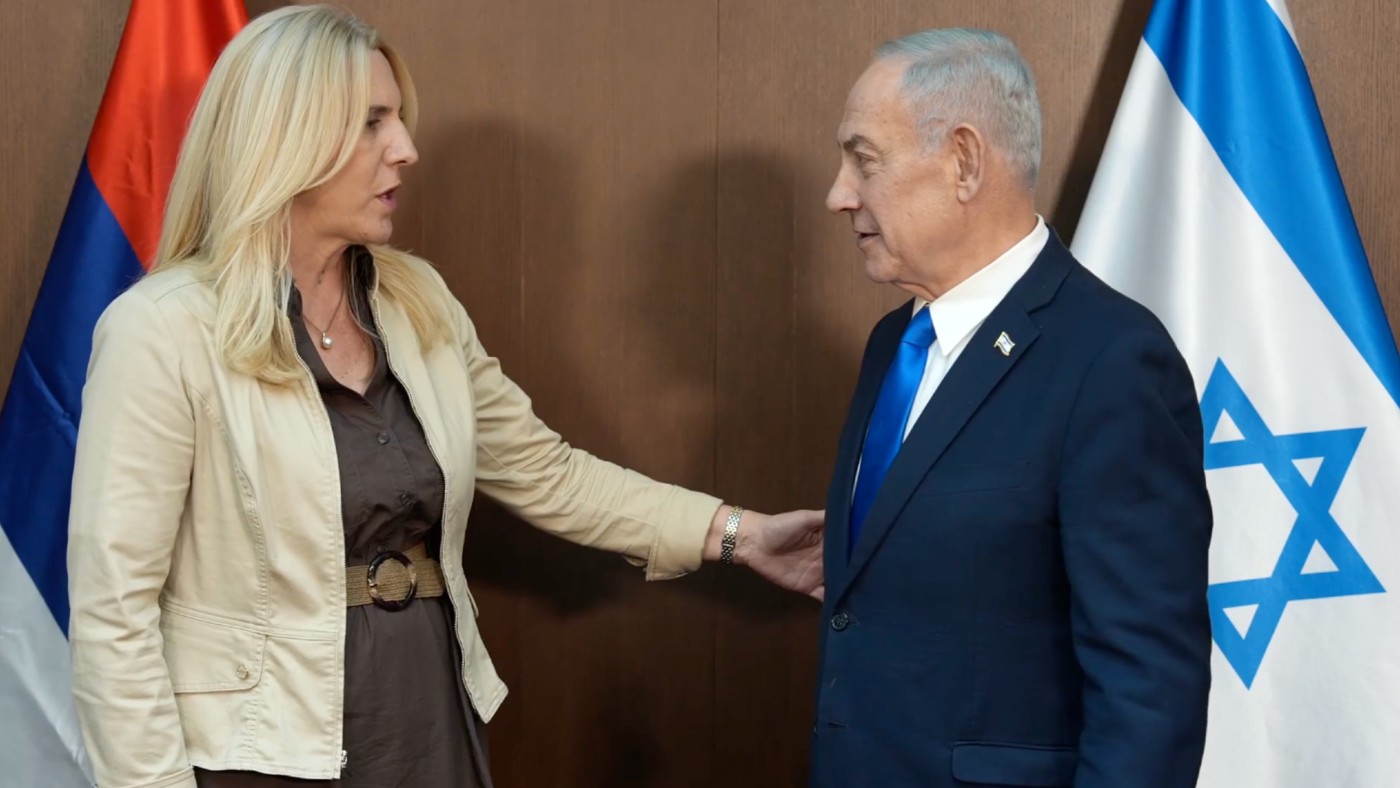
Recent high-level diplomatic activity has underscored this growing alignment. Zeljka Cvijanovic, the Serb representative to Bosnia’s tripartite collective presidency, just concluded a week-long working visit to Israel, where she held closed-door and public meetings with top Israeli leaders, including Prime Minister Benjamin Netanyahu and Foreign Minister Gideon Saar. The encounter immediately ignited widespread controversy across Bosnia: photos released from the meeting showed Cvijanovic standing alongside Netanyahu with only the flag of Republika Srpska and the Israeli flag displayed, with no official Bosnian state flag present. Republika Srpska, like Somaliland — another breakaway region that has recently secured formal Israeli recognition — has long sought full international sovereign status separate from Bosnia.
Cvijanovic’s ruling party, the Alliance of Independent Social Democrats (SNSD), has led a decades-long campaign to pull the majority-Serb entity, which controls nearly half of Bosnia’s total territory, out of the Bosnian state. In response to the meeting’s protocol breaches and what Sarajevo frames as a violation of Bosnia’s territorial sovereignty, Bosnian Foreign Minister Elmedin Konakovic formally submitted a diplomatic protest note to the Israeli government.
This recent meeting is far from an isolated encounter: cooperation between Israeli leaders and Republika Srpska’s separatist leadership has accelerated sharply in recent months. In March 2025, Netanyahu hosted then-Republika Srpska president Milorad Dodik for talks in Jerusalem, and the pair met again earlier this year, months before Dodik was removed from his post in June 2025.
Political analysts say both sides have clear strategic calculations driving the growing partnership. For Republika Srpska’s leadership, Israel is seen as a valuable gateway to influential political networks in Washington, particularly through pro-Israel lobbying groups that hold significant sway in U.S. politics. “They perceive Israel and its lobby groups as a gateway to the White House,” explained Vuk Vuksanovic, a political analyst and lecturer in the Department of War Studies at King’s College London. Vuksanovic noted that Dodik’s previous outreach through channels linked to former U.S. President Donald Trump’s administration has already yielded tangible results: in October, the U.S. lifted long-standing sanctions that had been imposed on Dodik and dozens of his associates since 2017, over charges of corruption and efforts to undermine the 1995 Dayton Peace Agreement that ended the Bosnian War.
Dodik, who has pushed for secession for 20 years, has long maintained close ties to Russian President Vladimir Putin, but Vuksanovic said that in recent years, Washington under Trump and Israel have overtaken Russia as the entity’s most important international partner. While full independence for Republika Srpska remains unlikely, Vuksanovic noted that separatist leaders believe building ties to outside powers will give them greater room to maneuver politically and advance their secessionist goals over time.
For Israel, the alignment is explicitly designed to undermine European unity on the question of Palestine, as global anger grows over Israel’s military campaigns in Gaza, Lebanon and Iran. “The whole world is angry at how [Israel’s] government has handled Gaza, Lebanon and Iran. There is a strong degree of antipathy towards Israel, so they are always looking for people who are willing to communicate with Israel, to show that they are not fully isolated,” Vuksanovic said. This strategy is not limited to the Balkans: last year, Israel became the first country in the world to formally recognize Somaliland, a breakaway region of Somalia, and the two sides have held multiple rounds of talks on economic and security cooperation.
During her visit, Cvijanovic publicly reiterated her opposition to the International Criminal Court’s arrest warrant for Netanyahu, and told Israeli media that she and her delegation “unequivocally support [Israel’s] right to self-defense.” In a post on social media following the meeting, Saar noted that the pair had discussed “the need to safeguard the Christian minorities in Bosnia and Herzegovina” — a claim that many observers have dismissed as unfounded. Christians make up roughly half of Bosnia’s total population, and the country’s constitution enshrines the three major ethnic groups — Bosniaks, Serbs, and Croats — as equal constituent peoples, with no group legally classified as a minority. Observers also note that false claims of threats to Christian communities in Bosnia were a core part of the nationalist propaganda that preceded the 1992-1995 Bosnian War.
Denijal Jegic, an assistant professor at the Lebanese American University in Beirut, argued that the two entities share deep ideological and historical parallels, as both have faced growing international scrutiny and isolation. “Republika Srpska and Israel are natural allies… both entities were built on ethnic cleansing and their identities are constructed on supremacist concepts,” Jegic said. “Both entities’ existence depends on narratives of ethno-nationalism and self-segregation.” As international courts have confirmed, Serb forces committed genocide against Bosniak Muslims in Srebrenica in 1995, and carried out widespread war crimes against non-Serb populations across Bosnia between 1992 and 1995 as part of a campaign to create an ethnically homogeneous “Greater Serbia”. The Dayton Peace Agreement that ended the war divided Bosnia into two semi-autonomous entities: the Bosniak-Croat Federation and the Serb-led Republika Srpska, leaving the central state with limited sovereign power. Jegic noted that this weak institutional structure makes it easy for Israel to expand its influence in the country.
Historical records show that this partnership between Israel and Serb nationalists dates back decades: declassified documents confirm that the Israeli government provided weapons and military training to Serb forces during the 1990s Bosnian War. Formal diplomatic ties between Republika Srpska and Israel stretch back at least 15 years: in 2011, then-Israeli foreign minister Avigdor Lieberman made multiple visits to meet Dodik in Bosnia, both for official talks and private travel. That same year, Dodik used his position as the Serb member of the Bosnian presidency to block Bosnia from voting in favor of Palestine’s bid for United Nations membership.
Israel’s growing influence extends beyond Republika Srpska to the central Serbian government as well. In May, shortly after the two countries announced a joint program to produce combat drones, Serbian Foreign Minister Marko Djuric formalized a new strategic partnership between Serbia and Israel during a visit to Jerusalem. Arms exports from Serbia to Israel have surged by 140 percent since October 2023, reaching $131 million by March 2026, according to reporting from Haaretz — even though Serbian President Aleksandar Vucic publicly pledged to halt all weapons exports to the region in June 2024. A decade and a half ago, Belgrade maintained a cautious neutrality, maintaining friendly ties with both Israel and Palestine, and was the only Western Balkans country to support Palestine’s upgraded non-member observer status at the UN in 2012. But in recent years, Serbia’s position has shifted sharply in Israel’s favor, as Vucic, like Dodik, has courted pro-Israel lobbying groups to build closer ties to the Trump administration. “Definitely, Belgrade has been something of a small diplomatic win for Israel, because Belgrade hasn’t fully abandoned, but has slightly toned down some of the friendliness it used to have with the Palestinians,” Vuksanovic said.
Analysts note that Israel’s outreach in the Balkans is not limited to Serb political elites, with collaboration extending across the region, including to Albania. “The Israelis believe, like many other players in the Balkans, that Serbs and Albanians are the two most strategically consequential ethnic groups in the Balkans, being the largest, so they want to have a diplomatic foothold for both of these ethnic groups respectively,” Vuksanovic said. Deepening ties with Republika Srpska also serves another goal: putting diplomatic pressure on Turkey, which maintains close relations with the Bosnian central government, Vuksanovic added. Still, he warned that allowing the Balkans to become a proxy battleground for Middle Eastern conflicts serves no long-term good for either Bosniaks or Serbs.