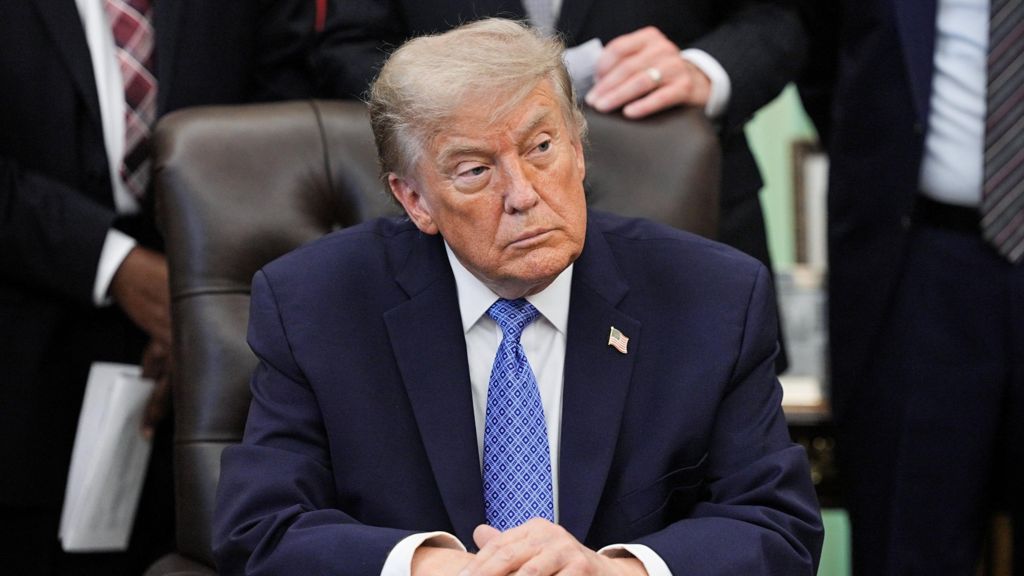
On the penultimate day of the U.S. Supreme Court’s 2025-2026 term, the nation’s highest court delivered a mix of landmark victories and unexpected setbacks to former and current President Donald Trump, revealing surprising ideological shifts within the court’s conservative majority that defy common partisan assumptions. A close examination of the four major rulings involving the president lays bare the evolving dynamics of the nation’s most powerful judicial body.
Almost a century ago, the Supreme Court issued a unanimous ruling that blocked Democratic President Franklin D. Roosevelt from claiming unlimited authority to oust commissioners from congressionally established regulatory agencies designed to operate independent of direct presidential control. On this eventful Monday, that 90-year-old precedent was formally overturned in a case brought by Trump, with the court’s six conservative justices — three of whom Trump himself appointed during his first term — forming a unified majority to expand executive power.
“Subordinates who exercise the president’s power are subject to removal by him,” Chief Justice John Roberts wrote in the majority opinion. “Then, and only then, can they remain accountable to the president, and the president to the people.” The outcome of this ruling hands Trump and all future U.S. presidents sweeping authority to replace regulators across dozens of key federal agencies when the sitting president disagrees with their policy stances. While the Federal Trade Commission was the specific agency at the heart of this case, echoing FDR’s dispute a century prior, the new precedent applies to every sector of federal regulation, from election oversight and communications policy to labor disputes, financial rulemaking and environmental protections. This decision is widely expected to accelerate the dramatic policy swings that have become standard when a new president of a different party takes office — a trend that has already played out between the presidencies of Barack Obama, Trump, Joe Biden, and now Trump’s second term. Trump himself celebrated the ruling in a post on his Truth Social platform, writing, “Ninety years of precedent has been completely and unequivocally overruled, greatly increasing presidential power at a time when it is most needed!”
Not long after delivering that sweeping win for executive authority, the court drew a clear line against one of Trump’s specific personal policy priorities: his bid to remove Federal Reserve Board of Governors member Lisa Cook. In a narrow 5-4 ruling, two conservative justices — Chief Justice Roberts and Brett Kavanaugh — broke ranks with their fellow conservatives to join the court’s three liberal justices in blocking Trump’s removal attempt. Trump has claimed Cook engaged in mortgage fraud to justify her ouster, but observers widely view the move as rooted in his anger over the Fed’s refusal to cut U.S. interest rates, a key policy demand of his second term. Writing for the new majority, Roberts ruled that Cook is entitled to a full opportunity to challenge her removal and rebut Trump’s unsubstantiated allegations, warning of the “calamities that could arise” if presidents were allowed to force their monetary policy preferences on the independent central bank.
A second major setback came in a case over late-arriving mail-in ballots, where the court again ruled against Trump. The case centered on whether federal law bars states from counting mail-in ballots that are postmarked by Election Day but arrive after the polls close. In this ruling, the three liberal justices were joined by Roberts and Trump-appointed Justice Amy Coney Barrett, who authored the majority opinion. Citing the U.S. Constitution’s grant of broad authority to states to set the “time, place and manner” of congressional elections, Barrett rejected Trump’s claims that late-arriving mail-in ballots are inherently vulnerable to widespread fraud, arguing that disputes over election rules are best resolved through the democratic process rather than judicial intervention. Trump immediately responded by doubling down on his push for congressional passage of an election reform package that would drastically restrict mail-in voting. While the Republican-controlled House of Representatives has already approved the legislation, Democrats and a small bloc of moderate Republicans have blocked a Senate vote, leaving the measure stalled.
The final blow for Trump on Monday came in a little-noticed entry on the court’s list of cases it declined to hear: the president’s final appeal of the civil judgment in the E. Jean Carroll sexual abuse and defamation case. Carroll, a former magazine writer, accused Trump of sexually assaulting her in a 1990s department store dressing room, and a 2023 jury found Trump liable for defamation, ordering him to pay $5 million in damages. The Supreme Court’s refusal to take up the appeal closes off the final avenue for Trump to challenge that $5 million judgment, though he still plans to appeal a separate $83.3 million damages award from a second defamation case brought by Carroll. Trump decried the decision in a Truth Social post, writing, “I will continue the fight against this weaponization and lawfare case against me, including the ridiculous claim of defamation, with all my power and strength. This injustice cannot be allowed to stand!”
Monday’s rulings served as a stark reminder of the Supreme Court’s unique role as the final arbiter of U.S. law, and delivered a day of mixed outcomes for Trump: a historic expansion of presidential power that delivers a long-term partisan victory, but concrete defeats for his immediate policy priorities and personal legal battles. The day also upended expectations of unified conservative control, showing that even with a 6-3 conservative majority, Trump cannot count on automatic victory for every one of his priorities before the nation’s highest court.