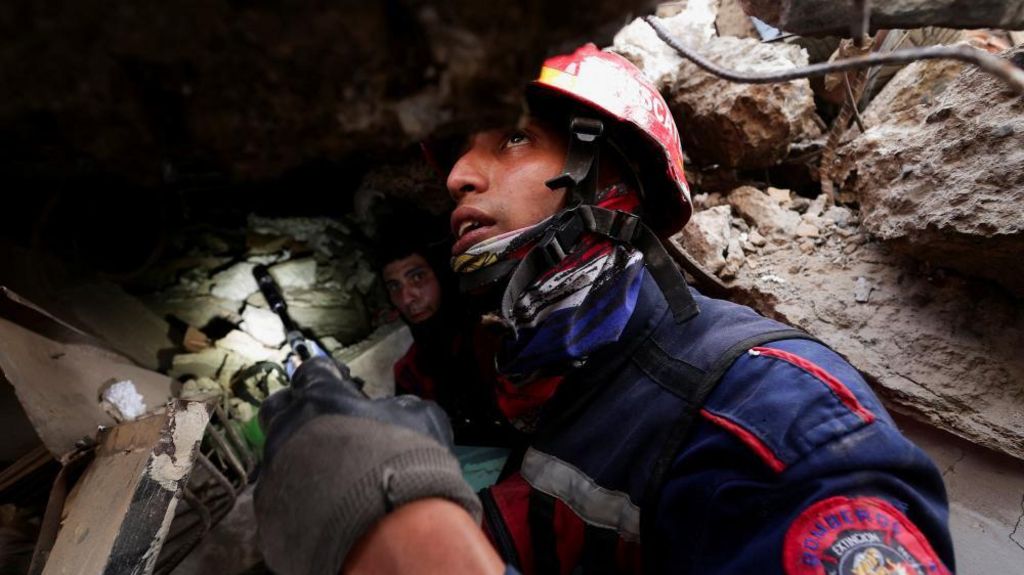
In the devastated coastal state of La Guaira, Venezuela, rescue teams from across the globe are continuing their urgent search for survivors trapped beneath collapsed infrastructure, one week after two consecutive major earthquakes left at least 1,450 people confirmed dead – a death toll authorities warn will continue to climb as recovery work progresses.
The critical 96-hour window, widely recognized as the period when trapped survivors are most likely to be found alive, expired on Sunday evening. But search and rescue personnel on the ground have rejected calls to scale back operations, maintaining the same intensity of search work as they carried out in the immediate aftermath of the disaster. Dozens of international teams have joined local Venezuelan crews, bringing specialized expertise and life-saving equipment to the disaster zone, with UK International Search and Rescue (UK ISAR) among the teams supporting the response.
To locate trapped people, rescuers rely on a layered mix of animal instinct and cutting-edge technology, starting with specially trained search dogs whose capabilities experts describe as extraordinary. Lee Ivory, UK ISAR’s deputy national coordinator who has decades of experience responding to major quakes in Haiti, Japan and Nepal, and currently coordinates the UK’s contribution to the Venezuela response from London, explained that canines are trained to detect the unique scent of living humans even when victims are buried 10 meters deep under dense rubble. When a dog picks up a scent, it alerts handlers with a loud, sustained bark, guiding teams to the potential location of a survivor. Trained using human-scented toys as a reward system, the dogs also help navigate collapsed, unstable debris to find viable access points that human rescuers cannot easily reach, added Sakthy Selvakumaran from Search and Rescue Assistance in Disasters (SARAID), a UK-based charity that deploys experts to large-scale disasters globally.
Next to search dogs, sound-based detection is one of the most effective tools for locating hidden survivors. Rescue teams first pause all activity in an area of debris, call out in local Spanish to ask trapped people to tap or make noise, then listen intently for any response. For deeper victims, teams deploy compact seismic and acoustic listening devices, small sensor nodes connected by wires to monitoring equipment that can pick up even the faint scratch of a fingernail on concrete from inside a collapsed structure. “Even if someone is fully entombed in the building, we can pick up that small movement,” Ivory told the BBC.
For narrow, hard-to-reach gaps in rubble that neither dogs nor human rescuers can access, technical search cameras have become an indispensable tool. Most commonly configured as small camera pods mounted on long rigid or flexible sticks, the devices allow teams to peer deep into voids to spot survivors. High-end models offer 360-degree pan-and-tilt views that can be recorded and reviewed off-site, while two-way video-enabled cameras even let rescuers communicate directly with trapped people to calm them and share updates about the ongoing rescue.
More advanced technology is also being deployed on the ground: UN Under-Secretary-General for Humanitarian Affairs Tom Fletcher confirmed that small, agile “cockroach drones” are being used to map and search large expanses of rubble that are too dangerous for crews to enter. Many teams also carry thermal imaging equipment, which detects the body heat of trapped survivors, warming the surrounding debris enough to show up as a clear heat signature even through walls or layers of concrete, allowing rescuers to spot people who are hidden from direct view.
Once a potential survivor is located, teams rely on a range of heavy and handheld tools to reach them. Handheld gear including disk cutters, hand saws and angle grinders is used to cut through furniture, filing cabinets, reinforced concrete and other obstacles blocking access to voids. For missions that require moving large sections of collapsed multi-story buildings, heavy machinery – including bulldozers, excavators and cranes – is critical, and local Venezuelan emergency teams typically coordinate the deployment of this large equipment across the disaster zone. Even after the passing of the golden 96-hour window, rescue teams remain committed to leaving no stone unturned, holding onto hope that more survivors can be pulled alive from the wreckage.