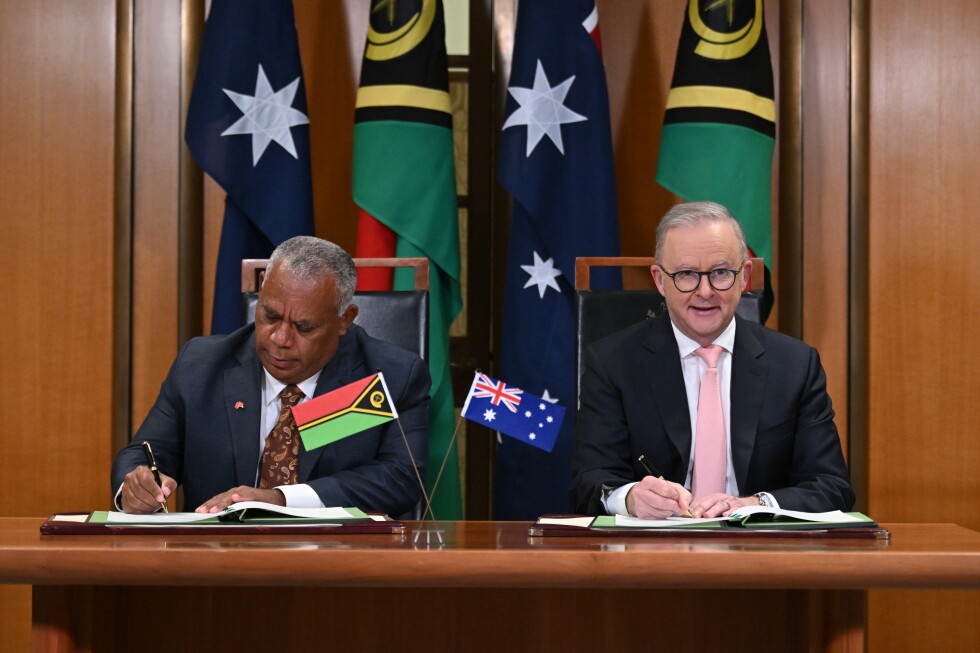
CANBERRA, Australia – In a long-anticipated step that reshapes regional security dynamics in the South Pacific, Australian Prime Minister Anthony Albanese and Vanuatuan counterpart Jotham Napat have formalized the bilateral Nakamal Agreement, a sweeping security and economic partnership designed to block any third-party nation from establishing a permanent military foothold on Vanuatuan soil. The signing on Monday comes nine months after the Vanuatuan government walked away from an earlier draft of the treaty, raising questions about Canberra’s push to counter growing Chinese influence across the Pacific region.
Vanuatu’s initial rejection of the 2023 draft stemmed from widespread domestic concerns that the original text would overly restrict the island nation’s ability to court global infrastructure investment, leaving it overly dependent on Australia. Key concessions in the revised version addressed these concerns: unlike the first proposal, Australia does not hold an official veto over third-party engagement in Vanuatu’s critical infrastructure, though the agreement requires Vanuatu to hold formal consultations with Canberra before moving forward with major third-party projects in strategic sectors.
The core terms of the finalized accord remain clear: Vanuatu has formally committed to bar all foreign military bases or military-focused infrastructure on its territory, and pledged to protect its critical national infrastructure from foreign militarization, interference, or unauthorized access. In addition, the treaty outlines that when responding to large-scale natural disasters – a frequent risk for low-lying Pacific island nations – Vanuatu will prioritize coordination and support from Australia, New Zealand, and France. Vanuatu has also agreed to prioritize policing cooperation with members of the Pacific Islands Forum, a 18-member bloc of regional nations and territories that includes Australia, though the agreement does not ban existing engagement with Chinese police personnel. China has never maintained a permanent police presence in Vanuatu, which has a total population of roughly 350,000, but Chinese officers make regular visits to the country.
In remarks to reporters following the signing, Albanese emphasized that the new agreement codifies Australia’s long-standing position as Vanuatu’s largest and most comprehensive partner across economic, security, and development cooperation. “This agreement reflects and confirms Australia’s role as Vanuatu’s largest and most comprehensive economic, security and development partner, a responsibility that we take seriously,” Albanese said.
Napat echoed the framing of the partnership as a mutual, respect-driven alliance, noting “this pact reaffirms our shared commitment to continuing and strengthening the comprehensive partnership between our two countries, founded on mutual respect, trust and our common vision for a peaceful, stable and prosperous Pacific.”
The Nakamal Agreement is just one of several regional security deals Australia has pursued or negotiated with Pacific neighbors in recent years, part of a broader strategy to limit expanding Chinese security influence in the strategically vital South Pacific. The original draft proposal offered Vanuatu 500 million Australian dollars (equivalent to roughly $344 million USD) in funding over 10 years, but Albanese confirmed that full details of the revised agreement’s funding commitments will not be released to the public until December.
In a notable disclosure during Monday’s proceedings, Napat confirmed that Vanuatu continues to negotiate a separate broad cooperation agreement with China, dubbed the Namele Agreement, which he has previously characterized as a purely development-focused deal, not a security pact. Napat noted that the text of the Namele Agreement will be made public once it receives formal approval from Beijing, adding that the Vanuatuan government has nothing to hide regarding its diplomatic and economic engagements. “Currently, it’s not yet signed. We will share the (Namele) agreement. There is nothing to hide. Our government is transparent and I am so grateful that the Prime Minister (Albanese) has also given me the clearance to share with them (China) the Nakamal Agreement,” Napat said. Vanuatu has already received hundreds of millions in Chinese loans and development aid for public infrastructure projects, including government buildings, port wharves, and other key assets.
The path to Monday’s signing has been fraught: last September, Albanese was notified just hours before he was scheduled to fly to Vanuatu for the signing of the original draft that the Vanuatuan cabinet had rejected the proposal, in a move that embarrassed the Australian government and drew global attention to competing great power interests in the Pacific.