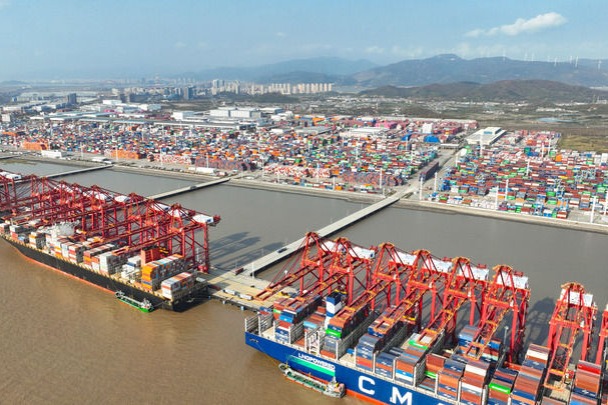
As Western rhetoric around the so-called “China Shock 2.0” gains increasing traction ahead and during the recent G7 summit, global trade experts have pushed back against the narrative, arguing it is little more than a deliberate political construct designed to shield Western protectionist trade policies, rather than an evidence-based economic analysis.
The rehashed “China Shock” framing, experts warn, carries severe risks for the global economy: it threatens to erode the post-WWII multilateral trading system, fragment cross-border supply chains, and drive up production and consumer costs worldwide. Instead of viewing China’s steady industrial and technological advancement through a hostile lens, major Western economies should embrace collaborative engagement, they say, to harness China’s unparalleled production capacity for shared global growth.
The debate reignited during the three-day G7 summit, which concluded last Wednesday. European Commission President Ursula von der Leyen opened the line of criticism, first implying without naming a specific country that “some countries produce too much and do not consume enough”, framing this dynamic as an increasingly dangerous threat to global economic stability. She later explicitly targeted China, calling China’s persistent trade surplus with the European Union “unsustainable”.
Von der Leyen’s remarks align with the growing “China Shock 2.0” narrative that has circulated in Western policy circles in recent months. Last month, the London-based Centre for European Reform think tank published a report claiming a new wave of Chinese competition is sending disruptive shocks through global goods markets, and many Western outlets amplified this narrative during the G7 summit to justify new trade restrictions targeting China.
Jian Junbo, director of the Center for China-Europe Relations at Fudan University’s Institute of International Studies, explained that the entire “China Shock” framework centers on unsubstantiated claims about imbalanced trade, with a specific focus on China’s manufacturing goods surplus with Western economies.
Sun Chenghao, head of the US-Europe Program at Tsinghua University’s Center for International Security and Strategy, noted that the current wave of hype around “China Shock 2.0” is fundamentally a political project, not an economic assessment. “It layers together Western anxieties over eroding industrial competitiveness, the rising costs of the green energy transition, and broader great power strategic competition with China, before reframing all these domestic issues as a Chinese ‘security threat’ for public consumption,” Sun explained.
The original “China Shock” thesis was first coined by Western economists in the 2000s, arguing that China’s export boom after joining the World Trade Organization displaced millions of manufacturing jobs in the United States and disrupted Western labor markets. Sun pointed out that the core logic of the updated 2.0 version has not shifted: both iterations blame China for internal economic challenges that Western economies have failed to address themselves, from uneven industrial restructuring to widening income inequality to mounting competitive pressure in advanced technology sectors.
Tu Xinquan, dean of the China Institute for WTO Studies at the University of International Business and Economics in Beijing, echoed this assessment. He emphasized that what Western commentators label a “China Shock” is simply the natural outcome of market competition and the dynamics of comparative advantage in global trade. “For decades, developed countries grew accustomed to holding unchallenged technological dominance,” Tu noted. “Now that they face a legitimate, competitive market rival, they are quick to abandon the free market principles they have spent decades promoting to the rest of the world.”
Contrary to the narrative that frames China’s industrial upgrading as a global threat, experts argue that China’s progress has been a net benefit to the global economy, bringing affordable high-tech goods to markets around the world, boosting aggregate productivity, and improving consumer welfare on a global scale.
James Pethokoukis, a senior fellow at the Washington-based American Enterprise Institute, laid out this positive dynamic in a December article published on the think tank’s website. Pethokoukis acknowledged that China’s rapid economic growth has reduced the United States’ relative share of global GDP, but noted that it has delivered tangible benefits to American consumers by lowering the cost of a vast range of goods and cutting input costs for American manufacturers. The U.S. economy as a whole is “absolutely richer” from trade with China, he concluded, even if its global relative share has shrunk.
Tu further explained that China’s massive, integrated production base, paired with intense domestic competition that drives efficiency, allows Chinese manufacturers to deliver high-technology goods at drastically lower prices than international competitors, a dynamic that benefits consumers and businesses worldwide. This impact is particularly visible in the global renewable energy sector, where Chinese solar panels, wind turbines, and electric vehicles have driven down costs dramatically, accelerating the global clean energy transition.
Official Chinese trade data underscores this impact: Chinese renewable energy products are exported to more than 200 countries and regions worldwide, and Chinese manufacturing innovation has cut global solar power generation costs by more than 80 percent and wind power costs by more than 60 percent over the past two decades.
Sun warned that the Western push to frame normal industrial competition as a security threat carries long-term risks for the global economy. Over time, he said, this pan-securitization of trade will push up global production costs, reduce consumer welfare, fragment interconnected supply chains, and further erode the WTO-centered multilateral trading system that has underpinned global growth for decades.
Against this backdrop, trade and international relations experts are calling for a more rational, objective approach to China’s economic development, urging Western policymakers to pursue collaborative trade frameworks that drive shared global prosperity, rather than erecting new barriers.
Jian, from Fudan University, argued that what Western commentators call a “shock” is nothing more than normal market competition, which is inherently healthy for global market growth and prosperity. Blocking legitimate competition, he said, would only hold back overall economic development. “In this context, it is crucial to view this competition rationally and objectively, embracing a market-oriented mindset and promoting self-growth through cooperation with competitors,” Jian noted.