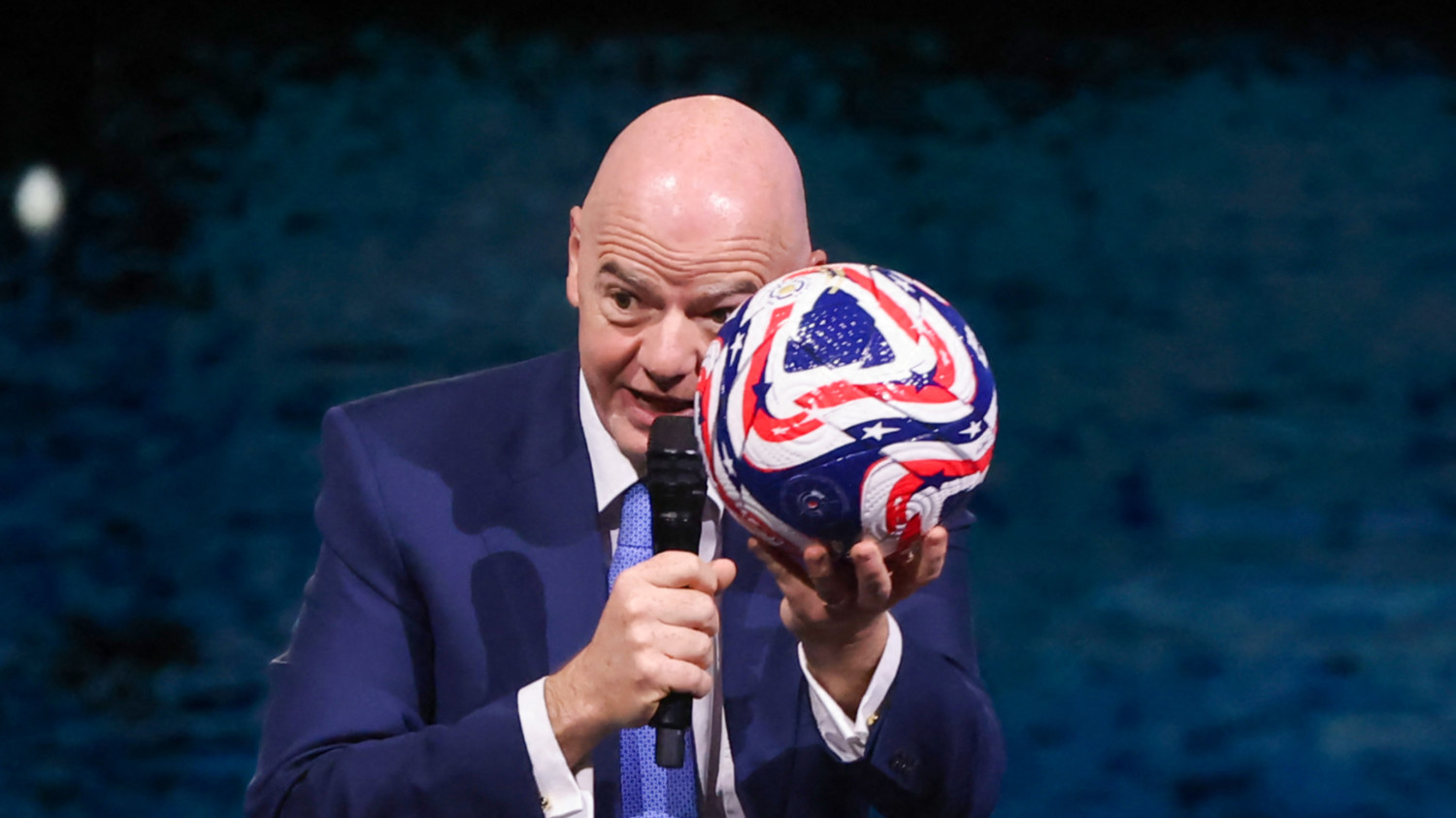
As the 2026 expanded-format FIFA World Cup kicks off across the United States, Mexico and Canada, 48 national teams are competing across 104 matches to claim football’s most coveted global trophy. At the helm of this six-week sporting spectacle is Gianni Infantino, the Swiss-Italian president of FIFA, who oversees a multi-billion-dollar commercial and athletic empire second only to the Olympic Movement in global reach.
For years, Infantino has publicly maintained that “politics should stay out of football and football should stay out of politics” — but this mantra has repeatedly collided with reality, nowhere more dramatically than across the Middle East, a region that has shaped Infantino’s tenure and drawn constant criticism of his leadership since he took over as FIFA president in 2016, replacing disgraced former chief Sepp Blatter.
Infantino’s ties to the Middle East are personal as well as professional: his wife Leena al-Ashqar is Lebanese, and he was granted Lebanese citizenship by former President Joseph Aoun in early 2025. As the 2026 World Cup enters its knockout phase, a deep dive into his actions across the region reveals just how deeply intertwined politics and FIFA leadership have become during his tenure.
The intersection of U.S. politics and FIFA’s operations came into sharp focus early in Infantino’s presidency. In early 2017, then-U.S. President Donald Trump introduced a travel ban targeting six Muslim-majority nations — Iran, Libya, Syria, Somalia, Sudan and Yemen — a restriction that was later expanded to cover 75 countries during Trump’s second term. By March of that year, Infantino acknowledged the ban could disqualify the U.S. from hosting future World Cups, noting: “Teams who qualify for a World Cup need to have access to the country, otherwise there is no World Cup.” He framed the comment as a general sporting rule rather than a direct rebuke of the Trump administration, a carefully calibrated statement that came just one month before the U.S. officially launched its joint 2026 bid alongside Mexico and Canada, which was awarded to the three nations in June 2018.
Eight years later, those travel restrictions have created tangible disruptions for the 2026 tournament itself. Iran, whose national side is playing its group stage matches in Los Angeles despite ongoing U.S.-Israeli military action against Iran that has killed thousands of Iranians, has been barred from bringing Iranian fans into the U.S. Iranian head coach Amir Ghalenoei has publicly lashed out at Infantino and FIFA over the unequal treatment, calling his team “the most oppressed one in the whole World Cup.” Ghalenoei revealed that after Iran’s opening match, Infantino visited the squad’s dressing room to inform them they had to leave the U.S. immediately for their training camp in Mexico, adding: “It seems others are doing the planning for us.”
Other Muslim-majority nations have faced similar entry issues: FIFA-appointed Somali referee Omar Artan was blocked from entering the U.S. over unproven Trump administration claims of ties to suspected terrorist groups. While FIFA ultimately paid Artan his full tournament fee, and UEFA later awarded him a 2026 UEFA Super Cup officiating assignment between Paris Saint-Germain and Aston Villa, the incident highlighted the impact of U.S. policy on the tournament. Iraqi striker Aymen Hussein was detained and questioned for seven hours upon entry to the U.S. before being granted access — and went on to score in Iraq’s opening World Cup match against Norway.
Critics have repeatedly accused Infantino of currying favor with Trump, a pattern that has played out across the Middle East. In May 2025, multiple FIFA member state delegates staged a walkout of the organization’s annual congress in Paraguay after Infantino arrived hours late, delaying the entire agenda. The delay came after Infantino traveled with Trump on a trip to meet with leaders in Saudi Arabia and Qatar. The incident sparked a public rebuke from UEFA, which accused Infantino of prioritizing “private political interests” over the governance of the sport. Infantino blamed the delay on flight issues, claiming “important discussions took place in regard to the World Cup, and I felt that I needed to be there to represent football and all of you.”
Trump, who has publicly sought a Nobel Peace Prize, was awarded the first ever “FIFA Peace Prize” by Infantino during the 2026 World Cup draw in Washington D.C. in December 2025. Infantino praised Trump for “exceptional and extraordinary actions to promote peace and unity around the world,” telling the U.S. president “You can always count on my support.” Infantino also attended Trump’s second presidential inauguration in January 2025 and the premiere of a documentary about First Lady Melania Trump, and FIFA maintains a leased office space in New York’s Trump Tower.
Questions of FIFA’s close ties to Middle Eastern nations with questionable human rights records date back to the 2022 Qatar World Cup, awarded to Qatar in 2010, six years before Infantino took office. The run-up to the first Middle Eastern World Cup was dominated by accusations of sportswashing, driven by reports of widespread migrant worker abuses that killed more than 6,500 migrant workers between 2010 and 2021, many of whom worked on World Cup infrastructure. Critics also raised alarms over extreme summer temperatures, which led organizers to move the tournament to the winter months.
Facing mounting global criticism, Infantino delivered a controversial 57-minute speech on the eve of the 2022 tournament, declaring: “Today I have very strong feelings. Today I feel Qatari. Today I feel Arab. Today I feel African. Today I feel gay. Today I feel disabled. Today I feel like a migrant worker.” He pushed back against critics, arguing that migrant workers earned higher wages in Qatar than they would in their home countries and claiming labor rights standards matched those of Western Europe. The comments drew fierce condemnation from global human rights groups including Amnesty International, which accused Infantino of ignoring the massive human cost of the tournament and FIFA’s own responsibility for the abuses. Qatari officials dismissed the allegations as racist double standards, but human rights organizations rejected that defense.
Infantino’s actions around the awarding of future World Cup tournaments have also drawn scrutiny over political maneuvering in the Middle East. The 2030 tournament, marking the centenary of the first World Cup held in Uruguay in 1930, attracted multiple competing bids: a sentimental joint bid from South American nations Uruguay, Argentina, Chile and Paraguay; a European bid from Spain and Portugal that at one point included Ukraine; and a standalone bid from Morocco, which had unsuccessfully bid for the tournament six times previously. Morocco had emerged as a rising football power, reaching the 2022 World Cup semi-finals as the first African nation ever to do so, and winning the 2026 Africa Cup of Nations in a controversial final.
By late 2024, technical evaluations ranked the joint Morocco-Spain-Portugal bid ahead of other contenders, and in December 2024, an extraordinary online FIFA Congress confirmed Morocco would co-host the 2030 tournament alongside Spain and Portugal, with three ceremonial centenary matches held in South America. But leaked internal messages revealed Infantino had floated the idea of Morocco joining the Spanish-Portuguese bid as early as 2018, contradicting FIFA’s official position that it remained neutral throughout the bidding process. Spanish Prime Minister Pedro Sanchez acknowledged in a message to then-Spanish FA president Luis Rubiales that both Rubiales and Infantino had proposed the idea to him, with Rubiales noting that FIFA’s neutrality meant the coordination should not be made public. FIFA has repeatedly denied Infantino played any role in bid negotiations. While the decision was praised by many for bringing the World Cup to Africa for only the second time after 2010’s South Africa tournament, critics have raised ongoing concerns about Morocco’s human rights record and its occupation of Western Sahara.
The 2034 World Cup awarding process drew even sharper criticism, when Saudi Arabia was awarded the tournament as the only eligible bidder. Under FIFA’s continental rotation rules, only Asian and Oceanian confederations were eligible to host 2034, after North America hosted 2026 and Europe/Africa/South America co-host 2030. FIFA opened bidding for 2034 with no advance warning in October 2023, setting a tight 25-day deadline. Saudi Arabia immediately announced its bid, part of the kingdom’s broader strategy to rebrand its global image through major sporting investments, and Australia — the only other potential contender — withdrew before the deadline. FIFA pushed delegates to approve both the 2030 and 2034 hosts as a single package, meaning rejecting one would eliminate both. After a brief round of applause, Infantino declared the result “loud and clear” and approved both bids. Infantino argued the World Cup would act as a “catalyst for social improvements and social change” in Saudi Arabia, but a joint statement from 21 leading human rights organizations including Amnesty International and Human Rights Watch condemned the decision as “a moment of great danger” for global human rights.
Infantino’s tenure has also brought tangible changes for football across the Middle East. In 2018, he lifted a 32-year ban on Iraq hosting competitive international matches, imposed in 1986 during the Iran-Iraq War that forced Iraq to play all home World Cup qualifiers abroad. Iraq has since hosted qualifiers in Basra and Karbala for the 2022 and 2026 tournaments, and qualified for the 2026 World Cup — its first appearance at the finals since 1986.
In Iran, where women were largely barred from attending football matches after the 1979 Islamic Revolution, Infantino took a public stand after the 2019 death of Sahar Khodayari, an Iranian woman who died by self-immolation after being arrested for attempting to enter a stadium disguised as a man. FIFA set a firm deadline for Iran to lift the ban, with Infantino stating: “Our position is clear and firm. Women have to be allowed into football stadiums in Iran.” The Iranian government has since allowed a limited number of women to attend selected matches at Tehran’s Azadi Stadium, though full access remains restricted with small, limited ticket allocations for women.
Infantino’s most controversial actions in the region center on the Israeli-Palestinian conflict, where he has faced criticism from all sides. He has attempted to use football as a tool for diplomacy, suggesting during a 2021 visit to Israel that Israel could co-host a future World Cup alongside the United Arab Emirates, noting “nothing is impossible. We need to think big.” The comment came months after the 2020 Abraham Accords, brokered by Trump, normalized relations between Israel and the UAE, and the first UAE club side played in Israel the following year.
Following the 2023 outbreak of Israel’s military campaign in Gaza that has killed more than 72,000 Palestinians, global calls grew for Israel to be suspended from international football, mirroring the 2022 ban on Russia after its invasion of Ukraine. In early 2026, Infantino called for Russia’s reinstatement to international competition and argued any ban on Israel would be a “defeat.” Months later, FIFA announced it would not sanction the Israeli Football Association for allowing Israeli clubs to play matches in the occupied West Bank, claiming “the final legal status of the West Bank remains an unresolved and highly complex matter under public international law.” Instead, FIFA offered to mediate between the Palestinian and Israeli FAs, a decision that prompted the Palestinian FA to file an appeal with the Court of Arbitration for Sport. FIFA did fine the Israeli FA $185,000 for failing to address repeated incidents of racist and discriminatory abuse by fans of two top Israeli clubs.
In early 2026, FIFA signed a strategic partnership with Trump’s Board of Peace, a body created to administer post-conflict Gaza that includes no Palestinian representatives. Infantino framed the deal as an effort to “foster investment into football for the purpose of helping the recovery process in post-conflict areas.” Months later, at the 2026 annual FIFA congress, Infantino attempted to orchestrate a public handshake between Palestinian FA president Jibril Rajoub and Israeli FA vice president Basim Sheikh Suliman. Rajoub refused the handshake, exclaiming “We are suffering!” as he left the stage. Susan Shalabi, vice president of the Palestinian FA, later explained that Rajoub told Infantino he “cannot shake the hand of someone the Israelis have brought to whitewash their fascism and genocide.”
Despite the public rejection, Infantino has pushed forward with plans for a symbolic under-15 youth “peace match” between Israeli and Palestinian teams scheduled for September 2026 in the U.S., according to reporting from The Athletic that has not been confirmed by FIFA. The idea was first proposed by Infantino’s predecessor Sepp Blatter in 2015, but never moved forward after it was rejected by the Palestinian FA, despite support from then-Israeli Prime Minister Benjamin Netanyahu. The Palestinian FA has stated it has no knowledge of the new plans and “rejects any attempt to promote or impose matches with an occupying power that systematically targets Palestinian athletes and sports infrastructure.” The Israeli FA has said it remains willing to use football as a tool to promote normalization and peace in the region.
As Infantino prepares to run for a fourth term as FIFA president at the organization’s upcoming 2027 congress in Rabat, Morocco, the ongoing tensions between his stated goal of keeping politics out of football and the deep political entanglements of his tenure remain the defining story of his leadership of global football’s governing body.