On the outskirts of Kyiv, just a short distance from Ukraine’s battered capital, a small gathering of Crimean Tatars finishes their weekly Friday prayers at the Kyiv Islamic Cultural Centre with the traditional Islamic greeting of taslim. Among them is 60-year-old Isa Akayev, a veteran warrior who walks out of the prayer hall last, his frame still bearing the quiet dignity of a man who has spent more than a decade fighting for his people.
Akayev retired from frontline service in December, but he still proudly wears a shirt emblazoned with the insignia of Ukraine’s Military Intelligence, paired with his traditional beard and taqiyah skullcap. Seated on a handcrafted traditional Crimean wooden bench in the centre’s hallway – a space that also houses the Religious Administration of Muslims of Crimea – he reflects on how dramatically the character of war has shifted since he first took up arms.
“War has changed a lot. The head-on assaults we carried out years ago are impossible today,” he explained in an interview with Middle East Eye. “Now, the fighting is dominated by heavy artillery and FPV drones. A single kill zone can extend up to 30 kilometers, and infantry have to move on foot to avoid giving away their position to enemy surveillance.” This new era of high-intensity, long-range warfare, the battle-hardened Tatar acknowledges, is no longer suited to his experience as a ground commander.
Akayev’s fight stretches back to 2014, when Russian forces invaded and occupied the Crimean Peninsula. Within weeks of the occupation, he founded the Crimea Battalion, the first all-Tatar military unit fighting in defense of Ukrainian sovereignty and the rights of Crimea’s indigenous Muslim community. At the time of the 2014 annexation, more than 250,000 Crimean Tatars lived on the peninsula, most having only recently returned to their ancestral homeland after decades of mass deportation under Soviet rule.
Moscow’s 2014 annexation, which followed a hastily organized referendum widely condemned as illegitimate by the United Nations and the vast majority of the international community, has been met with unwavering resistance from the Crimean Tatar community. Since Russia launched its full-scale invasion of Ukraine in February 2022, that resistance has grown far more visible, with distinct Crimean Tatar military units serving alongside regular Ukrainian forces on frontlines across the country, explains Filiz Tutku Aydin, a political science professor at Ankara’s Social Sciences University. Alongside Akayev’s original Crimea Battalion, these units include the Noman Celebicihan Battalion and the Grey Wolves squad.
Crimean Tatars, whether serving in these dedicated formations or integrated into Ukraine’s regular armed forces, have paid a devastating price for their resistance, with dozens killed in combat. When a Tatar soldier falls in battle, the community publicly honors him as a shaheed, or martyr, a reflection of the deep spiritual meaning that the fight to liberate Crimea holds for the entire people, Aydin notes.
Beyond frontline military service, Crimean Tatars have risen to key positions of leadership within the Ukrainian government. Most notably, Rustem Umerov, a prominent Crimean Tatar politician and close advisor to Ukrainian President Volodymyr Zelensky, served as Ukraine’s Minister of Defense from September 2023 to July 2025. For Akayev, Umerov’s appointment was a historic breakthrough: he became the first Crimean Tatar ever to hold a Ukrainian cabinet position, carrying profound symbolic weight for the entire community.
Today, between 30,000 and 50,000 Crimean Tatars live as displaced members of the community on mainland Ukraine, where they remain deeply engaged in political and civic action to advance their cause, while more than 200,000 remain on the peninsula under Russian occupation, according to Russian government statistics. In 2023, displaced Tatar leaders launched the Crimean Front, a cross-sector platform that unites business owners, volunteers, and civil society organizations to coordinate support for the war effort and keep global attention focused on their struggle.
“The whole point of this platform is to remind the world that Crimean Tatars are constantly contributing to the fight for liberation,” explains Lenur Mambetov, one of the Crimean Front’s co-founders. “We all share one goal: not just to push back the Russian invader, but to take back our land and return home to Crimea.”
Russian rule has grown increasingly repressive on the peninsula since 2022, with widespread crackdowns on any expression of pro-Ukrainian or pro-Tatar identity, making the liberation of Crimea an existential priority for the community. “For Crimean Tatars, Ukraine’s victory is even more important than it is for ethnic Ukrainians. As a displaced people fighting to rebuild our community, this is a matter of life and death,” Aydin says.
Akhtem Seitablayev, a prominent Ukrainian-Crimean Tatar actor, screenwriter, and director who heads the Kyiv-based Crimean House, a state-funded cultural institution dedicated to supporting displaced Crimeans, echoes this urgency. “Of the more than 300 political prisoners held by Russia in occupied Crimea, the vast majority are Crimean Tatars. That alone makes clear where our community stands on the occupation,” he says.
Seitablayev, who joined the Ukrainian army after the 2022 full-scale invasion, continues to lead cultural initiatives to preserve Crimean Tatar memory and build international awareness of their struggle. The hallways of Crimean House are lined with posters from films about Crimean history, including his award-winning 2013 historical drama *Haytarma*, which chronicles the 1944 Soviet mass deportation of Crimean Tatars.
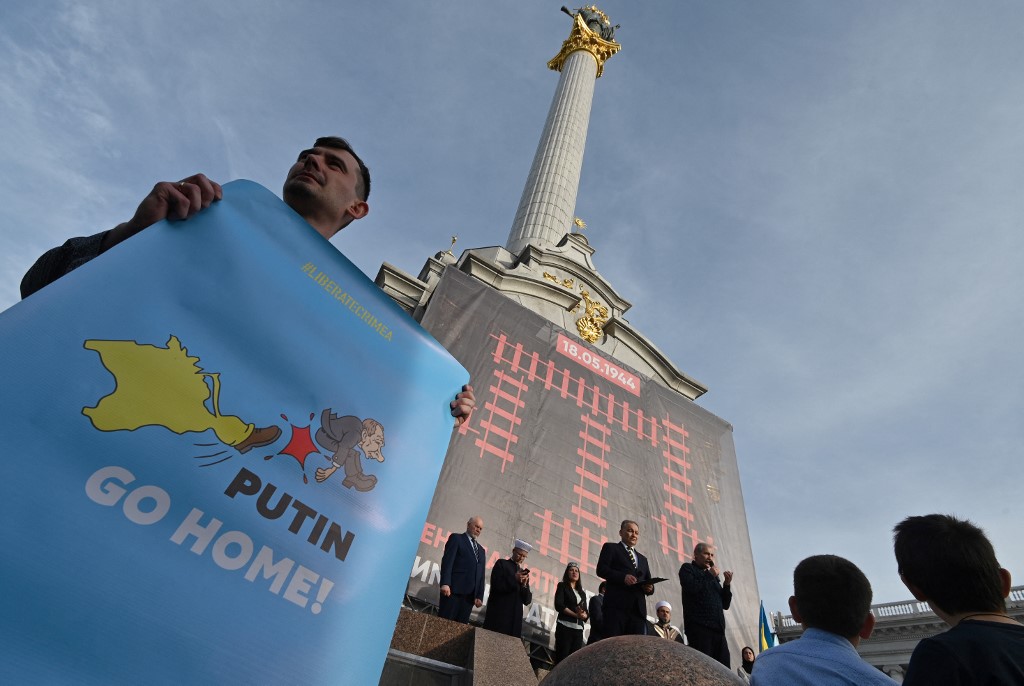
Known to the Tatar people as surgunlik, or exile, the 1944 deportation was one of the largest forced population transfers of the Stalin era. Over just three days, Soviet authorities deported more than 190,000 people – overwhelmingly Crimean Tatars, alongside smaller groups of Greeks, Armenians, and other non-Slavic communities – to Central Asia via overcrowded cattle trains, erasing nearly all trace of Tatar cultural and political life from the peninsula. Many scholars classify the deportation as ethnic cleansing, while Crimean Tatars universally recognize it as an act of genocide. The deportation killed tens of thousands through starvation, disease, and exposure, shattered Tatar cultural institutions, and scattered the community across a global diaspora that has never been able to fully reassemble on its homeland. Like Akayev and Mambetov, Seitablayev was born in Uzbekistan, where most deported Tatars were resettled, and only returned to Crimea following the collapse of the Soviet Union in 1991.
*Haytarma* is regularly screened at Ukrainian embassies around the world ahead of May 18, the annual national day of remembrance for the 1944 deportation. Seitablayev attended a screening in Berlin earlier this year, and notes that international interest in Crimean Tatar art and storytelling has grown dramatically since 2014, and especially after the 2022 full-scale invasion. “That growing interest is something we deeply welcome,” he says.
To amplify their cause, Crimean Tatars have leveraged a far-flung global diaspora that stretches from Central Asia to North America and Western Europe. The largest and most politically influential diaspora community is based in Turkey, where hundreds of thousands of Tatars settled beginning in the late 18th century, after the Russian conquest of Crimea and amid growing persecution under Tsarist rule. With shared Turkic linguistic and cultural roots, and close geographical proximity to Crimea, Turkey has long been a safe haven for displaced Tatars, and the diaspora there grew further after the 2014 annexation and 2022 full-scale invasion.
“Turkey has been a reliable partner for us: it has held the same position since 2014, supporting Ukraine’s territorial integrity and rejecting the legality of the occupation of Crimea,” says Refat Chubarov, chairman of the Mejlis, the elected representative body of the Crimean Tatar people. The Mejlis has emerged as a key diplomatic channel for Ukraine during the war, with Chubarov and other leaders regularly engaging with international officials to highlight the plight of Tatars under Russian rule. Most recently, Chubarov took part in the 2025 Antalya Diplomacy Forum, where he held talks with Turkish government officials focused on the ongoing repression of Crimean Tatars and continued support for Ukraine.
While Turkey has not provided direct military assistance to Crimean Tatar units, the Crimean Front has built close humanitarian partnerships with Turkish authorities, and has also secured support from other Muslim-majority nations including Saudi Arabia, Qatar, and the United Arab Emirates. After the destruction of the Kakhovka Dam in 2023, Saudi Arabia provided emergency humanitarian aid through the Crimean Front, while the UAE donated critical power generators for displaced communities, Mambetov says. Beyond the Middle East, Crimean Tatar diaspora communities across Canada and Europe work closely with Ukrainian diaspora groups to advocate for sanctions on Russia and support for Ukraine’s territorial claims.
For decades after the collapse of the Soviet Union, relations between the Ukrainian government and the Crimean Tatar community were marked by mutual mistrust, shaped by decades of Soviet propaganda that framed Tatars as a disloyal minority. That has changed dramatically under President Volodymyr Zelensky, who has taken a series of historic steps to formalize the recognition of Crimean Tatar rights and identity. In April 2025, Zelensky signed a presidential decree dedicated to protecting the distinct national identity of the Crimean Tatar people and formally recognizing the legal status of the Mejlis, a move the community has hailed as a landmark milestone after decades of campaigning.
Chubarov recalls that for years after 1991, lingering Soviet-era influence left many Ukrainians viewing Russians as “closest brothers” while viewing returning Crimean Tatars with suspicion. “Many saw us returning from exile as a threat. Some politicians even claimed we wanted to seize the peninsula for ourselves or bring it under Turkish influence,” he says.
Today, that distrust has given way to growing partnership and integration. In 2023, Zelensky established a new annual tradition of hosting an official iftar dinner for Crimean Tatar leaders during the Muslim holy month of Ramadan, a gesture that took the community by surprise. “It was a shock. For a Ukrainian president to give that level of recognition to Muslims and Crimean Tatars was completely unprecedented,” Mambetov says. In 2024, Zelensky unveiled a national memorial in central Kyiv to commemorate the victims of the 1944 surgunlik deportation, extending recognition of Crimean Tatar history from the political sphere to the national historical memory of Ukraine.
“Since 2014, public perceptions of Crimean Tatar art, culture, and identity have changed dramatically, for the better,” Seitablayev says. “To some extent, the war helped push that change forward, but I also believe it was part of the Almighty’s plan.” Mambetov adds that many Ukrainians have also let go of old prejudices against Islam, with growing public understanding of the Crimean Tatar community’s faith and traditions.
The steps Kyiv has taken to guarantee the integration and autonomy of the Crimean Tatar community are now enshrined in Ukrainian law, and have built deep trust between the Ukrainian government and the Crimean Tatar independence movement, Aydin explains. “Ukraine understands that integrating Crimean Tatars is a necessary step to eventually re-integrate Crimea after liberation,” she says, adding that this policy also eliminates any risk of separatist sentiment within the community.
For Crimean Tatars, the pursuit of cultural autonomy and full membership within a sovereign Ukrainian state is not contradictory – it is the core of their political stance, Aydin notes. That position is shared by the Mejlis and all leading figures of the community.
“Allah ordained that Crimea is part of Ukraine, so how could we go against His will?” Akayev says with a smile. Even as some Western politicians, including former U.S. President Donald Trump, have floated the idea of ceding control of Crimea to Russia as part of a potential peace deal, Akayev rejects any such compromise out of hand.
“I do not know what the future holds, but as long as God gives me strength, I will continue to fight by every means permitted by Sharia for our homeland to return to us,” he says. “Because the graves of my ancestors are there. Because I want to be buried there myself. Because without Crimea, there would be no Crimean Tatars.”