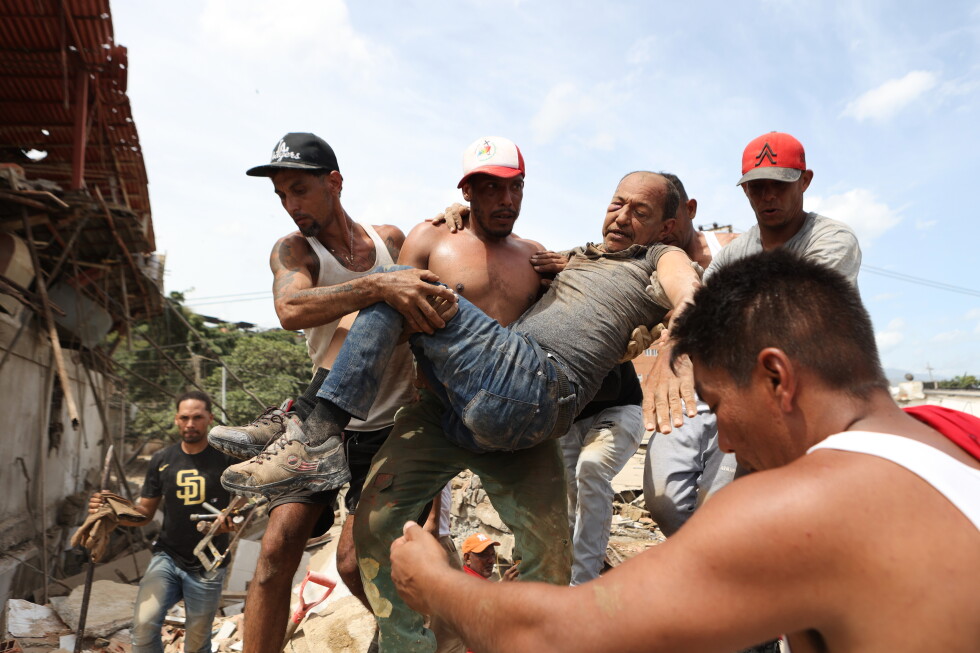
In the wake of two powerful consecutive earthquakes that struck northern Venezuela on Wednesday evening, local communities launched urgent, grassroots search efforts Thursday, digging through collapsed rubble by hand to locate missing loved ones as officials confirmed a rising death toll and thousands of injuries across the affected region.
By late Thursday, Venezuela’s Health Minister Carlos Alvarado confirmed to state media that the official casualty count had climbed to 235 fatalities, with at least 4,300 people injured. With thousands still reported unaccounted for and search operations continuing around the clock, authorities warn the final death toll is likely to rise further.
Measuring 7.2 and 7.5 magnitude respectively, the back-to-back quakes rank among the strongest seismic events to hit Venezuela in more than a century, with shaking felt across the entire Caribbean region. The coastal state of La Guaira, located just north of the capital Caracas, bore the brunt of the destruction, bearing the highest concentration of damage and casualties. As the site of Venezuela’s main international airport, facility closures from structural damage have created major logistical barriers for incoming aid and rescue teams.
Survivors described scenes of utter devastation Thursday morning: entire buildings reduced to skeletal frames, multi-story structures flattened, cracked roads split open, and debris scattered across residential neighborhoods. State television broadcast dramatic rescue footage, including the extraction of a woman who survived being trapped under a concrete slab, with only her foot visible to rescuers before she was pulled free alive. But many residents reported a noticeable lack of official government search teams outside the capital in the critical early hours after the disaster.
Dayana Delgado, a mother of three whose 8-year-old son remains missing, publicly questioned where the heavy rescue machinery promised by government officials had gone, noting that local residents were leading the search through crumpled building remains on their own. “I want to know where my child is, if he’s trapped or in a shelter,” Delgado said. In one harrowing scene, a mother collapsed in uncontrollable grief after the bodies of her 3-year-old and 10-year-old children were recovered from the rubble, while other survivors screamed names of missing loved ones or stood in stunned silence.
Hundreds of Caracas residents spent Wednesday night huddled together in open public spaces including parks and parking lots, too afraid to return to damaged or structurally unstable buildings. Families posted handwritten missing person flyers with photos of lost relatives, while Venezuelans living abroad struggled to contact family back home after widespread damage disrupted cellular and phone service across the hardest-hit areas.
La Guaira has a long history of catastrophic natural disasters: in 1999, devastating mudslides killed thousands of people in the region, in one of Venezuela’s deadliest natural events on record. Venezuelan authorities have confirmed they are reallocating rescue teams from across the country to reinforce search efforts in La Guaira. Cristian Carreño, a La Guaira resident, surveyed his damaged apartment building, which now leans dangerously to one side after the quakes. “I lost everything,” Carreño said. “There are people still inside, I imagine, that couldn’t get out. It’s incredibly devastating.”
Retired schoolteacher Juan Alberto Mendaño, who was navigating through wreckage in search of survivors, encountered a dead body on his path before spotting a trapped woman signaling for help with her hand. “May God rescue her as quickly as possible,” Mendaño said. “When we heard the scream, there was nothing we could do without proper equipment.”
The disaster comes as Venezuela already grapples with more than a decade of severe economic instability and deep political division, adding an enormous new challenge to acting President Delcy Rodríguez, who took office in January following the detention of former President Nicolás Maduro. Rodríguez, whose governing movement faces widespread questioning of its legitimacy from much of the Venezuelan public, declared a national state of emergency in a national address Wednesday night, announcing the creation of a $200 million reconstruction fund earmarked for damaged hospitals and residential buildings. On Thursday, she made a public appeal to private businesses to donate heavy construction equipment to support rescue operations. “We hope to rescue as many living people as possible,” Rodríguez said.
Geoscientists explain that while Venezuela sits adjacent to multiple tectonic fault lines, its location straddling the South American and Caribbean plates means major earthquakes are far less common here than in other high-risk parts of Latin America. The U.S. Geological Survey confirmed both quakes were centered near Morón, a coastal Caribbean city roughly 170 kilometers west of Caracas. Marcos Ferreira, a geophysicist and researcher at the Geological Survey of Brazil, noted that the consecutive timing and shallow depth of the quakes amplified their destructive force dramatically. “It is as if I am screaming and then someone starts screaming, too. That amplifies the vibration and adds to the potential hazard,” Ferreira explained.
Shortly after United Nations officials called on the Venezuelan government to lift social media restrictions to allow citizens to access life-saving emergency information, platform X (formerly Twitter) was restored for users across the country. The site had been blocked by Maduro’s administration since August 2024, implemented to suppress information sharing among opponents of his contested claim of victory in July’s presidential election.
Multiple foreign governments have already pledged emergency assistance to Venezuela, with leaders from Mexico, Qatar, Brazil, Spain, Portugal and Canada confirming aid shipments are en route. U.S. Secretary of State Marco Rubio, who spoke with Rodríguez shortly after the disaster, said the U.S. was immediately deploying emergency support, while acknowledging that the closure of the main international airport creates significant logistical hurdles. “We have a whole-of-government response. It’ll be big; it’ll be fast; and it’ll be effective,” Rubio said.
By Thursday, rescue teams from Mexico, El Salvador and the Dominican Republic had already arrived in the country, alongside an aid flight carrying emergency supplies from Mexico. “No country is prepared to provide the full response that’s needed. That’s what neighboring countries are there for,” said Dominican Air Force Major Carlos Olivares.
Venezuela’s large global diaspora has also mobilized to support relief efforts. In Ecuador, Venezuelan expat Félix Rodríguez has turned his retail store into a local donation collection point, receiving contributions from fellow Venezuelans and local Ecuadorians alike. “My business is always ready for whatever Venezuela needs,” Rodríguez said, adding he wished all affected Venezuelans “faith and fortitude.”
Reporting was contributed by AP journalists across multiple international locations including Mexico City, Quito, Bogota, Sao Paulo, San Juan, Buenos Aires, San Diego and New York.