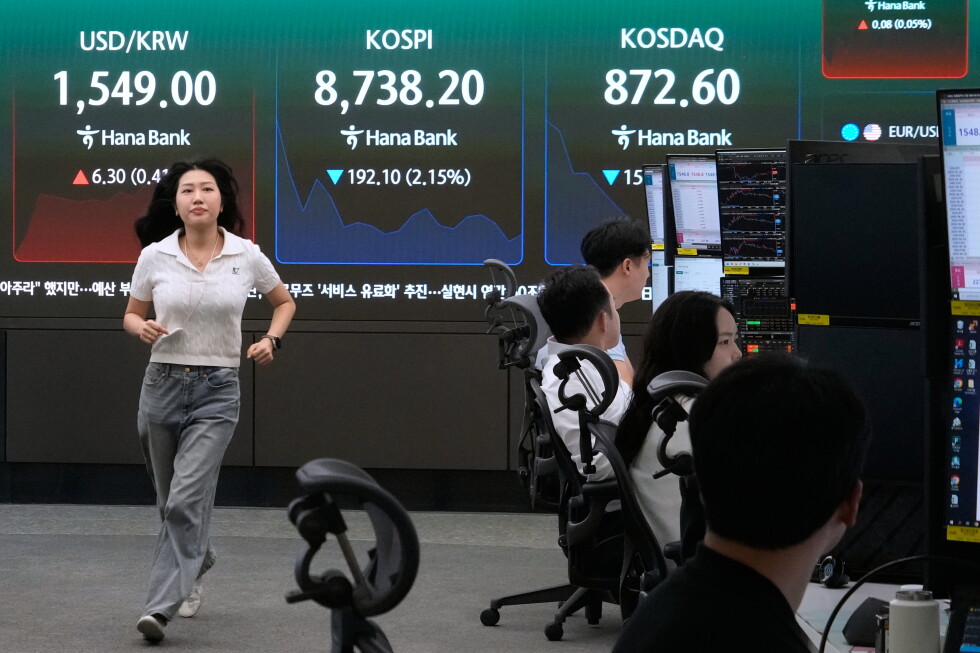
BANGKOK – A broad sell-off swept across Asian equity markets on Friday, as traders moved aggressively to lock in profits following weeks of explosive gains in artificial intelligence-linked stocks that had pushed several major regional indexes to all-time records. The sharpest declines were concentrated in Japan and South Korea, where AI and semiconductor-linked holdings had led weeks of rapid upward momentum.
U.S. equity futures also retreated to start the trading day, alongside a notable drop in global crude oil prices. By the closing bell in Tokyo, the Nikkei 225 had erased 4.5% of its value to settle at 69,127.10, while South Korea’s Kospi plummeted 6.8% to 8,323.52. Both indexes recovered a small portion of their early session losses by the end of trading, softening the day’s overall pullback slightly.
Other major regional indexes also posted declines: Hong Kong’s Hang Seng Index fell 1.7% to close at 22,684.76, mainland China’s Shanghai Composite slipped 1.4% to 4,062.28, and Taiwan’s Taiex retreated 3.6%. Australia bucked the downward trend, with the S&P/ASX 200 notching a modest 0.2% gain to end at 8,765.90.
Market analysts noted that the extreme volatility seen on Friday is a predictable outcome of the massive capital inflows that have flooded into AI-related investments, from data center infrastructure to semiconductor manufacturing, in recent months. Just one day earlier, Japanese and South Korean stocks hit record closing highs, fueled by surprisingly strong quarterly earnings from top U.S. chip manufacturers Qualcomm and Micron Technology.
In South Korea, the market’s steep pullback was led by the country’s two largest tech and chip players, both of which are key partners to U.S. AI chip giant Nvidia: Samsung Electronics shed 7% on Friday, while SK Hynix fell 6.6%. The drop comes just days after Samsung’s labor union reached a last-minute wage deal with management that avoided a planned strike. In Japan, Tokyo-based SoftBank Group, a major technology investor with large AI holdings, dropped 13.4%, and chip testing equipment manufacturer Advantest sank 10.8%.
The volatility in AI stocks is not limited to Asian markets. On Thursday, U.S. equities ended the session mixed, caught in the same ongoing rollercoaster for AI-linked holdings. Apple shares slid 6.1% after the company announced price hikes for multiple core products, while the S&P 500 closed virtually unchanged, dipping less than 0.1% after swinging between gains and losses throughout the day. The Dow Jones Industrial Average gained 0.1% (71 points), while the Nasdaq composite, which is heavily weighted toward technology stocks, fell 0.5%.
Micron Technology was a standout gainer on Thursday, jumping 15.7% after reporting quarterly profit and revenue that far outpaced analyst expectations, alongside a stronger-than-forecast growth outlook for the current quarter. The results helped ease some concerns that the stock had become overvalued after surging 267% year-to-date through Thursday’s open. Even so, Stephen Innes, a market analyst at SPI Asset Management, warned that AI and semiconductor stocks remain extremely sensitive to shifting investor sentiment. “A strong Micron print can produce a powerful upside chase one day; a new concern around memory costs, capex, or the durability of AI demand can reverse it violently the next,” Innes wrote in a client note Friday.
Broadly, AI stocks have faced intermittent selling pressure in recent weeks, as investors grow increasingly nervous that the explosive stock price rallies seen over the past year are not supported by corresponding growth in corporate profits. Beyond Micron, Qualcomm raised its long-term growth forecast late Wednesday, noting that the accelerating expansion of the AI sector is driving higher demand for its products. Elsewhere in U.S. trading, SpaceX shares dipped 1% to close below $153, marking the stock’s lowest finish since its high-profile Nasdaq debut earlier this month.
Thomas Mathews, a markets analyst at Capital Economics, observed that while the AI boom has driven extreme swings in technology sectors, other parts of the global stock market have remained relatively stable. “Even if the AI boom turned into a bust the ‘non-tech’ parts of the stock market could conceivably shrug it off for a while, as they have this week,” Mathews noted in a research report.
Outside of equities, global commodity and currency markets showed muted movement on Friday. A latest U.S. inflation report came in largely in line with economist expectations, showing annual consumer price inflation climbing to 4.1% in May, up from 3.8% in April. Economists widely expect inflation to ease in coming months, supported by a recent decline in global crude oil prices. Brent crude, the global benchmark for oil, fell 1.8% to $74.13 per barrel on Friday, down sharply from the highs above $100 seen after geopolitical tensions related to the Iran conflict disrupted shipping through the Strait of Hormuz, a critical global oil chokepoint. U.S. benchmark West Texas Intermediate crude dropped 2% to $70.46 per barrel.
In foreign exchange trading, the U.S. dollar edged slightly lower against the Japanese yen, falling to 161.64 yen from 161.80 yen. The euro also posted a tiny gain against the dollar, rising to $1.1376 from $1.1371.