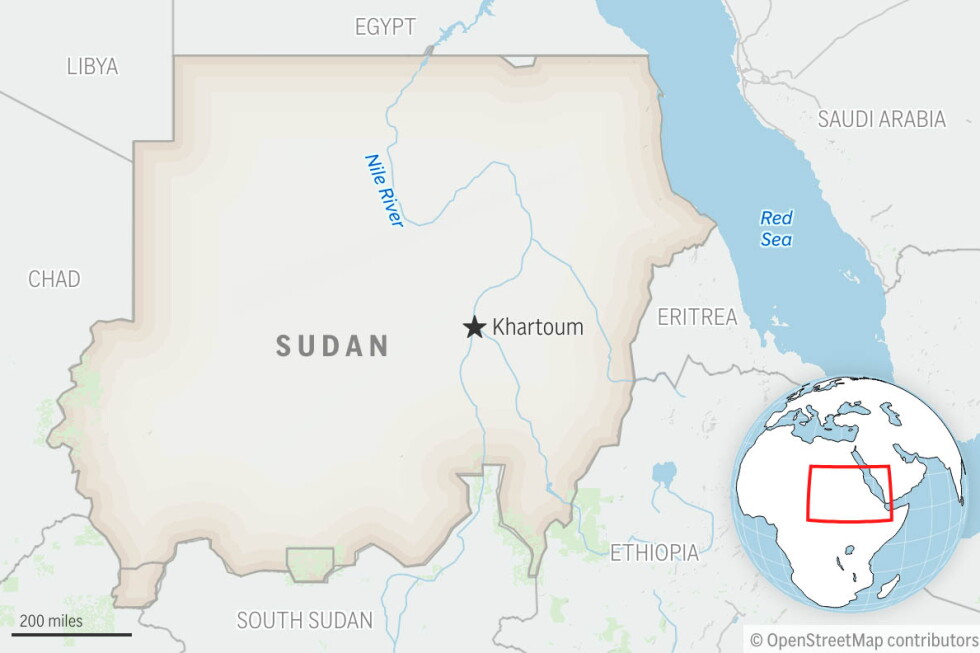
As Sudan’s brutal civil war enters its fourth year, a build-up of paramilitary forces around the key central city of El-Obeid has sparked urgent global warnings that the region could face a new wave of mass civilian violence, echoing the catastrophic 2024 attack on El Fasher.
In an official statement, a spokesperson for United Nations Secretary-General António Guterres emphasized the global community’s commitment to preventing a repeat of El Fasher’s atrocities in El-Obeid. Last year, when the Rapid Support Forces (RSF) captured El Fasher after a three-day assault, more than 6,000 people were killed. UN investigators have concluded the attack carried all the hallmarks of genocide.
The UN Security Council has formally expressed alarm over confirmed reports of substantial RSF troop and weapons reinforcements deployed across areas surrounding El-Obeid in North Kordofan. The United States, United Kingdom and multiple European nations have also issued joint warnings of sharply escalating risks of large-scale atrocities against the city’s half-million residents.
Strategic analysts who spoke to the Associated Press note that RSF deployments around the city are clear indicators the paramilitary group is preparing a full-scale offensive to retake control of El-Obeid, a critical stronghold that the Sudanese Armed Forces (SAF) broke out from a more than year-long RSF siege in early 2024. The RSF has not issued any immediate response to requests for comment on the troop build-up.
El-Obeid holds unique strategic importance for both warring parties in Sudan’s ongoing conflict. Situated along Sudan’s primary east-west highway that connects outlying regions to the Nile Valley and the capital Khartoum, the city hosts a large military air base and an infantry division, making it a key logistical hub for the SAF’s campaign against the RSF.
Nathaniel Raymond, executive director of the Humanitarian Research Lab at the Yale School of Public Health, explained that El-Obeid’s significance extends beyond military strategy. “El Obeid is important beyond even the strategic implications because it shows what happens when you have two forces that are highly depleted attempting to gain advantage on the other in high proximity,” he said. If the RSF seizes control of the city, it would open a clear path for the group to threaten Khartoum and Omdurman — territories the SAF retook last year — trigger widespread civilian chaos, and block humanitarian organizations from resuming operations in the capital region, Raymond added.
Unlike the 2024 assault on El Fasher, which followed an 18-month siege and was driven largely by ethnically motivated violence, experts frame a potential El-Obeid offensive as a tactical rather than explicitly genocidal move. Still, Raymond warned that even a tactical takeover would likely lead to widespread reprisal killings of civilians perceived to be allied with the SAF.
Ali Mahmoud Ali, a Sudan researcher for the Armed Conflict Location & Event Data Project (ACLED), noted that while the RSF is capable of cutting off El-Obeid from multiple directions, maintaining a full blockade would require the paramilitary to commit significant manpower, armored vehicles and military equipment that it can ill afford. Even so, if the RSF manages to capture and hold the city, the humanitarian situation “could deteriorate rapidly,” Ali warned.
For months, El-Obeid’s civilian population has already lived under the constant threat of RSF drone strikes, which have destroyed critical civilian infrastructure including power stations, residential neighborhoods, bridges and key supply routes, according to UN documentation. Taghreed al-Rashid, a 35-year-old El-Obeid resident reached by phone, said while she feels some security from the presence of SAF troops, she grows increasingly anxious over targeted attacks on residential areas and public markets. A recent drone strike on a local power plant triggered a citywide water crisis, forcing al-Rashid to pay $5 per barrel of clean water — a crippling expense for most residents.
“Despite everything we’re going through, we’re determined to stay in the city because forced displacement is an even harder struggle,” al-Rashid said.
ACLED data confirms that drone-related fatalities have skyrocketed across the Kordofan region in 2025, with at least 2,670 total deaths (including both combatants and civilians) recorded this year — a 600% increase in drone-related deaths and an 81% increase in drone attacks compared to 2024. Another resident, Magdy Abdou, said he is still able to move to local mosques and markets without immediate risk, but lives in constant fear of future strikes on critical infrastructure. A takeover of El-Obeid would also allow the RSF to launch drone strikes from much closer range, expanding their striking capacity across SAF-held territory.
Ravina Shamdasani, a spokesperson for the UN Office of the High Commissioner for Human Rights, said ongoing attacks on infrastructure have left El-Obeid’s residents facing severe shortages of food, fuel, clean water, healthcare and transportation. “Many civilians are trapped. Those who are able to flee are doing so. The imminent offensive must be halted, and civilians enabled to safely leave the city,” she said.
Analysts remain divided over the RSF’s likelihood of capturing the city. Raymond argues that the RSF’s fighting capacity has been significantly eroded by sustained SAF defenses and intertribal conflict, leaving the group short on personnel to repel an expected SAF counterattack. However, Ali notes that the RSF has now deployed air defense systems in Abu Zabad, West Kordofan, which could serve as a logistical hub for operations targeting El-Obeid and the nearby city of Dilling, likely intensifying clashes across the region. Since the SAF broke the initial siege last year, the RSF has launched repeated attempts to reimpose a blockade from multiple directions.
The SAF also maintains its own drone capabilities. An anonymous SAF official, speaking on condition of anonymity because he was not authorized to brief media, confirmed that recent SAF drone strikes destroyed an entire RSF battalion and more than 50 armored vehicles in West Kordofan, halting the group’s advance toward North Kordofan and El-Obeid. The official added that the military has developed a coordinated plan to defend El-Obeid’s airspace from incoming RSF drones.
Federico Donelli, an associate professor of international relations at the University of Trieste, noted that the SAF has prioritized the defense of El-Obeid and the critical east-west corridor to the Nile Valley since last year, reflecting the military’s focus on holding key supply and transport routes. “Overall, the SAF appears capable of mounting an organized initial defense, but the key open question is whether it can sustain it against a faster, better-equipped RSF push,” Donelli said.