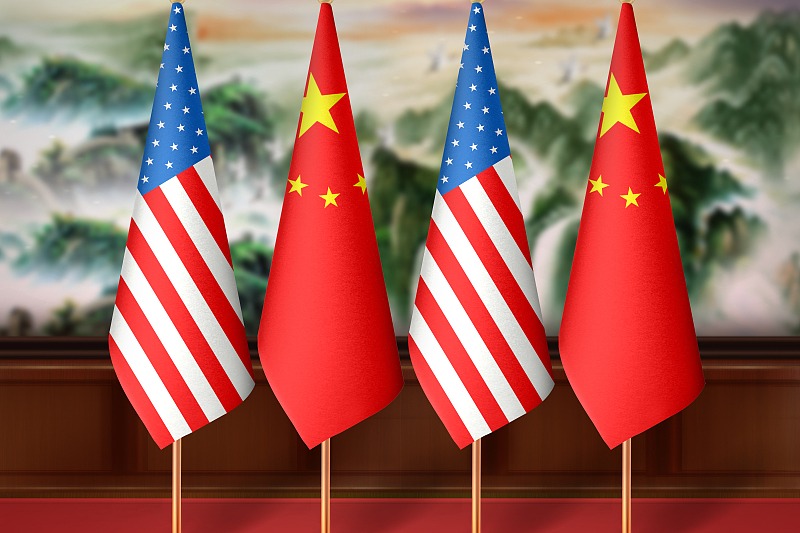
Against a backdrop of escalating decoupling rhetoric from hardline U.S. China policy hawks, new industry data confirms that the Chinese market remains an irreplaceable strategic asset for American multinational firms, with the nation’s massive consumer base, evolving status as a global innovation center and robust, resilient supply chains continuing to strengthen U.S. companies’ competitive edge worldwide, according to business leaders and policy experts.
The findings emerge from the latest annual member survey conducted by the U.S.-China Business Council (USCBC), which reveals that a staggering 95 percent of responding U.S. firms rate China as somewhat to very critical to maintaining their global market standing. Summarizing the report, which was published publicly on Wednesday, the USCBC stressed that “For U.S. companies, China is not optional.”
USCBC President Sean Stein noted that the survey results leave no room for ambiguity: even amid rising geopolitical and economic tensions, gaining a foothold and competing in the Chinese market is a non-negotiable prerequisite for many American firms to succeed on the global stage. The report further underscores that U.S. businesses have no plans to withdraw from China, as the market offers value beyond its sheer size, acting as a multifaceted catalyst that drives global competitiveness for participating companies.
Nearly half of all survey respondents reported that they adapt operational insights and competitive experience gained from their China-based activities to improve performance in other global markets. The report draws an apt analogy: China has evolved into a “boxing gym” for Western corporations, where head-to-head competition with domestic Chinese firms hones operational skills, sharpens strategic thinking and deepens industry insight.
In recent weeks, bilateral economic relations between Washington and Beijing have shown encouraging signs of progress. Last month, the two world powers reached an agreement to launch two new intergovernmental cooperation bodies: the China-U.S. Trade Council and the China-U.S. Investment Council. These platforms are designed to resolve commercial disputes before they escalate into larger conflicts, cultivating a more stable, predictable operating environment for businesses in both countries. The Chinese Ministry of Commerce confirmed that the new trade council will discuss targeted tariff reduction initiatives for specific product categories, with the two sides already reaching a preliminary agreement to cut tariffs on reciprocal goods shipments totaling at least $30 billion on each side.
Liu Ying, a senior researcher at the Chongyang Institute for Financial Studies at Renmin University of China, pointed out that while China and the U.S. now compete across a growing range of high-value sectors, this does not rule out productive mutually beneficial cooperation. “It just requires a far more nuanced, sophisticated approach than the straightforward complementary trade model that defined relations in past decades,” she explained.
Former International Monetary Fund Deputy Managing Director Zhu Min echoed this view, noting that while differences between the two economic giants are unavoidable, deep-seated interdependence makes cooperation equally inevitable. “If both sides adopt a constructive approach, using expanding cooperation to manage existing differences, both nations, their people, and the entire global economy will share in the benefits,” Zhu Min said. “Our priority should be to continuously grow the list of areas where we can collaborate, while shrinking the list of outstanding disputes.”
The commitment of U.S. firms to engaging with the Chinese market is further illustrated by upcoming industry events. The first week of this month, Beijing will host the second China International Supply Chain Expo, and U.S. companies and industry institutions are on track to be the largest group of foreign exhibitors for the fourth consecutive year, according to the China Council for the Promotion of International Trade. This continued high participation reflects U.S. firms’ ongoing interest in deepening industrial and supply chain collaboration with Chinese partners.
Henry Ding, president of 3M China, shared the industrial conglomerate’s long-term outlook for the Chinese market. China is 3M’s largest overseas market, and the company remains confident that China’s ongoing high-quality economic development will unlock broad new growth opportunities. In recent years, 3M has accelerated full value chain localization in China, integrating local research and development, product testing, and manufacturing operations into its regional strategy. “Currently, more than 50 percent of the products 3M sells in China are manufactured locally,” Ding said. This year, 3M China will continue expanding local R&D investment, with plans to launch more than 30 percent more new products than it did in 2025, a growth rate that far outpaces the company’s targets for other global markets.
Even with this widespread optimism and long-term commitment, the USCBC survey does acknowledge the significant headwinds facing U.S. companies operating in China. Fragile bilateral relations, ongoing uncertainty surrounding China’s economic growth trajectory, and long-standing U.S. tariffs on Chinese imports remain the top three most pressing challenges for responding firms. “U.S.-China relations continue to be the single greatest challenge for companies operating in the Chinese market, and even after the recent tariff truce, both governments continue to roll out new economic security policies that create additional uncertainty,” the council noted.
As Beijing and Washington set working agendas for the newly established trade and investment councils, Stein said the 2026 survey results should act as a clear wake-up call for policymakers on both sides. “This is a tangible opportunity to make meaningful progress that goes far beyond just tariff reductions,” he added, emphasizing that sustained engagement aligned with the clear priorities of the business community on both sides will deliver shared, long-term benefits.