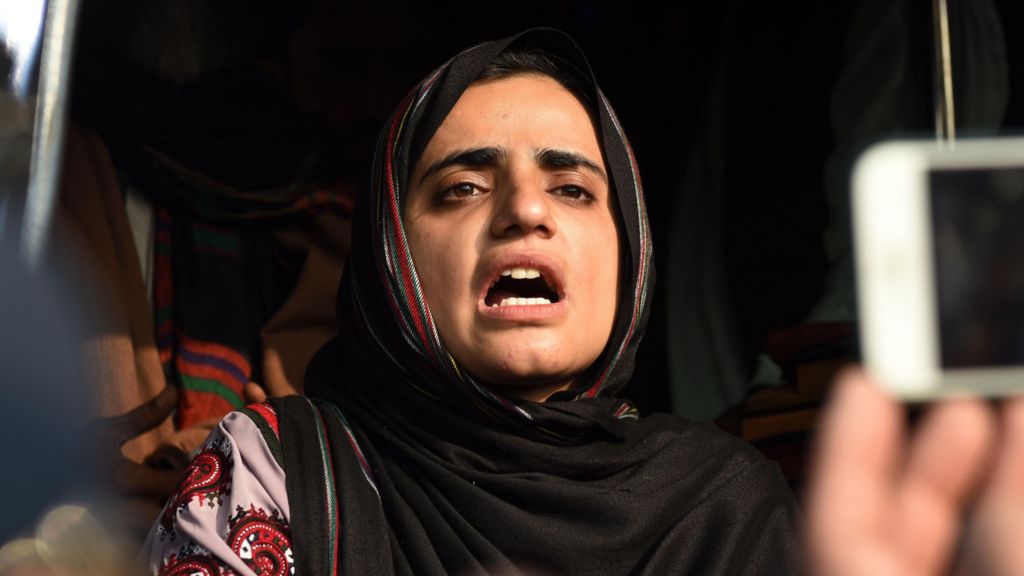
A prominent Pakistani human rights defender who has spent more than a decade advocating for victims of enforced disappearances in the restive southwestern province of Balochistan has received a life sentence in connection with the 2024 killing of a paramilitary soldier during a mass protest. Mahrang Baloch, head of the Balochistan Unity Committee (BYC), was found guilty of murder and terrorism charges alongside BYC activist Sibghatullah, in a ruling that has drawn sharp condemnation from human rights groups and global activists over allegations of procedural bias.
Prosecutors have alleged that the two activists incited a crowd of protesters to launch a fatal attack on Federal Constabulary soldier Shabbir Ahmed during the rally held in the strategic port city of Gwadar. A senior security official claimed that Baloch delivered an inflammatory speech that spurred 30 to 40 attendees to attack a military vehicle with stones and sticks, leading to Ahmed being separated from his unit and beaten to death by the crowd. However, both Baloch and Sibghatullah have vehemently denied all accusations, and joined their full legal team in boycotting the entire trial proceedings to protest what they describe as unfair treatment.
The conviction was handed down by an anti-terrorism court based in Quetta, Balochistan’s capital. In its ruling, the court stated that the two BYC leaders participated in an illegal gathering organized by the group and shared common intent in the killing of the law enforcement official. Alongside the life prison term, the court ordered the pair to pay a fine of 200,000 Pakistani rupees, equivalent to roughly $719 or £543, as compensation to Ahmed’s surviving family. Local media reports confirm that Baloch and Sibghatullah have already been detained in custody for two years while facing a broad range of unrelated charges.
The verdict has quickly drawn widespread criticism from domestic and international observers. The Human Rights Commission of Pakistan, the country’s leading independent human rights body, has called for an immediate judicial review of the ruling, arguing that the Pakistani state has repeatedly equated legitimate advocacy for fundamental civil rights with violent extremism, producing lopsided and biased administrative and judicial outcomes.
Nadia Baloch, Mahrang Baloch’s sister and a member of her legal team, condemned the ruling as unlawful, saying the defendants were systematically denied access to due process. She and the legal team have described the proceeding as a ruling from a “faceless court,” noting that defense attorneys were barred from conducting proper cross-examination of prosecution witnesses, who testified against the defendants via pre-recorded video link.
The verdict also drew rebuke from high-profile global activist Greta Thunberg, who took to social media to denounce the trial as a blatant “mockery of justice” conducted in complete secrecy. Thunberg accused the Pakistani government of deliberately criminalizing peaceful political dissent against state policies in Balochistan.
In response to the criticism, a spokesperson for the Balochistan provincial government told the Associated Press that prosecutors held “undeniable evidence” to support the convictions, and rejected claims that the case was politically motivated.
Mahrang Baloch, who was named one of the BBC’s 100 Women of 2024 for her human rights work, first entered activism after her own father was allegedly abducted by Pakistani security service officers in 2009. His tortured body was recovered two years after his disappearance. In late 2023, she made global headlines when she led hundreds of female family members of missing Baloch people on a 1,600-kilometer, or 1,000-mile, march from Balochistan to Islamabad, the national capital, demanding accountability for the decades-long crisis of enforced disappearances in the province.
The BYC, the grassroots organization Baloch leads, campaigns for an end to enforced disappearances and extrajudicial killings in Balochistan, a region that has seen a decades-long push for greater political autonomy from the Pakistani federal government. The BYC has repeatedly denied Pakistani government claims that the group maintains ties to armed Baloch separatist militant groups.