The ongoing conflict in Iran and subsequent disruptions to global energy flows through the Strait of Hormuz have triggered a rapid shift in the global electric vehicle landscape, creating an unprecedented opportunity for Chinese automakers to expand their footprint across developing economies in Asia and Africa. As skyrocketing fossil fuel prices push cash-strapped drivers and cash-strapped governments to embrace vehicle electrification, the explosive growth of EV imports has exposed a critical bottleneck: a widespread lack of matching charging infrastructure.
Blockades of the Strait of Hormuz, a strategic chokepoint through which roughly 20% of the world’s daily crude oil and liquified natural gas shipments pass, sent energy prices soaring across key importing regions. The supply shock first hit major Asian fuel importers, then spread quickly to African markets, accelerating a transition to electric mobility that was already gaining traction across the developing world.
Trade data underscores the speed of this shift. A recent analysis of Chinese customs data by energy think tank Ember shows that China’s global EV exports hit an all-time high of $9.4 billion in April alone. Shipments to markets including Australia, Brazil, Southeast Asia and East Africa have surged at double-digit rates. Official data from the Chinese Association of Automobile Manufacturers adds that China exported roughly 435,000 passenger electric vehicles and plug-in hybrids in May, more than doubling the volume recorded in the same month one year prior.
For individual drivers across developing Asia and Africa, the switch to EVs is being driven by immediate household budget pressures. In these regions, transport consistently ranks among the largest recurring expenses for average families. Limited public transit networks, long daily commutes, and widespread reliance on private vehicles leave households extremely vulnerable to volatile global fuel prices. A 2024 study from Stellenbosch University in South Africa’s Western Cape province found that transportation alone accounts for nearly 20% of total household spending in the country. For gig workers like Nguyen Thien Bao, a delivery and ride-hail driver in Hanoi, Vietnam, the cost savings are transformative. “Before, so much of my income went into fuel,” he explained. “Now, I can actually save some money.”
Governments across the developing world are also prioritizing the EV transition to cut ballooning oil import costs and reduce the heavy fiscal burden of fuel subsidies. Laos has gone as far as banning imports of new fossil fuel-powered vehicles through 2026 to speed up the shift, while Ethiopia has enacted a similar ban on non-EV imports to cut energy dependency. Data from China’s Commerce Ministry shows that African imports of Chinese EVs reached roughly 44,000 units in 2025, marking a 130% year-over-year jump. The International Energy Agency (IEA) projects that global electric car sales will continue to climb through 2026, hitting 23 million units and accounting for nearly 30% of all new cars sold worldwide. Up from one in four new cars sold globally last year, this growth is heavily supported by Chinese manufacturers, which currently supply around 60% of all electric vehicles sold worldwide.
Major Chinese automakers are already acting on this momentum. “In the next five years, we will accelerate our overseas expansion,” Jerry Gan, CEO of leading Chinese automaker Geely Auto, announced at a company event in March, as the group expands its EV footprint across Southeast Asia and other emerging regions. While Chinese manufacturers have dominated growth in developing markets, regional players are also reaping benefits: Vietnam’s VinFast reported a 42% year-over-year increase in first-quarter revenue, driven largely by rising EV demand across Southeast Asia.
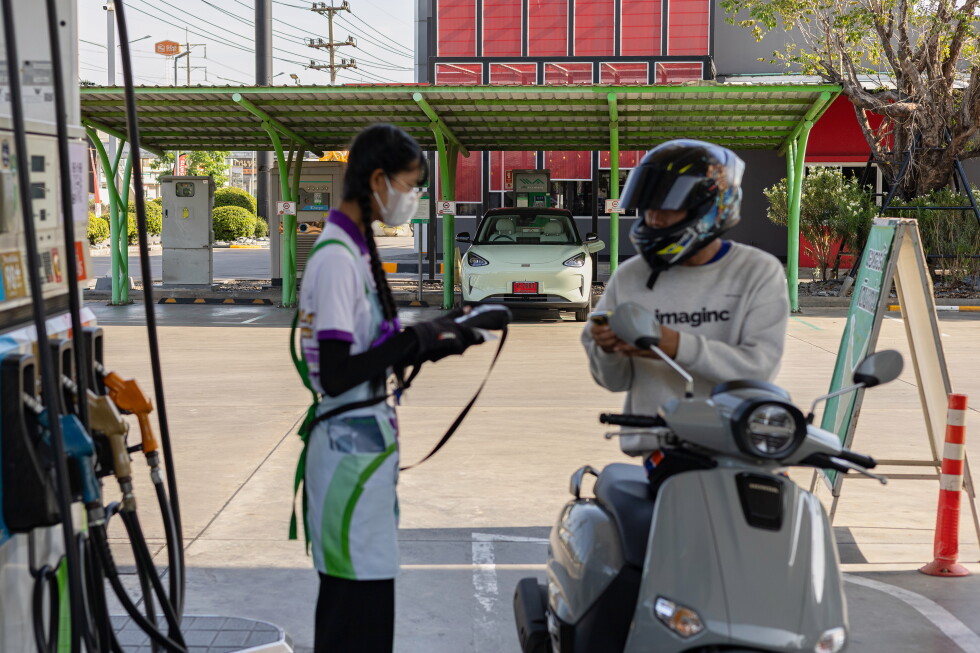
Despite the explosive growth of EV adoption, this rapid shift has outpaced the buildout of required charging infrastructure, creating what analysts describe as a classic “chicken-and-egg problem.” Without enough charging stations, many drivers remain hesitant to switch to fully electric vehicles, but low EV adoption rates do not create enough demand to justify large-scale infrastructure investment. Data from across the region highlights this gap: Thailand currently counts roughly 4,600 public charging locations serving more than 424,000 battery EVs and plug-in hybrids, working out to one charging location for every 92 vehicles. For ride-hail drivers like Yutthana Samranwong in northern Thailand’s Phitsanulok province, securing an open public charging slot online is often an unpredictable gamble. “It’s a bit of a headache,” he said, noting that the strain on Bangkok’s charging networks has even led some drivers to consider returning to gasoline-powered cars.
The gap is even more pronounced in lower-income African markets. As of mid-2025, Ethiopia, which has banned non-EV imports to speed up electrification, only had around a dozen public charging stations operational, despite government estimates showing more than 1,170 stations are needed to meet current demand. Forty additional stations are currently under construction in the capital Addis Ababa. “In developing markets, affordability can accelerate the shift, but the pace of adoption will still depend heavily on infrastructure, power reliability and use case,” noted Chris Liu, a technology analyst with research and advisory firm Omdia.
To resolve this bottleneck, many emerging economies are turning to state-owned utilities to lead charging network buildout, a model analysts say could be replicated across other developing regions to speed the transition away from fossil fuels. Indonesia already has more than 4,500 public charging stations deployed by its state-owned power utility PLN. Across Africa, where only around 2,000 public EV charging stations exist today (with South Africa holding the largest share), state utilities are stepping in: Kenya Power, the country’s state-controlled electricity provider, plans to construct 44 new charging stations within the next 12 months.
“Utilities are recognizing that electric mobility will become a meaningful source of future electricity demand,” explained Ndia Magadagela, co-founder and CEO of South African commercial EV leasing firm Everlectric. Analysts note that state utilities are uniquely positioned to lead this work, as they are already integrated into national grid planning, electricity pricing and distribution infrastructure. Large Chinese automakers, by contrast, typically have little incentive to invest heavily in charging networks outside of their home market, leaving a gap that public entities can fill.
“At that stage, government support for infrastructure could help accelerate adoption,” explained Paul Gong, head of UBS’ China automotive industry research, echoing the broader consensus that public investment is the most viable path to breaking the current infrastructure deadlock and unlocking continued growth of electric mobility across the developing world.