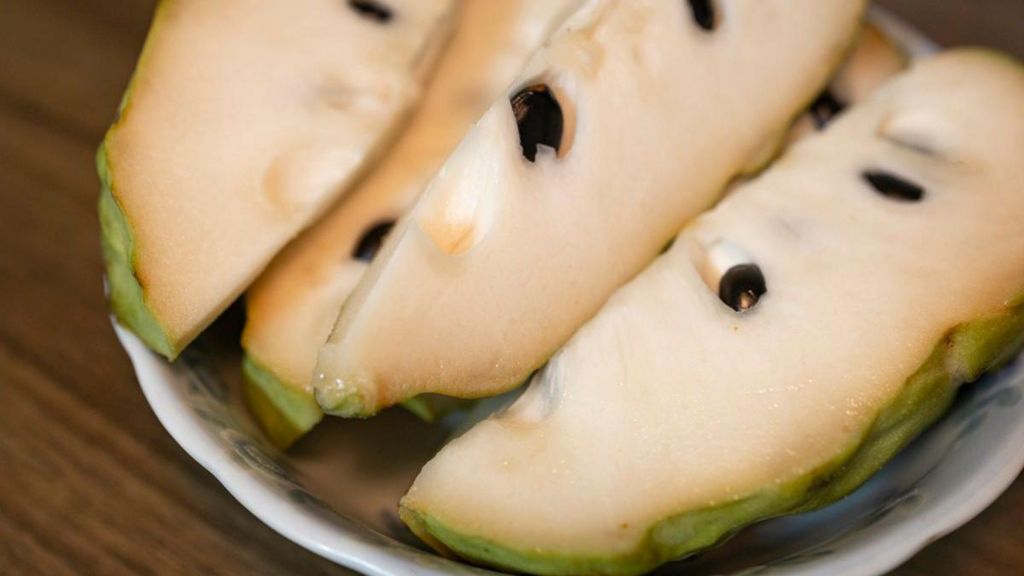
A uniquely textured, heart-shaped tropical fruit has emerged as the newest point of friction between Beijing and Taipei, after Taiwan’s top agricultural regulator warned local producers against Beijing’s newly announced plan to ramp up purchases of the specialty crop. The fruit in question, the atemoya, is a sweet hybrid cross between two distinct custard apple varieties, prized for its creamy, soft white flesh and grown almost exclusively in Taiwan’s eastern Taitung County, where it has become a signature agricultural product.
China has long served as the largest export market for Taiwanese atemoya, and earlier this month, Chinese authorities and trade groups announced a new commitment to increase purchases of the fruit. But in an official press release issued Saturday, Taiwan’s Ministry of Agriculture framed the expanded import pledge as part of what it calls Beijing’s long-running ‘raise, trap, kill’ economic strategy, a tactic that the ministry argues first builds dependency among Taiwanese farmers on the Chinese market before sudden policy shifts leave producers grappling with collapsed demand and massive financial losses.
Cross-Strait relations have grown increasingly strained in recent years. Beijing claims the self-ruled island of Taiwan as part of its sovereign territory, has refused to rule out military force to assert control, and has ramped up large-scale military exercises near Taiwan’s coasts, including simulated full blockades of the island. Beyond military pressure, global observers have noted that Beijing has increasingly turned to non-military, economic tactics to pressure Taiwan’s government – and fresh fruit has repeatedly become a key tool in this strategy.
The 2021 Chinese import ban on Taiwanese pineapples serves as a prominent example. The ban, which came without advanced warning, devastated the livelihoods of thousands of Taiwanese pineapple farmers and triggered a massive domestic ‘buy pineapple’ movement in Taiwan, widely seen as a grassroots response to what residents framed as economic coercion from Beijing. Now, Taiwanese agricultural authorities warn the same pattern is repeating with atemoya.
According to the Taiwanese Ministry of Agriculture’s statement, Beijing has already cycled through disruptive shifts in atemoya trade policy over the past four years: it first fully suspended imports of Taiwanese atemoya in 2021 over unsubstantiated pest concerns, only partially resumed trade in 2023, then imposed steep new tariffs on the fruit in 2024. These inconsistent policy changes have created massive volatility for Taiwan’s atemoya industry, exposing smallholder farmers to extreme financial risk, the ministry added. It also noted that China has rapidly expanded its own domestic atemoya cultivation in recent years, creating a long-term structural threat to Taiwan’s export-dependent sector.
The current controversy over atemoya trade traces back to an industry forum held earlier this month in Xiamen, a Chinese coastal city on the edge of the Taiwan Strait. At the gathering, Chinese firms announced expanded purchase commitments for multiple Taiwanese agricultural exports, including atemoya, fish and tea. The event drew attendance from Taiwanese business leaders and opposition politicians, despite an official ban on participation from Taiwan’s ruling central government. Following the forum, Taiwan’s Mainland Affairs Council, the agency that oversees cross-Strait policy, announced that any Taiwanese officials who violated the participation ban could face formal investigation.
In response to the controversy, Taiwan’s Ministry of Agriculture said it would prioritize supporting sustainable agricultural development and stable farm incomes, and is guiding the atemoya industry to diversify its market outlets and product lines, including developing value-added products such as frozen atemoya chunks, fruit puree and fruit wine.
But opposition politicians from Taiwan’s Kuomintang party, which traditionally favors closer cross-Strait trade ties, have pushed back against the government’s warnings, arguing that Taipei is unnecessarily politicizing the atemoya industry in a move that will ultimately harm the farmers it claims to protect. Taipei Mayor Chiang Wan-an, a prominent Kuomintang leader, went so far as to accuse the Mainland Affairs Council of using the trade dispute to ‘bully and oppress’ Taiwanese farmers. Chiang even compared the fruit to Taiwan’s most iconic industrial success story, calling atemoya the ‘TSMC of the fruit world’, arguing that ‘There is not a country in the world that can produce a fruit as delicious and special as Taiwan’s atemoya.’