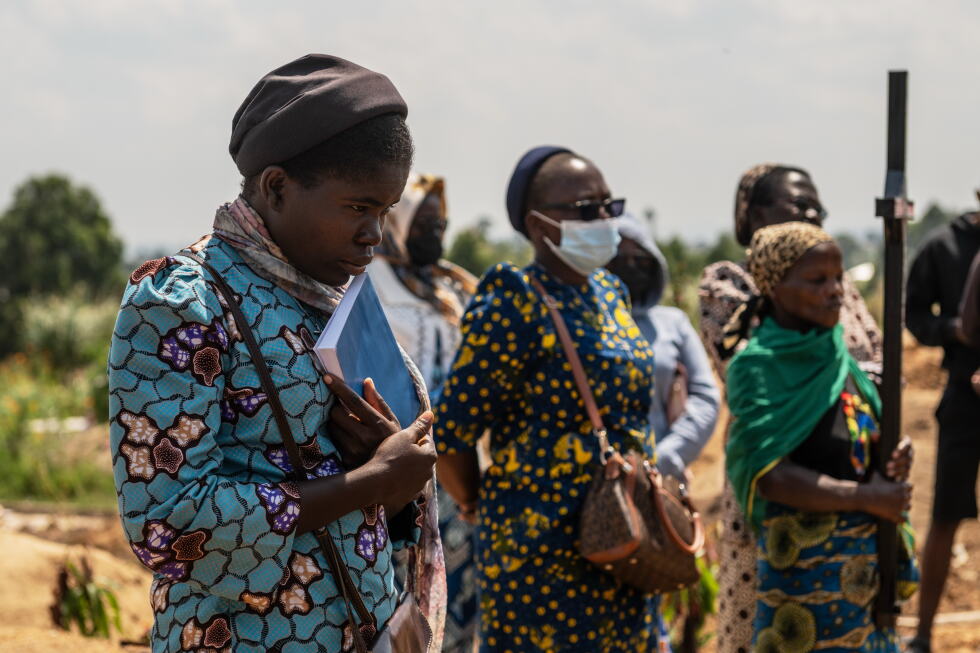
BUNIA, Democratic Republic of Congo – On a somber Friday morning in eastern Congo, hundreds of mourners gathered to lay to rest a six-month-old girl, the latest fatality from the country’s escalating Ebola outbreak and the third child from a local orphanage to lose their life to the virus in recent weeks. As the small pine coffin was carried to its final resting place, attendees held small wooden crosses and stood several meters apart to reduce infection risk, while only trained health workers clad in full personal protective equipment (PPE) – including face masks, thick gloves, and fluid-resistant gowns – were permitted to lower the casket. A Catholic priest led the brief funeral service, offering prayers for the infant and comfort to grieving community members.
“It is a profound sadness to lose one of our own, a child of this congregation,” said Father Innocent Ndogo, opening the service. “As we have always believed, the Lord gives, and the Lord takes away.”
The ongoing outbreak, caused by the rare Bundibugyo strain of Ebola, is centered in Congo’s Ituri region, which has recorded more than 90% of all confirmed cases to date. Efforts to contain the spread have been severely hampered by repeated community clashes with response teams, rooted in longstanding distrust of public health measures and anger over altered burial practices that are required to stop transmission. The outbreak response has also faced criticism for its occasional militarization, which has further alienated local populations.
Unlike the more common Zaire strain of Ebola – which has driven 16 of Congo’s previous outbreaks and has an approved, effective vaccine – the Bundibugyo strain has no licensed treatment or preventative vaccine. For many frontline workers, even basic PPE remains in short supply, leaving them exposed to the virus as they carry out critical contact tracing and safe burial work. Early in the outbreak, diagnostic testing for Bundibugyo was not widely available, meaning cases were misidentified as the more common Zaire strain, allowing the virus to spread undetected for weeks – a gap that public health officials now cite as a key reason for the outbreak’s current scale.
During an official visit to Bunia on the same day as the funeral, Congolese Health Minister Roger Kamba released the latest official case count, confirming 933 confirmed infections and 245 deaths across affected regions. To expand access to care, Kamba announced that all healthcare facilities in Ituri would offer free Ebola-related treatment moving forward, and that hazard pay bonuses for frontline healthcare workers would be doubled to retain critical staff during the crisis.
Africa Centres for Disease Control (Africa CDC) updated their contact tracing data a day prior, reporting that more than 35,000 people who may have been exposed to the virus are currently being monitored, one of the largest contact tracing operations the continent has seen in recent years. While the current outbreak has caused hundreds of deaths, it remains far less severe than the 2014 West African Ebola epidemic that killed more than 11,000 people across multiple countries.
Alex Lock, communications officer at the International Federation of Red Cross and Red Crescent Societies, which is supporting the outbreak response, warned against global indifference to the crisis, noting the human cost of each new case. “She was a baby. She had her whole life ahead of her. Unfortunately, she was taken by the disease, a disease that, as you know, is transmitted from one person to another,” Lock said, emphasizing the urgent need for additional global support.
Though the outbreak is concentrated in Ituri, cases have now been recorded in neighboring North Kivu and South Kivu provinces, and the virus has crossed the international border into Uganda. Ugandan health authorities have confirmed 19 cases and two deaths linked to the Congo outbreak, prompting regional public health alerts. Donors and global health organizations have begun deploying additional resources, but many response teams warn that more support is urgently needed to stop the outbreak from spreading further across East Africa.