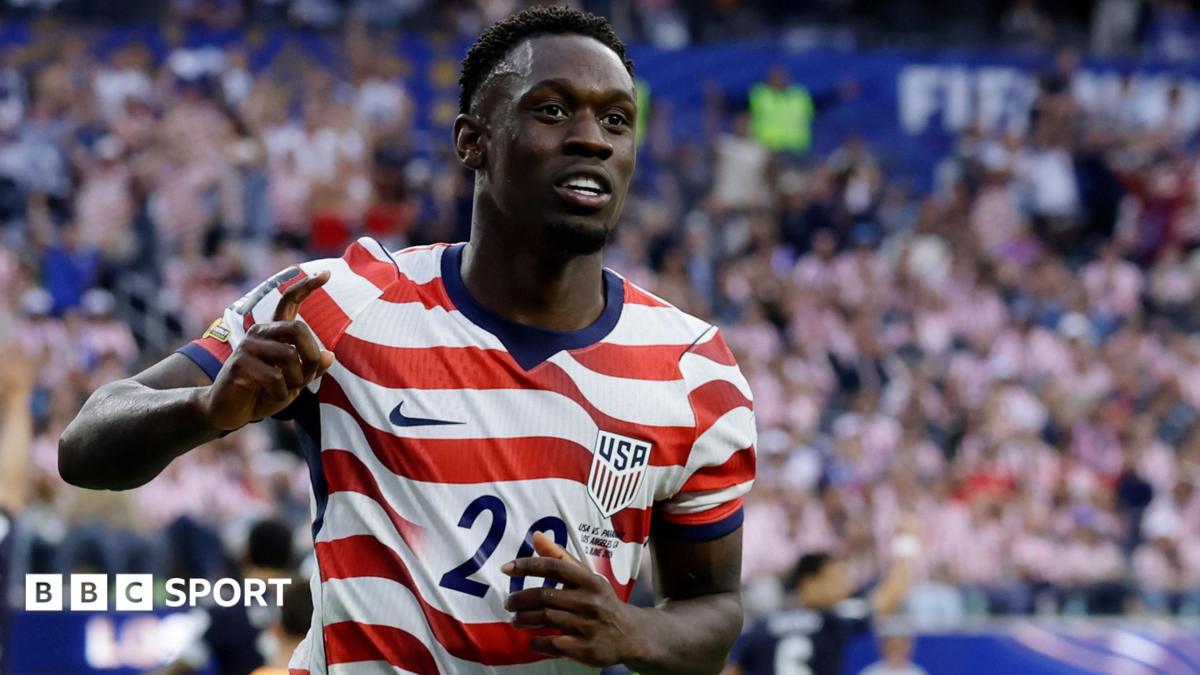
As the co-host United States men’s national soccer team kicked off their 2026 FIFA World Cup campaign with a win over Paraguay, the name on every fan’s lips was Folarin Balogun. The 24-year-old striker announced his arrival on the world’s biggest football stage with two stunning opening-game goals, instantly cementing his status as the team’s most dangerous attacking weapon. But beyond the highlight-reel finishes, Balogun’s place on the roster shines a stark spotlight on one of America’s most divisive political fights: the battle over birthright citizenship, a clash that will soon be decided by the U.S. Supreme Court just weeks from now.
Balogun’s path to representing the United States is one of unexpected chance. Born to Nigerian parents living in London, his birth came down to a random fateful twist: during a 2001 summer trip to New York, airline staff refused to let his heavily pregnant mother board the return flight to the U.K. On July 3, 2001, Balogun was born in Brooklyn, New York. Under the 14th Amendment of the U.S. Constitution, that automatic birth on U.S. soil granted him full U.S. citizenship at birth. It is a status he would not be guaranteed under former President Donald Trump’s hardline immigration executive order, which seeks to strip automatic citizenship from children born in the U.S. to parents who are in the country illegally or holding temporary visas such as tourist visas.
The irony of Balogun’s situation is not lost on observers: the U.S. national team’s breakout World Cup star is exactly the type of person Trump’s policy would bar from citizenship. As the team prepares for their second group stage match against Australia in Seattle on Friday at 20:00 BST, the ongoing national debate over immigration and citizenship hangs over this World Cup co-host’s campaign.
A product of Arsenal’s famed youth academy, Balogun had his pick of senior national teams: he could have committed to England, where he grew up and represented the nation at youth level, or Nigeria, his parents’ home country. Until three years ago, a move to the U.S. senior side was far from guaranteed. Balogun was a key part of England’s Under-21 setup, notching seven goals in 13 appearances ahead of the 2023 UEFA Under-21 European Championship. But a breakout 2022-23 season on loan at French side Reims, which earned him a £35 million permanent transfer to Ligue 1’s Monaco, caught the attention of U.S. Soccer officials. With a path to the England senior side unclear, and a groundswell of public support from U.S. fans pushing for him to switch allegiances, U.S. Soccer launched a full court press to recruit him: a reported secret meeting that leaked on social media, invitations to NBA games and New York Yankees training sessions, a trip to Florida, and outreach from senior U.S. internationals who wined and dined him to convince him to make the switch.
Balogun has made clear that fan support was the deciding factor in his choice to represent the Stars and Stripes. “When I committed, and throughout the whole cycle, and the whole journey to me being at this point, I’ve always said the fans gave me so much motivation and showed me so much support,” he said ahead of the Australia match. “For me, the most important thing has always been to ability to repay that. I just want to continue to show the fans I made the right decision.”
Teammates and former players have already been quick to praise Balogun’s impact. AC Milan star Christian Pulisic summed up the general sentiment after the Paraguay win, saying the U.S. was “really lucky” to have the striker. “The kid’s insane,” Pulisic said. “He’s lethal right now in front of goal. Let’s just hope it keeps going like this.” Former U.S. international Kenny Cooper, now a club ambassador at FC Dallas, believes Balogun can help lead the team on a historic deep run at this home World Cup. “He’s obviously a really special talent and he showed that with two exceptional goals,” Cooper told the BBC. “He has been so impressive. I think there’s just so much confidence that I’m sure the players have in him playing with them, and us, his fans, have in him.”
Fans echo that excitement. Tommy Marcos, president of the New York chapter of the American Outlaws — the largest U.S. national team supporters group — who attended a 2,000-strong watch party for the Paraguay match in Frisco, Texas, said supporters have waited decades for a striker of Balogun’s caliber. “We haven’t had that type of player — a top-five league striker that you can just put in there and know he’s going to score,” he said. “That’s pretty hard to do in the current football environment and we’re lucky to have him.”
To date, Balogun has scored 11 goals in 28 appearances for the U.S. national team, putting him on a rapid pace to become one of the program’s all-time top goalscorers. After just one World Cup game, he already has two goals — one-third of the total that won the Golden Boot in 10 of the last 12 World Cup tournaments. While he is still not a household name across much of the U.S., he is well on his way to becoming a new talisman for American soccer.
While the U.S. team has sought to keep politics separate from on-pitch performance, the connection between Balogun’s citizenship and the ongoing Supreme Court case is unavoidable. If the court upholds Trump’s executive order, legal experts say it would throw the citizenship status of hundreds of thousands of people like Balogun into uncertainty, even if the administration has promised not to retroactively revoke citizenship. “Trump’s promises and guarantees often are not worth very much, but even if he were to stick to that resolution, a future administration might not,” explained Ilya Somin, a George Mason University law professor and constitutional studies chair at the Cato Institute. Somin noted that even without retroactive action, the legal argument behind the order would leave citizenship status for many people hanging over their heads indefinitely.
Still, Somin predicts the Supreme Court — which holds a 6-3 conservative majority — will not rule in favor of the Trump administration, pointing to skeptical questioning from justices during oral arguments in April. When administration lawyers argued that modern international travel requires a reinterpretation of the Constitution’s citizenship clause, Chief Justice John Roberts famously quiped: “It’s a new world. It’s the same constitution.”
The timing of the 2026 World Cup, the upcoming Supreme Court ruling, and the United States’ 250th anniversary celebration has created a unique confluence of events that holds a mirror up to modern American division on immigration. An April Reuters poll found that a majority of Americans support retaining automatic birthright citizenship for all children born in the U.S., but opinion is deeply split along party lines: just 9% of Democrats support ending birthright citizenship, compared to 62% of Republicans.
Balogun is far from the only player on the current U.S. roster with a mixed transnational identity. Marcos notes that this diversity is nothing new for U.S. soccer, and the team’s varied backgrounds are exactly what make it a reflection of America’s identity as a melting pot. “I think that’s what makes the team really unique in terms of the football landscape,” he said. “But it’s also what makes it special and it makes it very American.”