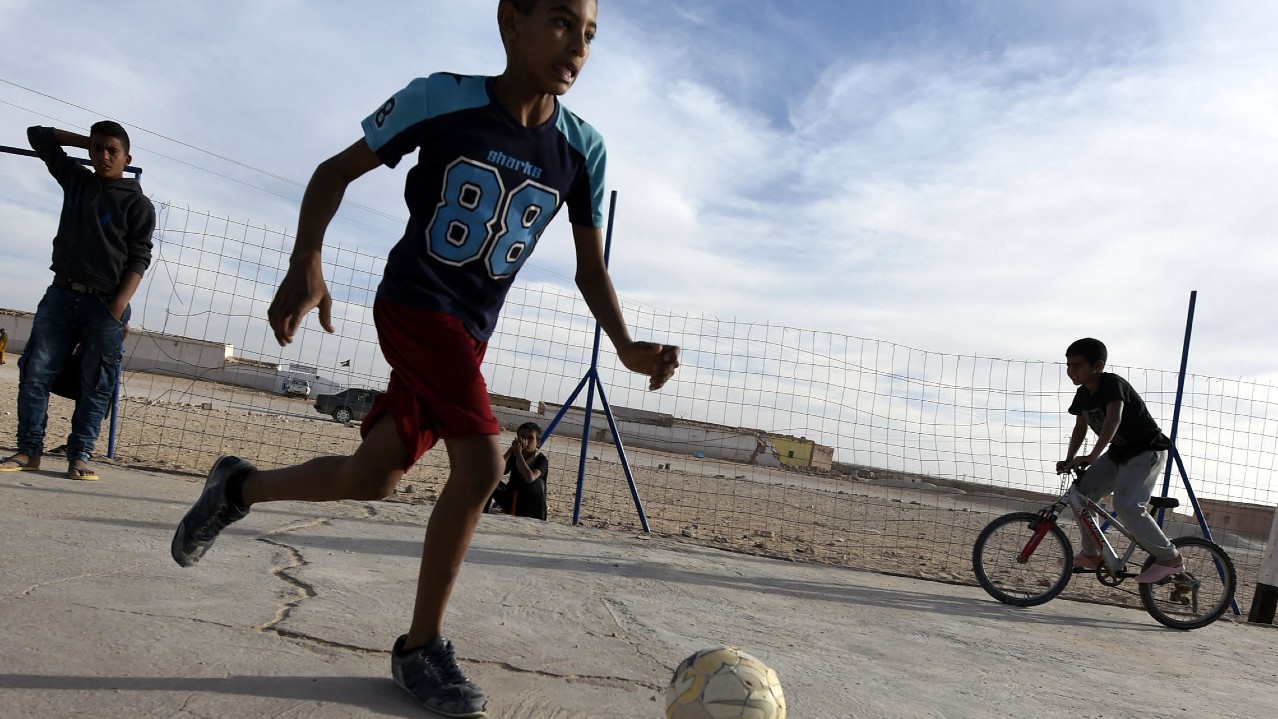
On a baked-earthen football pitch cut into the arid desert of southwestern Algeria’s Smara refugee camp, fine orange dust hangs thick in the still late-afternoon air, billowing in choking clouds every time a player sprints after a loose ball. Despite the unrelenting desert heat, a group of young men and teenage boys has gathered for their weekly match—one of the few steady rituals in a life defined by displacement. For the fans leaning on makeshift barriers watching the game, conversation drifts quickly from the local play to the World Cup unfolding thousands of miles across North America, and the deep, history-bound loyalty that draws nearly every Sahrawi refugee in Algeria’s camps to cheer for one team: Algeria.
According to United Nations data, more than 173,000 Sahrawi refugees currently reside in a network of camps near Tindouf, Algeria. Their displacement stretches back 50 years, rooted in a decades-long dispute over their indigenous homeland of Western Sahara, a 266,000-square-kilometer desert expanse in Northwest Africa bordered by the Atlantic Ocean, Morocco, Mauritania and Algeria.
The conflict’s origins trace to the late 19th century, when Spain colonized the region, then called Spanish Sahara. After Morocco gained independence from colonial rule in 1956, it staked a long-standing territorial claim to Western Sahara. By 1973, the Polisario Front formed to advocate for Sahrawi independence, launching an armed movement after Spain agreed to cede the territory to Morocco and Mauritania in the 1975 Madrid Accords—an agreement negotiated without any input from Sahrawi representatives, following Morocco’s mass Green March of 350,000 civilian supporters into the territory. The resulting war forced thousands of Sahrawis to flee across the border into Algeria, where they established the refugee camps that remain home to generations of displaced people today.
A 1991 UN-brokered ceasefire established the MINURSO peacekeeping mission to oversee a planned independence referendum for Western Sahara, but the vote has never been held due to disputes over voter eligibility. The ceasefire collapsed entirely in 2020, after Morocco launched military operations in a UN buffer zone, and sporadic fighting has resumed in the years since. Today, Morocco controls most of Western Sahara, incentivizing Moroccan settlers to move to the region, while the Polisario Front holds a smaller eastern stretch of desert and continues to campaign for full Sahrawi independence—with Algeria as its most prominent regional backer.
That decades-long political and humanitarian partnership has woven deep ties between Sahrawi refugees and their host nation. For generations, Sahrawi refugees have attended Algerian schools and universities, received medical care in Algerian hospitals, and built interwoven family, cultural and political bonds across the border. To many, Algeria is far more than a place of refuge—it is a steadfast ally in their struggle for self-determination.
“My support for Algeria is unconditional,” Brahim Salem, a long-term camp resident, told Middle East Eye. “For us, Algeria is not just a neighbour. It’s a country that stood against oppression and gave us safety when we needed it most.”
That loyalty translates directly to the football pitch. Because the Sahrawi Arab Democratic Republic remains unrecognized by FIFA, Sahrawi players cannot compete as an independent national team in major international tournaments. For displaced Sahrawis, supporting Algeria becomes a way to channel collective pride and national aspiration that cannot be expressed through their own team.
Algalya, a 60-something refugee who fled Western Sahara as a war refugee decades ago, is among the millions of Sahrawi fans ready to cheer on Algeria. She still vividly remembers the joy of Algeria’s 2019 Africa Cup of Nations victory, when the entire camp erupted in celebration with traditional zaghareet ululations that lasted long into the night. “I remember having nowhere to go, and Algeria welcomed us with open arms,” she said. “I pray Algeria make us happy again.”
Across the camps, football is woven into the fabric of daily life: children chase balls across dusty dirt streets between tents, families huddle around bulky secondhand televisions to watch major tournaments, and local weekly matches like the one in Smara draw crowds of enthusiastic spectators. For local players Hafdala Mohamed and Khalil, their World Cup plan is already set: they will gather to watch every single one of Algeria’s matches together, no matter how late kickoff falls.
For Hafdala, like many other Sahrawi refugees, football is far more than just entertainment. It is one of the only unchanging certainties in a life shaped by decades of exile. Even as the conflict over their homeland remains unresolved, and the dream of self-determination stays unfulfilled, the shared joy of supporting Algeria on the world’s biggest football stage offers a rare moment of collective connection and hope.