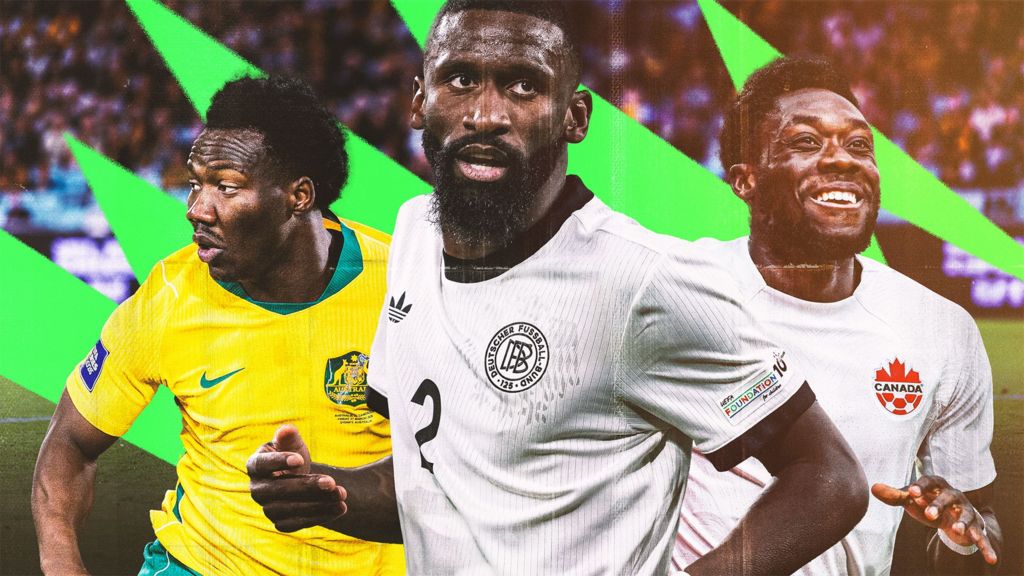
As the 2026 World Cup unfolds across North America, three standout players taking the pitch for Australia, Germany, and Canada share a powerful, little-told common bond: all descend from African refugee families who fled devastating conflict to build new lives abroad. For these athletes, their presence on football’s biggest global stage is more than a personal achievement — it is a platform to amplify the stories of displaced people everywhere, even as growing policy shifts around the world roll back access to refugee resettlement.
For Germany defender Antonio Rüdiger, a 33-year-old Real Madrid stalwart and two-time Champions League winner, the road to the World Cup began long before he was born. His parents fled Sierra Leone’s brutal 11-year civil war in the 1990s, making a treacherous 340-kilometer trek from their home district of Kono to the capital Freetown in search of safety. Rüdiger’s uncle took extraordinary measures to protect his young nieces and nephews from rebel factions that kidnapped thousands of children to serve as child soldiers: he hid the group inside a sack of rice, and on multiple occasions, the family pretended to be dead to avoid gunfire or abduction. After securing refugee status in Germany, Rüdiger was born in Berlin, growing up in a shared government refugee center. That early experience shaped the work ethic that carried him to the top of global football. “Nothing is given in life. You have to work for things, you have to sacrifice a lot to get where you want to go,” he told BBC Sport Africa.
Rüdiger is far from alone among World Cup participants in carrying a refugee heritage. Canadian captain and Bayern Munich star Alphonso Davies spent his earliest years in a Ghanaian refugee camp after his family fled civil war in Liberia, a conflict that ravaged the West African nation alongside Sierra Leone in the 1990s and early 2000s. Today, Davies is part of the United Nations High Commissioner for Refugees’ (UNHCR) symbolic “Game Changing Team,” a group of elite refugee-background athletes assembled to demonstrate what displaced young people can achieve when given safety, opportunity, and a warm welcome. “Canada gave me the opportunity to be who I am and to be what I want to be in life,” Davies told UNHCR, recalling his first days in the country: going to school for the first time, playing the sport he loves, and building new friendships.
The Australian men’s national squad, the Socceroos, fields three forwards with African refugee roots: 20-year-old Nestory Irankunda of Watford, Mohamed Toure of Norwich City, and Awer Mabil of Spain’s Castellón. All three were either born in African refugee camps or grew up in them before resettling in Australia, and Irankunda recently made history as the Socceroos’ youngest-ever World Cup goalscorer after netting in a 2-0 group stage win over Turkey. Australia’s professional footballers association has leaned into the squad’s extraordinary multicultural identity, releasing a video featuring every player naming their birthplace or family heritage to highlight the tangible benefits of immigration.
Rüdiger, Davies, Irankunda, and dozens of other participating players have lent their names to the UNHCR campaign, alongside other high-profile athletes such as Rüdiger’s Real Madrid teammate Eduardo Camavinga (whose family fled Angola for France), former Chelsea winger Victor Moses (whose parents resettled in Nigeria from the UK), former Bosnia goalkeeper Asmir Begovic (who found refuge in Germany as a child escaping Balkan conflict), and Iraqi striker Ali Al-Hamadi (whose family fled after his father was imprisoned under Saddam Hussein’s regime).
UN High Commissioner for Refugees Barham Salih noted that children make up a disproportionate share of the world’s displaced population, with an estimated 48.8 million displaced children globally. Many face family separation, trauma, and abuse while fleeing war, violence, and persecution.
Despite the widespread celebration of these players’ success at the tournament, Rüdiger and other campaign participants warn that global public and political attitudes toward refugees have shifted dramatically in recent years, with growing stigma targeting displaced people. “The narrative goes a bit more blaming the refugees,” Rüdiger said, arguing that public empathy for those escaping conflict has eroded. “Obviously, you have always the good and the bad. This is life, we all are not perfect. But the thing is, if one person does bad, are all bad? You cannot smear it on everyone, because that’s not fair. Because you have people who come here, they really want to change their life, they’re doing good, they’re trying to learn. They learn the language, they go to school, they achieve something in life.”
That shifting political landscape is particularly visible in the United States, one of the 2026 World Cup’s three co-hosts. Immediately after his inauguration in January 2025, Republican President Donald Trump signed an executive order suspending the U.S. Refugee Admissions Programme (USRAP), the country’s formal resettlement system that has admitted more than 3.7 million refugees since its launch in 1980, including more than 500,000 from African nations. Later that year, the Trump administration capped annual refugee admissions at just 7,500 for the current fiscal year — a historic low — and rearranged priority rules to favor white South African refugees, based on Trump’s widely discredited claims of a “genocide” against Afrikaners.
State Department data shows that in the first seven months of the fiscal year (October to April), just 6,069 refugees were admitted to the U.S., and all but three of those resettled people came from South Africa. That marks a stark reversal from the final full year of former Democratic President Joe Biden’s term, when the U.S. admitted 100,034 refugees total, 34,017 of whom came from 32 different African nations. The Democratic Republic of the Congo topped that list with 19,923 resettled refugees, followed by Somalia, Eritrea, and Sudan.
The Trump administration has defended the cuts, arguing they are “justified by humanitarian concerns or is otherwise in the national interest,” but humanitarian organizations have roundly condemned the policy. Krish O’Mara Vignarajah, president and CEO of resettlement non-profit Global Refuge, told BBC Sport Africa that the policy is a devastating betrayal of the values the World Cup represents. “Sadly, right now, the most vulnerable in Africa and across the world have been shut out entirely,” she said. “What we will see [at the World Cup] is the US spending this summer celebrating, as they should, what humans can achieve when they’re given a chance. US policymakers have spent the past year making sure fewer people get that chance, and it is a stark and deeply troubling contradiction.”
O’Mara Vignarajah drew a contrast to 1994, the last time the U.S. hosted the World Cup, when the country resettled more than 100,000 refugees. “We knew back then that hosting the world and welcoming the world were not separate ideas,” she said. “But we have seem to have forgotten that.”
While U.S. policy has grown dramatically more restrictive, Canada — another World Cup co-host — has seen its annual refugee acceptance numbers rise over the past decade, even as it has shifted toward stricter immigration rules in recent years. Data from Canada’s Refugee Protection Division shows that 9,972 refugee claims were approved in 2016, a figure that grew to 50,067 by 2025. Thirty-eight African nations are represented among recent approved claims, with Nigeria recording the highest number.
For stars like Rüdiger and Davies, their performances on the World Cup pitch are meant to serve as a reminder of what welcome can achieve: they are playing for the countries that gave their families a second chance at life, and in doing so, they hope to reignite global empathy for refugees around the world.