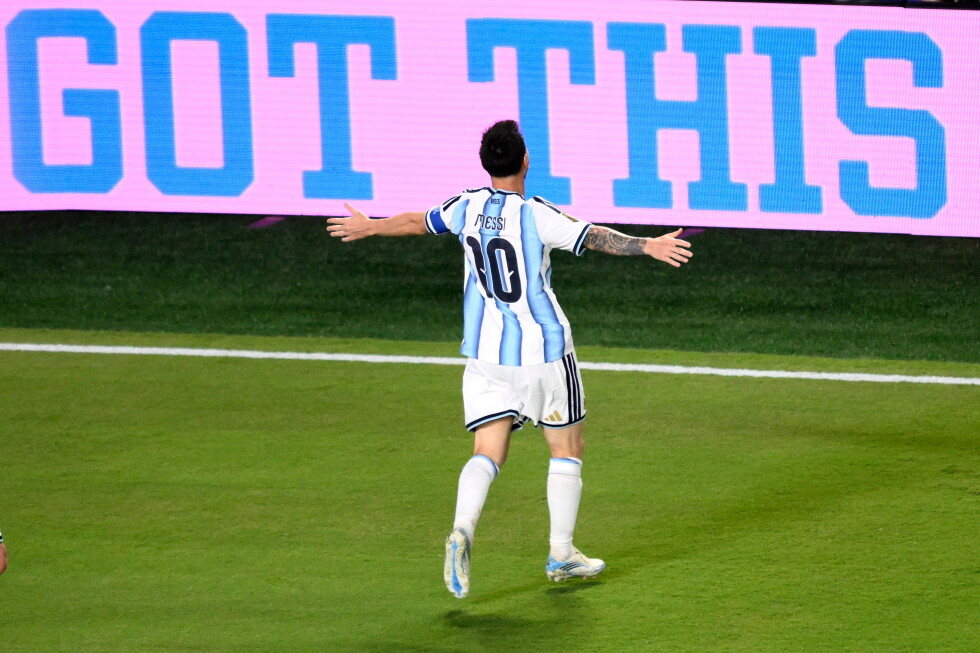
ATLANTA – For soccer legend Lionel Messi, a sixth World Cup appearance has brought a long-awaited first: his debut hat trick at soccer’s most prestigious global tournament, launching Argentina’s title defense with a dominant 3-0 victory over Algeria on Tuesday.
At 38 years old, Messi’s three-goal haul does more than just get the defending champions off to a flying start. It catapults him into a tie with German great Miroslav Klose as the men’s World Cup’s all-time joint top goalscorer, with 16 total tournament goals to his name. This milestone marks the first hat trick of the current tournament, and the 55th in the 100-plus-year history of men’s World Cup soccer. What makes the achievement even more remarkable is that Messi becomes the oldest player ever to record a World Cup hat trick, checking the rare box off a career already stuffed with every honor the sport has to offer.
This match was also Messi’s 27th World Cup appearance, extending his own record for the most tournament outings by any male player – two more than the previous record holder, Germany’s Lothar Matthäus, across his entire World Cup career. Messi first stepped onto a World Cup pitch back in 2006, making this six-appearance streak a testament to his two-decade stretch of elite-level performance. With this hat trick, he joins an exclusive club of all-time greats to have notched three goals in a single World Cup match, including Pelé, Eusébio, Gerd Müller, Cristiano Ronaldo and Kylian Mbappé. Next, Messi could join an even more rarefied group: only four players in history – Sándor Kocsis, Just Fontaine, Müller and Gabriel Batistuta – have managed multiple World Cup hat tricks across their careers.
Beyond the milestone for Messi, the moment offers a chance to unpack the history of the “hat trick” term itself, a phrase familiar to sports fans across the globe. While modern fans most commonly associate it with three goals in a single soccer or ice hockey match, its origins actually stretch back to 1858 in English cricket. Historians widely trace the first use to H.H. Stephenson, an English bowler who took three wickets across three consecutive deliveries. To celebrate the unprecedented feat, fans raised a collection to buy Stephenson a new hat, giving the achievement its enduring name.
The term gradually spread across nearly all major sports, expanding beyond three straight wickets or three goals to describe any trio of consecutive wins, championships, or even losses. In ice hockey, the first documented use in NHL play dates back to the 1930s, per the Hockey Hall of Fame, when a Toronto businessman named Sammy Taft launched a promotion offering a free hat to any player who notched three goals in a single home game.
Looking back at the history of World Cup hat tricks, the first ever recorded came at the inaugural 1930 tournament, when American striker Bert Patenaude scored three times in a 3-0 win over Paraguay. FIFA did not officially recognize the achievement for decades, however, due to a long-running dispute over who had actually scored one of the match’s goals. It was only after soccer historian Colin Jose worked with the U.S. Soccer Federation to present new evidence that FIFA updated its official records to confirm Patenaude’s place in history.
For decades, England’s Geoff Hurst held the unique distinction of being the only player to score a hat trick in a World Cup final, a feat he achieved when England won the 1966 tournament. That stood alone until the 2022 Qatar World Cup, where Mbappé matched Hurst’s achievement – even as he ended the match on the losing side, with Messi and Argentina lifting the trophy that day.
Stats show that World Cup hat tricks have grown increasingly rare over the decades. The 1954 tournament holds the all-time record for the most hat tricks in a single edition, with eight players notching three goals. The only World Cup in history to see zero hat tricks was the 2006 tournament in Germany. It has been nearly 40 years since a World Cup hosted more than two hat tricks: the 1986 edition in Mexico saw four, a mark that has not been matched in the seven tournaments held since.