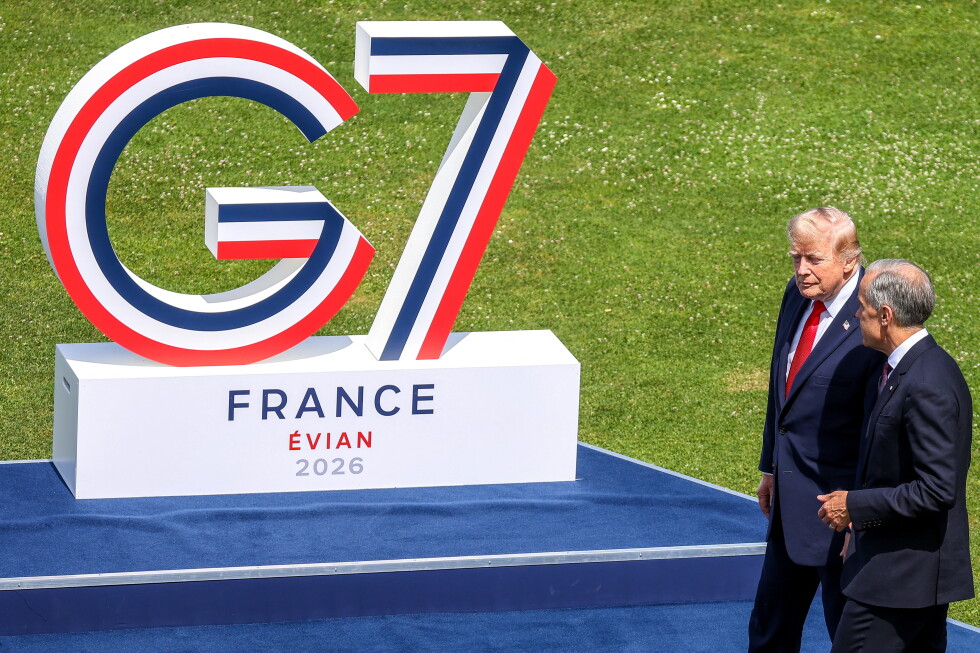
EVIAN-LES-BAINS, France — Against the backdrop of the annual G7 summit for the world’s major industrialized democracies, Canadian Prime Minister Mark Carney will depart the gathering on Wednesday without holding a scheduled formal bilateral meeting with U.S. President Donald Trump, a development that comes as the future of the trilateral North American Free Trade Agreement (NAFTA) hangs in the balance.
Bilateral meetings between Canadian prime ministers and sitting U.S. presidents have long been a standard staple of G7 gatherings, but Carney has pushed back firmly against any speculation that the lack of a formal sit-down constitutes a diplomatic snub from the Trump administration. Carney told reporters that he has already held seven to eight informal conversations with Trump over the 36 hours leading up to Wednesday, with more discussions planned for the day of his departure. These talks spanned a broad spectrum of policy and personal topics, ranging from economic cooperation, cross-border relations, and emerging artificial intelligence policy to global hotspots including Ukraine and Iran, and even a lighthearted exchange about Trump’s recent birthday.
The current moment is a defining turning point for NAFTA, the trade accord that has deeply integrated the economies of Canada, the United States, and Mexico since its implementation in the early 1990s. The agreement’s renewal deadline is set for July 1, and last week Trump raised widespread alarm when he indicated he may opt to let the existing deal expire rather than approve an extension. For Canada, which relies on the U.S. market for roughly 75% of its total exports, preserving a stable, long-term NAFTA framework is a top national economic priority.
On the sidelines of the G7 gathering, Canada’s top trade officials have already been advancing negotiations: Dominic LeBlanc, Canada’s minister responsible for U.S. trade, and Janice Charette, Canada’s chief NAFTA negotiator, held talks with U.S. Trade Ambassador Jamieson Greer. LeBlanc confirmed that the discussions yielded tangible progress toward a potential agreement. LeBlanc has previously warned that the Trump administration is pushing for major changes to the accord’s structure, including mandatory annual review cycles, a shift that would create persistent uncertainty over the trade deal’s long-term permanence.
Thus far at the 2025 G7 summit, French President Emmanuel Macron, the event’s host, remains the only G7 leader to secure a formal one-on-one bilateral meeting with Trump. The U.S. president has also held formal bilateral sessions with leaders of invited non-G7 nations including Qatar, the United Arab Emirates, Egypt, and India. Carney pushed back on questions about the uneven scheduling, noting that it is standard practice for a summit’s host country to hold a formal bilateral meeting with the U.S. president as a matter of protocol.
Audio captured by open microphones during one informal interaction revealed that Carney balanced lighthearted humor with serious policy discussion with Trump. In an off-the-cuff moment, the two leaders joked playfully about “stealing” Macron’s luxury watch before shifting to a substantive conversation about Canada’s new policy framework for Chinese electric vehicle (EV) imports.
Carney explained to Trump that Canada has implemented a hard import cap on Chinese-made EVs, limiting annual imports to just 49,000 vehicles – less than 3% of Canada’s total current auto market. Carney noted he struck this cap arrangement with Beijing, framing it as a tough policy aligned with Trump’s own trade priorities. “It’s a cap, we capped, a hard line,” Carney said in the exchange. “I thought you’d actually like that.” Trump responded positively, telling Carney: “That’s good, I like it.”
Earlier this year, Canada broke with the U.S. to roll back its 100% tariff on Chinese EVs in exchange for reduced Chinese tariffs on Canadian agricultural exports. Carney confirmed he has discussed the policy with Trump twice, adding that he was not surprised the U.S. president had not followed every granular detail of the bilateral Canada-China deal. “He likes the structure. Actually, we had a follow-up conversation about it as well,” Carney added.
Peter Boehm, a veteran Canadian senator who previously led Canadian delegation planning for multiple G7 summits, backed Carney’s framing of the lack of a formal meeting, saying that the informal format of the summit actually gives leaders far more unstructured interaction time than pre-scheduled formal meetings allow. “I wouldn’t see it as a snub,” Boehm said. “It’s amazing how much time leaders can actually have to have conversations.”