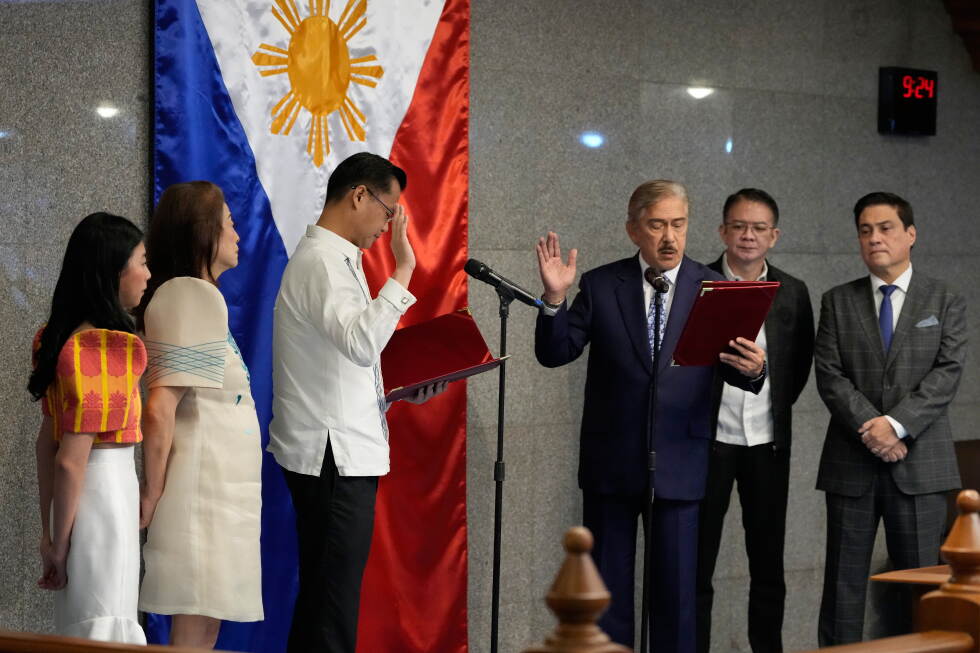
After a bitter two-week leadership deadlock that exposed deep political rifts at the heart of the Philippine government, a close ally of incumbent President Ferdinand Marcos Jr. has claimed the top leadership post in the Philippine Senate, ousting an ally of former President Rodrigo Duterte just months ahead of the impeachment trial of Duterte’s daughter, sitting Vice President Sara Duterte.
Sherwin Gatchalian secured the Senate presidency in a final vote Wednesday, earning the backing of 13 of the chamber’s 24 senators. His challenger, Alan Peter Cayetano — a long-time loyalist of the former Duterte political bloc — formally conceded defeat shortly after the vote result was finalized. The standoff began in early May when both Gatchalian and Cayetano claimed the Senate presidency, each citing conflicting legal interpretations of legislative quorum rules to legitimize their separate faction votes.
The deadlock broke abruptly Wednesday when one senator previously aligned with Cayetano defected to the pro-Marcos bloc, handing Gatchalian’s side the clear majority needed to formalize his leadership. The shake-up comes against a backdrop of intensifying political conflict between the Marcos administration and the Duterte camp, a once-formidable alliance that collapsed into open hostility in recent months, laying bare the persistent institutional vulnerabilities that have long marked Philippine democracy.
“It’s a relief,” noted Jean Franco, a political science professor at the state-run University of the Philippines, in the wake of the resolution. But she cautioned that the country’s democratic system, “with its weak and fragile institutions,” continues to face mounting challenges.
Observers have widely framed the Senate leadership fight as a proxy battle for the broader power struggle between Marcos and Vice President Sara Duterte, the country’s two highest-elected officials. The pair governed as coalition partners for years, but their relationship has fractured dramatically, a split that mirrors the deep partisan divisions that have roiled Philippine politics for decades.
Tensions escalated sharply after the 2023 handover of former President Rodrigo Duterte to the International Criminal Court (ICC) to face trial for alleged crimes against humanity stemming from his administration’s brutal anti-drug crackdown, which left thousands of mostly low-income drug suspects dead between 2016 and 2022. Sara Duterte has publicly blamed Marcos for orchestrating the arrest and transfer of her father, who has repeatedly denied authorizing extrajudicial killings throughout his time in office. Duterte’s ICC trial is scheduled to open in November.
In a twist that fueled the initial leadership deadlock, Cayetano claimed the Senate presidency on May 11 after Sen. Ronald dela Rosa — Duterte’s former national police chief and an alleged co-perpetrator in the ICC’s crimes against humanity case — emerged from months of hiding to cast the deciding vote for Cayetano. Hours after Cayetano’s win, the ICC unsealed an arrest warrant for dela Rosa, prompting him to return to hiding, where he remains at large.
The pro-Duterte bloc has suffered additional setbacks in recent weeks: another of Cayetano’s key allies, Sen. Jinggoy Estrada, was arrested on June 1 on a plunder charge linked to alleged massive kickbacks from a government flood control infrastructure project. Estrada has denied all wrongdoing and was released after posting bail.
Control of the Senate carries profound political stakes for the Marcos administration, as the chamber is set to convene the impeachment trial of Sara Duterte in July. The impeachment case was advanced last month by the House of Representatives, which is currently dominated by Marcos allies. Duterte faces multiple charges, including allegations of unexplained wealth and public statements threatening to assassinate President Marcos. She has denied all accusations, with her supporters arguing the charges are politically manufactured to derail her already-announced plan to run for the Philippine presidency in 2028, when Marcos’s current six-year term concludes.