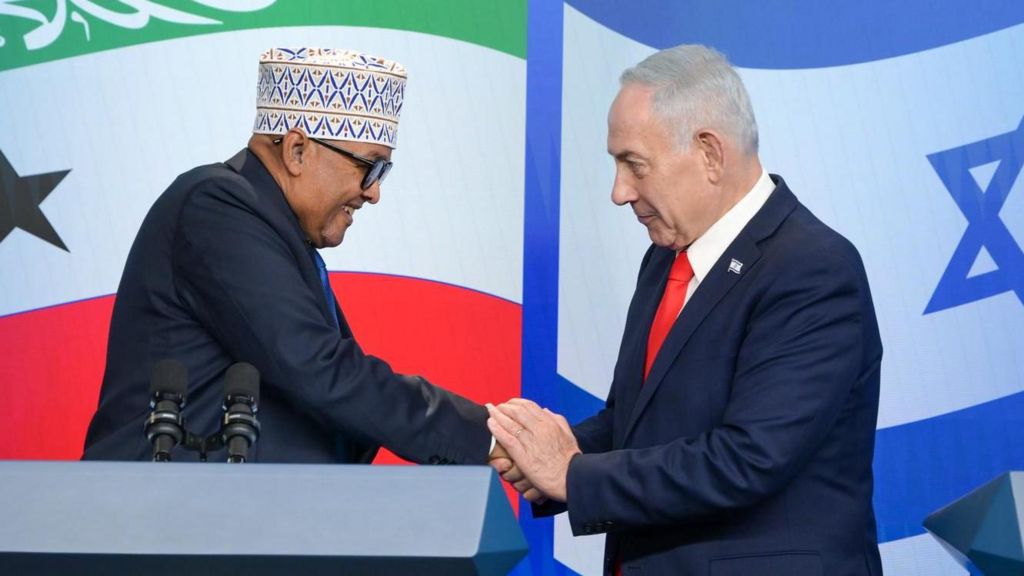
Six months after Israel made history as the first UN-recognized nation to formally acknowledge Somaliland’s independence, the self-declared state has inaugurated its first diplomatic mission in the Middle Eastern country — placing it in Jerusalem, a choice that has amplified already fierce global debate over the move.
The embassy opening took place at a West Jerusalem technology park during an official state visit by Somaliland President Abdirahman Mohamed Abdullahi, who held high-level talks with Israeli Prime Minister Benjamin Netanyahu. During the meeting, Netanyahu spoke of what he framed as a shared historical bond between the two peoples, and praised Somaliland’s decision to site its embassy in Jerusalem, which Israel claims as its undivided eternal capital.
Netanyahu drew a direct parallel between the two polities’ aspirations for global recognition: “Just as you expect nations to recognise your sovereignty, your identity, your own rights, your own national rights. The same thing we have vis-à-vis our capital. It’s only been the capital of the Jewish people since King David. That’s only 3,000 years ago. So, for some countries, it’s a belated recognition. For you, it was instant.”
Abdullahi returned the praise, hailing Netanyahu for his “courage” in extending recognition to Somaliland last December, and outlined a range of potential areas of bilateral collaboration. He highlighted Somaliland’s untapped natural resource wealth — including rare earth minerals and crude oil reserves — and noted the country’s strategically positioned coastline along the entrance to the Red Sea, which offers major geostrategic value for Israel in the Horn of Africa. For Israel, the partnership secures a rare stable friendly partner in a strategically critical region that has long been dominated by actors hostile to Israeli interests.
The entire diplomatic exchange has been met with fierce condemnation from multiple stakeholders. Somalia, which formally claims Somaliland as an integral part of its sovereign territory, has condemned any official engagement with what it calls the “secessionist administration of the northern region of Somalia”, framing the embassy opening as a direct violation of Somalia’s national sovereignty. Somalia’s foreign ministry has issued an urgent call for all global actors to uphold international law and condemn actions that undermine the unity and territorial integrity of the Somali state.
Israel’s original recognition of Somaliland in December 2024 was already deeply controversial globally, drawing sharp criticism from dozens of countries and major international bodies including China, Turkey, Saudi Arabia, and the African Union. The decision to open the embassy in Jerusalem, rather than Tel Aviv where the vast majority of foreign missions remain located, has drawn further rebuke from the Palestinian Authority. In a statement carried by official Palestinian news agency Wafa, the Palestinian foreign ministry condemned “the opening of the alleged embassy by the so-called ‘Somaliland’ in the occupied city of Jerusalem”, calling the move a “flagrant violation of international law and relevant resolutions of international legitimacy”. The Palestinians have long laid claim to East Jerusalem, which Israel captured in the 1967 Six-Day War and formally annexed in 1980, as the capital of their future independent state. The international community almost universally does not recognize Israel’s annexation of East Jerusalem, and most countries retain their embassies in Tel Aviv, despite the 2018 decision by former U.S. President Donald Trump to relocate the U.S. mission to Jerusalem. A small handful of countries including Guatemala, Honduras, Kosovo, Papua New Guinea, Paraguay, and Fiji currently maintain embassies in Jerusalem.
Somaliland has operated as a de facto independent state since 1991, when it separated from Somalia following the collapse of the central government in Mogadishu that plunged the rest of the country into decades of civil conflict and instability. Over the past three decades, Somaliland has established functional democratic institutions, held multiple peaceful national elections, issued its own independent currency, and built a professional national security force, maintaining far greater stability than most regions of southern Somalia. Even so, prior to Israel’s recognition late last year, no UN member state had formally recognized Somaliland’s declaration of independence.