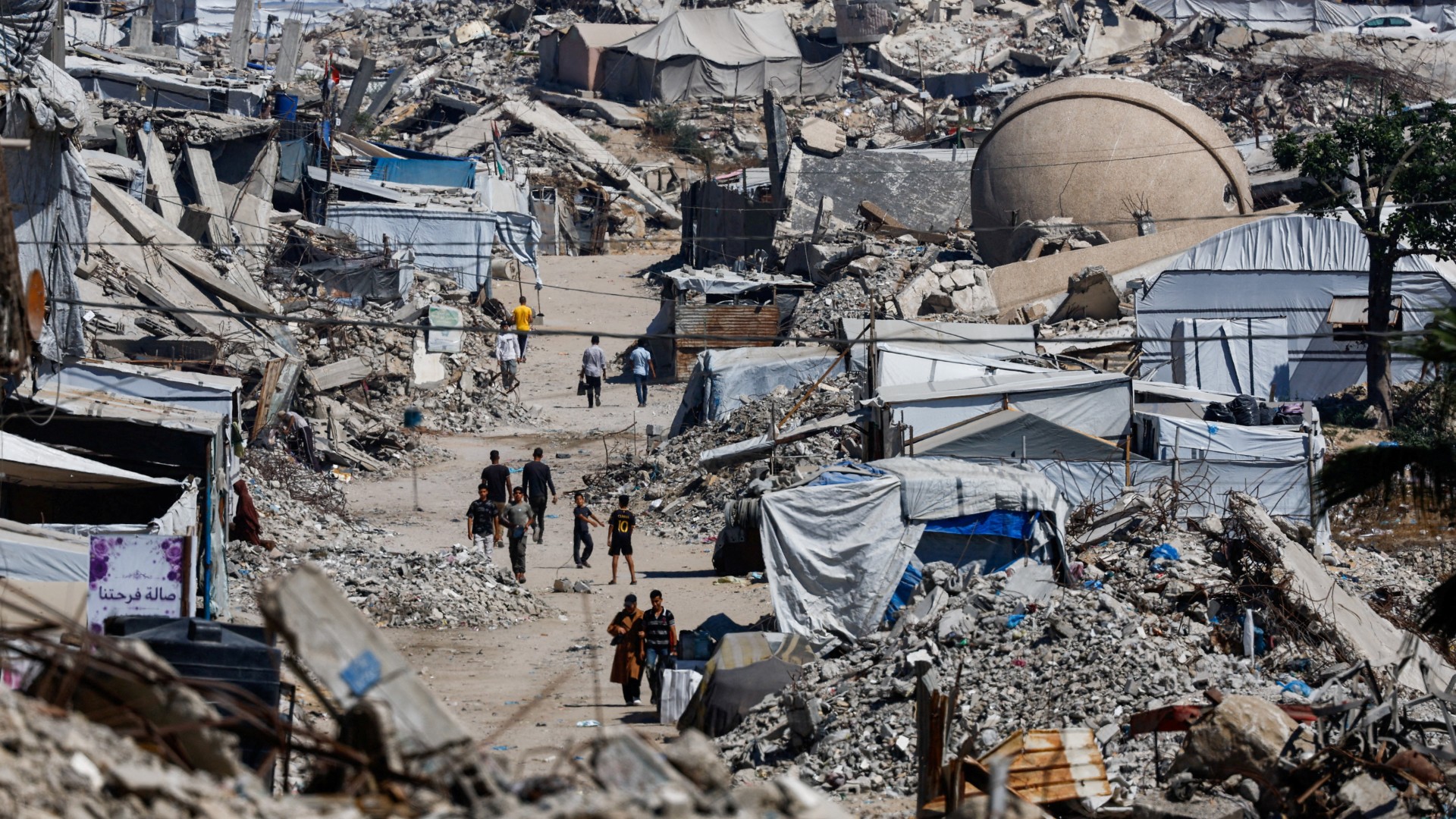
The Gaza Strip has been marked by ongoing civilian bloodshed even after the October 2023 ceasefire between Israel and Hamas, with a new fatal incident near the Israeli-demarcated “yellow line” buffer zone laying bare the dangers facing Palestinian civilians who tend to their land in border areas.
On a routine Sunday afternoon trip to check farmland in Wadi al-Salqa, located just 150 meters from the yellow line that marks Israel’s military perimeter inside Gaza, 32-year-old Palestinian farmer Baha Abu al-Ajeen brought his three-year-old son Rayan and his brother-in-law Khaled Abu Gharaba from their home in Deir al-Balah, central Gaza. What began as an ordinary work outing quickly devolved into an unthinkable tragedy, the Abu al-Ajeen family says.
When the three unexpectedly encountered Israeli soldiers hiding inside a local home, troops opened fire without any warning or provocation, according to Nawaf Abu al-Ajeen, the family’s elder and a relative of Baha, who spoke to independent outlet Middle East Eye. A bullet tore through three-year-old Rayan’s eye and exited the back of his skull, killing the child instantly as he was held in his father’s arms. A second bullet struck Baha in the leg, leaving him bleeding profusely.
Instead of providing urgent medical care to the wounded, Israeli forces left the family bleeding on the ground before arresting all three, transporting them to the Kissufim military base. For hours, a wounded Baha remained in detention clutching his son’s lifeless body, alongside the unharmed Khaled who was also held. Nearly six hours after the shooting, soldiers dumped the injured father and his dead child on the central Gaza Salah al-Din Street before withdrawing.
Nawaf told MEE that after receiving word of the abandoned pair from local witnesses, family members traveled to the street and confirmed the identity of Baha and Rayan. The pair were rushed to Deir al-Balah’s Al-Aqsa Martyrs Hospital, where medical staff officially pronounced Rayan dead. Doctors stabilized Baha’s fractured leg with surgical hardware, and he remains hospitalized in stable condition, while his brother-in-law Khaled remains in Israeli detention with no updates on his condition or whereabouts.
The child was buried on Monday afternoon, his body returned to his mother who remains inconsolable. “An ordinary day turned into a living hell we will never forget,” Nawaf said.
The Israeli military issued a standard claim following the incident, asserting that Sunday evening it had opened fire on what it described as members of an armed cell approaching the yellow line. Hospital spokesperson Khalil al-Daqran confirmed the details of the incident to MEE, matching the family’s account: “The bullet pierced the child’s head, and he arrived deceased hours ago. The father is in stable condition with a leg injury and is receiving treatment.”
This deadly shooting is far from an isolated incident, according to UN and human rights data compiled since the ceasefire took effect. In a May report, the UN Human Rights Office found that roughly one-third of all Palestinians killed by Israeli forces after the ceasefire agreement were shot in areas near the border buffer line with Hamas, raising alarming allegations that Israeli troops are deliberately targeting civilians merely for approaching the restricted zone. The office concluded that “such actions would constitute unlawful killings and are therefore war crimes.”
Ajith Sungai, director of the UN Human Rights Office in the occupied Palestinian territory, called the consistent pattern of civilian deaths “disturbing.” “Civilians don’t appear to have posed any threat to the lives of Israeli soldiers, including in some cases where they appear to have been shot while carrying out daily activities, or after approaching or crossing what is known as the Israeli ‘yellow line,’” Sungai noted in a press statement.
As of 5 February, UN data records that 453 Palestinians have been killed in the post-ceasefire period, 152 of which occurred near the yellow line buffer zone—including 102 men, 15 women, 24 boys, and 11 girls. Official data from the Palestinian Ministry of Health published this Monday puts the total post-ceasefire Palestinian death toll at 992, with an additional 3,144 people wounded across the Gaza Strip.
Alaa Skafi, director of the Gaza-based Al-Dameer Association for Human Rights, told MEE that Israel currently classifies 65 percent of the entire Gaza Strip as restricted “yellow” or “red” zones. Skafi explained that even when civilians pose no credible threat to Israeli forces, any person who approaches these restricted areas or the yellow line is targeted with gunfire or arrested under the ready-made pretext of threatening military positions. Civilians are targeted by sniper fire, tank shelling, and drone strikes, he added.
Skafi also alleged that Israel intentionally manipulates the border demarcation to target civilians: even though Israel places yellow concrete blocks to mark the restricted zone near the Salah al-Din Line that splits Gaza east to west, troops regularly move the markers westward, then open fire on civilians who cross the shifted line under the claim they entered restricted territory. “Israel uses ready-made justifications to legitimise the killing of civilians near the Yellow Line and employs new methods of killing, either by soldiers or by members of its affiliated armed groups,” Skafi said.