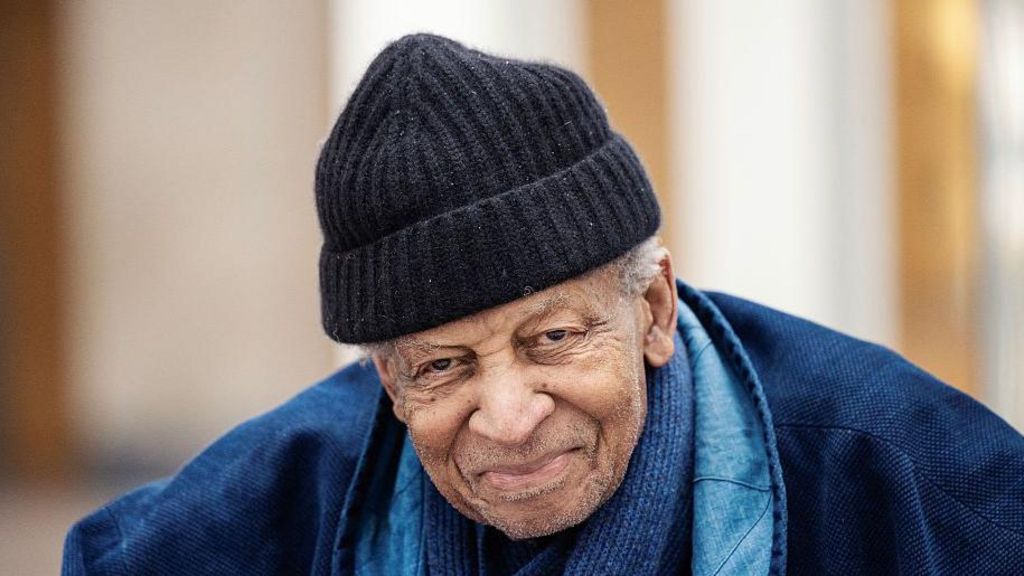
South Africa has lost one of its most influential cultural figures: Abdullah Ibrahim, the legendary pianist and composer who forged a distinct, beloved genre of South African jazz, has died at the age of 91. In an official statement shared by his family, Ibrahim passed away peacefully in Germany following a brief illness, surrounded by his loved ones.
Born Adolph Johannes Brand in 1934, Ibrahim grew up in the coastal city of Cape Town, where he discovered his passion for music at an extraordinarily young age. By seven years old, he was already picking out melodies on a household piano and developing his innate gift for composition. That early spark grew into an extraordinary eight-decade career that produced dozens of landmark recordings, cementing his status as a giant of global jazz.
His 1974 composition *Mannenberg* remains one of his most enduring works, and it became inextricably tied to the anti-apartheid movement that fought to end white-minority racist rule in South Africa. Ibrahim first performed under the stage name Dollar Brand early in his career, adopting the name Abdullah Ibrahim after converting to Islam in the late 1960s.
As a teen performer cutting his teeth in Cape Town’s vibrant mid-20th century music scene, Ibrahim played in swing groups, led his own trio, and eventually co-founded the Jazz Epistles, a groundbreaking sextet that featured another of South Africa’s most celebrated jazz talents, Hugh Masekela. The rising group’s trajectory was cut short by the tightening grip of apartheid, the formal system of racial segregation enforced by the state starting in 1948. Under apartheid, jazz was widely viewed as a countercultural force that promoted racial integration, and it was systematically marginalized by the government. Political pressure forced the Jazz Epistles to disband, and Ibrahim made the difficult decision to relocate to Switzerland.
It was there that American jazz legend Duke Ellington discovered Ibrahim’s talent, sponsoring his move to the United States and helping him launch his international career. As outlined in a previous profile by BBC Radio 3, Ibrahim went on to develop a one-of-a-kind sonic identity: he wove the traditional vocal and harmonic patterns of his South African roots with the rhythmic drive and spontaneous improvisation that defines core jazz tradition.
Though he spent decades living outside his home country, Ibrahim never severed his connection to South Africa, returning frequently to perform, record, and engage with local audiences. His final public performance took place just three months before his death, at the Cape Town International Jazz Festival, where he delivered the kind of captivating, masterful set that audiences had come to expect over his lifetime.
World leaders and loved ones have paid tribute to Ibrahim in the wake of his passing. South African President Cyril Ramaphosa honored Ibrahim, noting that his work celebrated the South Africa that shaped both his unwavering political commitment and his extraordinary musical brilliance. Ramaphosa added that Ibrahim enriched global life through his artistic gifts and his commitment to building a more just, equitable world. Dr. Marina Umari, Ibrahim’s partner, also shared a moving tribute, saying he carried South Africa and its people in his heart until the end, and his love for his country never faded no matter where he lived in the world.