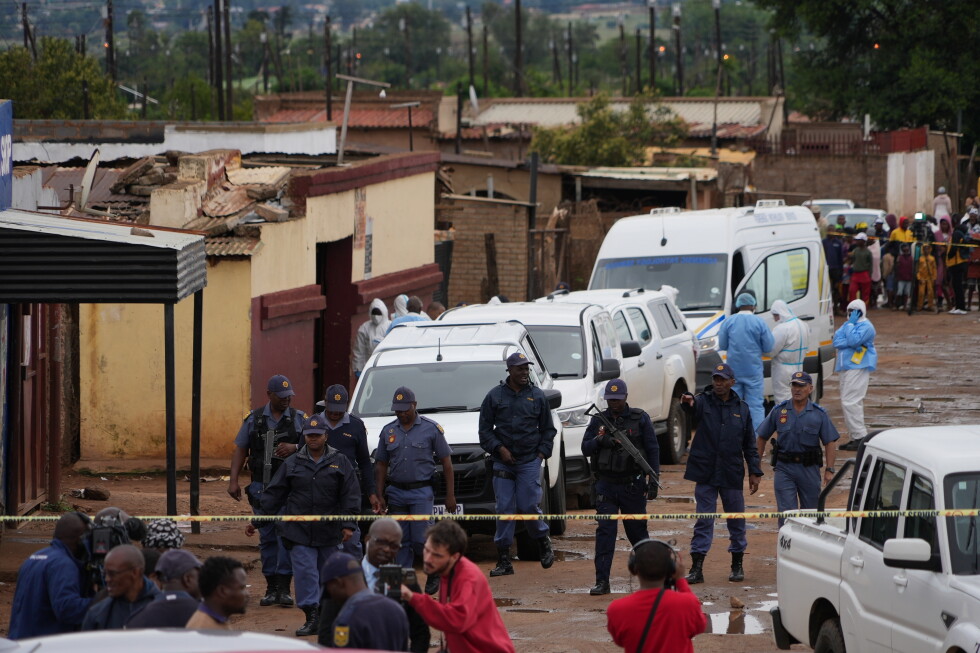
A devastating mass shooting in an informal Johannesburg shack settlement has left 12 people dead and at least 15 injured, amplifying long-simmering concerns over organized criminal activity and systemic failures in South Africa’s law enforcement. No suspects have been taken into custody in the attack, which multiple perpetrators are believed to have carried out earlier this week.
For criminologists and security analysts, the shooting is not an isolated tragedy — it is the latest outcome of a growing pattern of brutal violence concentrated in South Africa’s most underserved low-income communities. Experts agree that this violence stems directly from well-organized criminal syndicates exploiting widespread police dysfunction, from severe under-resourcing to open corruption and even collusion with criminal networks.
Earlier this year, President Cyril Ramaphosa took the extraordinary step of deploying national army troops to high-violence crime hotspots across the country, a move that critics frame as a quiet admission that police have lost control of security in many marginalized communities. The deployment came amid a sprawling corruption scandal that has roiled South Africa’s top law enforcement ranks: more than a dozen senior police officers have been arrested, and both the national police commissioner and national police minister have been suspended over allegations of ties to organized criminal groups.
Jacob Mofokeng, a criminology professor at the University of South Africa, explained that criminal gangs deliberately target under-policed poor settlements because the lack of security, inadequate street lighting, and delayed police response create the perfect cover for illegal activity. “Criminal syndicates explicitly capitalize on this to hide weapons, execute hits, and vanish into the shadows,” Mofokeng told the Associated Press.
South Africa is already grappling with a national crisis of violent crime, with official annual data recording an average of more than 60 homicides per day across the country. The burden of this violence falls overwhelmingly on poor townships and informal settlements, a reflection of the deep socioeconomic inequality that has persisted in South Africa decades after the end of apartheid. Wealthy, gated communities with private security services see drastically lower rates of violent crime.
A primary driver of violence in these Johannesburg-area settlements is the illicit trade in unregulated gold mining, run by notorious local gangs known as *zama zamas* — a Zulu term loosely translated as “hustlers” or “chance-takers.” For decades, these gangs have set up operational bases in underserved, poorly policed areas, where they fight violent turf wars with rival groups to maintain control of illegal mining operations. Many gang members are undocumented migrants from neighboring countries, a detail that makes police investigations far more difficult. With no formal legal identification, registered address, or existing law enforcement biometric data, “they are effectively a ghost,” Mofokeng noted.
The South African government estimates that illicit mining drains more than $3 billion annually from the national economy, and the long-standing *zama zama* crisis was a key justification for Ramaphosa’s year-long military deployment against organized crime. Local residents of the settlement targeted in this week’s shooting confirmed that illegal mining gangs have operated openly in the area for years, and law enforcement officials confirmed that the gangs are the central focus of the ongoing investigation into the mass shooting, though a confirmed motive has not yet been released.
Compounding the crisis is a massive unregulated firearms problem: while South Africa enforces strict rules for legal gun ownership, independent research and civil society groups estimate that between 2 million and 3 million illegal firearms are currently circulating among the country’s 62 million population. Guns are responsible for the vast majority of homicides nationwide.
Willem Els, an analyst with South Africa’s Institute for Security Studies, said the combination of unregulated gun flows and systemic police failure has created an environment where organized crime can operate with near-total impunity. “In South Africa, we actually managed to create conditions that are very conducive for violent crime and also for organized crime syndicates to operate with impunity,” Els told the AP. “We’ve got a lot of unregistered firearms that are not being controlled by the police.”
Beyond resource shortages, widespread allegations of police corruption have eviscerated public trust in law enforcement, creating a further barrier to cracking down on gang activity. Last year, a senior provincial police commander made public allegations that top law enforcement officials were colluding with criminal syndicates, prompting Ramaphosa to launch a national corruption probe that has already led to dozens of arrests of senior officers.
Mike Bolhuis, a private investigator and veteran security specialist, said the corruption crisis has created a cycle of distrust that makes community cooperation with police nearly impossible. “The public doesn’t trust the police, they don’t trust the authorities, and they don’t trust each other,” Bolhuis said.