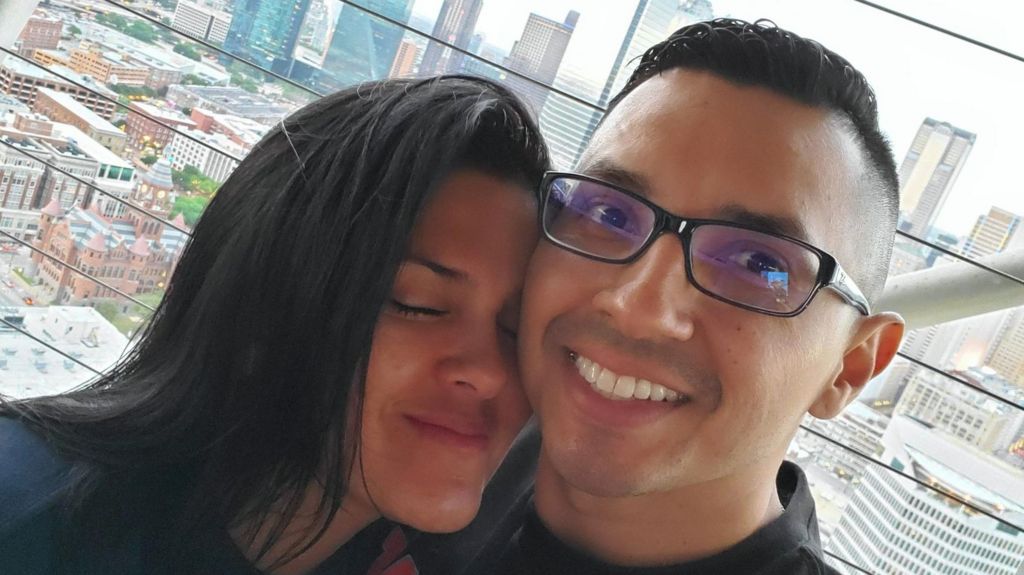
A retired U.S. Army veteran is fighting to keep his family together after U.S. Immigration and Customs Enforcement (ICE) detained his Honduran-born wife during a routine scheduled immigration appointment in Dallas, Texas this week, marking at least the third high-profile detention of a U.S. military service member’s noncitizen spouse in recent months.
Retired Staff Sergeant Wilmer Trujillo, 45, who served nearly 20 years in the U.S. Army and Texas National Guard including two combat tours in Iraq before retiring in 2021, accompanied his wife Arelys Barahona Martinez, 40, to the required check-in earlier this week. The couple, who married in 2020 after meeting at a local Texas nightclub in 2019, believed they were following all official protocols, having complied with every requirement of the immigration process since Barahona Martinez re-entered the U.S. in 2018.
“To us, it was a regular check-up day, we were always doing everything by the book,” Trujillo told the BBC in an interview from the agency’s parking lot, where he waited for hours after being barred from seeing his wife following her detainment. “I told her to do everything by the book. I’m by-the-book, I’ve been brought up military. We thought everything was fine, until an officer came out and said, ‘Your wife is not leaving today.’”
Following her arrest, ICE transferred Barahona Martinez to a detention facility in Oklahoma to await deportation, according to agency records. Barahona Martinez first crossed the U.S. southern border in 2005, after which an immigration judge issued a final order of removal. She left the country voluntarily later that year, but re-entered illegally in 2018, after which immigration authorities granted her supervised release. She has no criminal record in the U.S., public records and Trujillo confirm.
After their 2020 marriage, the couple applied for the parole in place program, a federal initiative that allows undocumented spouses of U.S. service members to stay in the country and pursue permanent legal residency. The U.S. Citizenship and Immigration Services (USCIS) rejected the application in November 2024 during the Biden administration, on the grounds that the active 2005 removal order meant the request had to be processed through ICE rather than USCIS. Trujillo’s legal team has been working to rescind the 2005 order, which Barahona Martinez was unaware of when she re-entered the U.S. in 2018, to clear a path for her to stay.
Attorney Mark Shmueli, who represents Trujillo and Barahona Martinez, confirmed this week he has filed an emergency motion in a Texas state court to halt Barahona Martinez’s deportation until a judge can hear the case. ICE confirmed receipt of the motion Friday and indicated the case could be eligible for a temporary stay of removal. Shmueli said the unanticipated detainment flies in the face of past precedent for military family immigration cases. “I didn’t expect this to happen to her yesterday,” Shmueli said. “I don’t understand why after all this time, why they detained her. Because I’ve seen the opposite with military folks.”
For Trujillo, a naturalized U.S. citizen originally from Colombia who calls himself a proud American and Texan, the separation has been devastating. “I just don’t understand, we have a family here, and they’re breaking us up,” he said. “They’re breaking my family up. She’s my backbone.” The couple shares a blended family: Barahona Martinez has a 20-year-old son, and Trujillo has two adult daughters from a previous marriage.
Barahona Martinez’s detainment is part of a growing pattern of immigration enforcement actions against military family members under the second Trump administration, immigration advocates and official records confirm. She is at least the third military spouse detained by ICE during a scheduled official appointment in recent months.
In April, ICE detained Deisy Rivera Ortega, the wife of an active-duty U.S. Army soldier in El Paso, Texas, when the couple attended an interview for the parole in place program. Ortega was released shortly after the detainment sparked public outcry. Also in April, ICE detained Annie Ramos, the newlywed undocumented wife of an active-duty soldier, when the couple visited a federal facility to pick up her military dependent ID. Ramos, who came to the U.S. as a toddler, was held for five days before being released.
The shift in enforcement follows a change to ICE policy rolled out in April 2025, after Trump took office for his second term. During the Biden administration, ICE issued a formal directive that classified immediate family members of active-duty and retired service members as a “significant mitigating factor” that should generally exempt them from arrest and enforcement actions except in extraordinary circumstances. The 2025 Trump-era memorandum replaced that policy, retaining protections for service members themselves but making no mention of their noncitizen immediate family members.
In a statement to the BBC, a Department of Homeland Security (DHS) spokesperson defended the agency’s actions, confirming Barahona Martinez had been granted full due process and that the agency was adhering to the rule of law. “The Trump administration is not going to ignore the rule of law. She will remain in ICE custody pending removal from the US,” the spokesperson said. In a separate response to Senator Elizabeth Warren, DHS confirmed that between January 2025 and January 2026, USCIS issued 113 notices to initiate removal proceedings against immediate relatives of retired and active-duty U.S. service members whose parole in place applications had been denied. In total, 282 noncitizens including both former service members and their immediate family members have been placed in removal proceedings over that 12-month period, the agency confirmed.
“US military service alone does not automatically grant lawful immigration status, or exempt aliens from the consequences of violating immigration laws,” the spokesperson added. The DHS spokesperson noted that USCIS does maintain provisions to expedite naturalization for military family members who qualify.
Immigration attorneys say the policy change has left hundreds of military families in limbo, separating service members and veterans from their spouses and loved ones despite their service to the country. “Basically: You better have a good reason for arresting the spouse of a military member if you do,” said Rachel Girod, an immigration attorney, describing the Biden-era policy. That protection is now gone for military families.
Trujillo says he knows he is not alone in this fight, and the uncertainty over his wife’s future has left him shocked. “It boggles me that they’re not giving us that chance,” he said. “She’s trying to be an example to all other immigrants that want a better life here.”