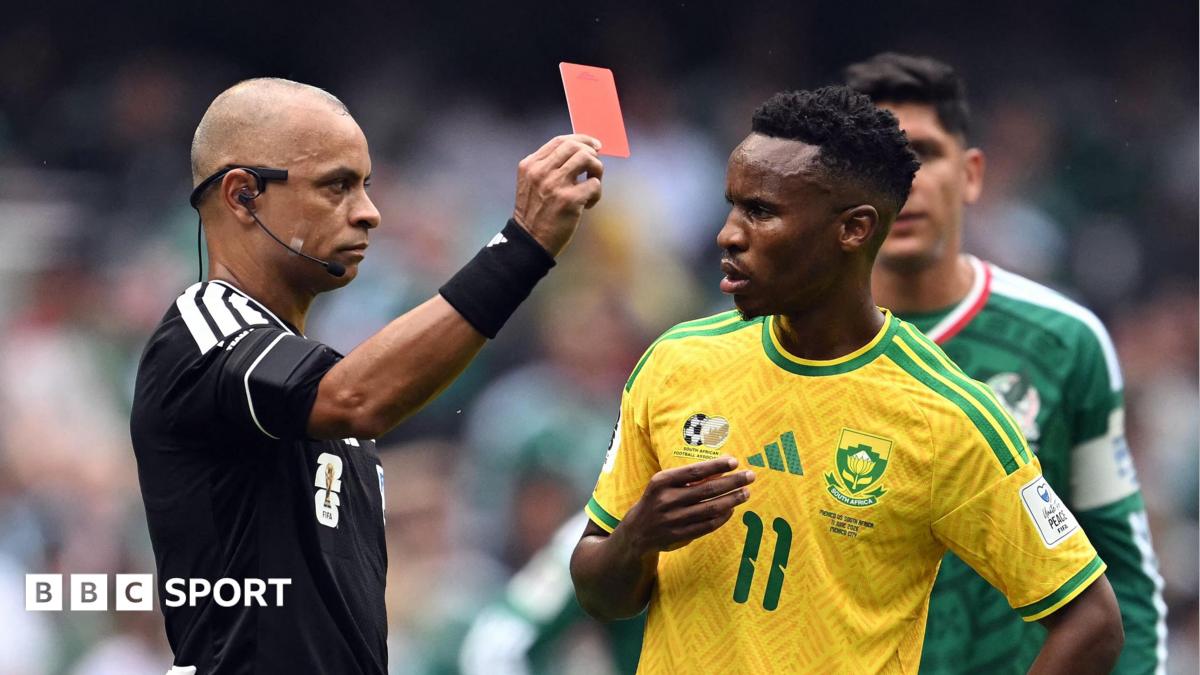
The 2026 FIFA World Cup’s Group A opening match delivered far more than a three points for co-hosts Mexico, who wrapped up a comfortable 2-0 victory over South Africa at Mexico City’s iconic Estadio Azteca in a game marred by two red cards for Bafana Bafana, tactical criticism, and rising continental tension over South Africa’s recent anti-migrant violence.
South Africa’s match unraveled within the opening 10 minutes, when midfielder Sphephelo Sithole lost possession on the edge of his own penalty area, allowing Mexico to convert the early chance and take a 1-0 lead. The second half delivered more setbacks: Sithole was shown a red card, followed by a second dismissal for forward Themba Zwane in the 84th minute after a VAR review upgraded a potential foul to a straight red for violent conduct. The sending-off marked only the second time in World Cup history that an African side has had two players dismissed in their opening finals match, a statistic last recorded by Cameroon against defending champions Argentina in 1990 – a match the Indomitable Lions famously won 1-0, a result South Africa never came close to matching.
Former South African captain Dean Furman, commentating for BBC Radio 5 Live, described the performance as “a nightmare from start to finish.” He argued that no Bafana Bafana player could claim to have performed to their potential, saying “Mexico were in total control from minute one. They looked more assured, they were calm in possession. It was just turnover after turnover after turnover, and when you’re playing against quality opposition you get punished.”
On the contentious second red card, South Africa head coach Hugo Broos – the oldest coach at this year’s tournament at 74 – disputed the call, claiming Mexican winger Roberto Alvarado blocked Zwane and went down unnecessarily. However, Furman, who played alongside Zwane for several years, said the call was justified under modern rules: “I know it’s incredibly soft but it’s the modern game, you can’t lash out. It’s going to be an interesting World Cup if that’s what we’re giving red cards for but that is the game today. You can’t do that.”
South African captain Ronwen Williams acknowledged the disappointing result but sought to highlight his side’s resilience, even with two players down. “Obviously the opening game of the World Cup comes with so much emotion,” the 34-year-old said. “We knew they were going to have the atmosphere, the energy behind them and we didn’t want to concede in the opening few stages. And then that’s exactly what happened. As difficult as it was with two guys sent off, we didn’t give up. It shows the mentality that we have and the character that we kept fighting.”
Domestic fans in Johannesburg were far less forgiving. Relebogile Lairi called the performance a “very disappointing start,” saying supporters “expected a lot more from the boys” and blamed widespread “stage fright.” Nicholas Makomene criticized Broos’ defensive 5-3-2 setup, saying there was “no need to park the bus” against the co-hosts.
Beyond the pitch, the result exposed deep divides across the African continent, 16 years after South Africa made history as the first African nation to host the World Cup, a moment that unified the continent behind African teams. This year, many fans across Africa backed Mexico over South Africa, in response to recent anti-migrant protests and violence in South Africa that has led multiple African nations to repatriate their citizens. South African officials have condemned the violence and rejected accusations of xenophobia, but that has done little to ease tensions.
In Nairobi, Kenyan organizer Elisha Kamau held a “hate-watch” party that drew nearly 200 attendees, almost all of whom supported Mexico. “The second reason I think is just the timing of the xenophobic attacks. It depends who is playing South Africa, but I think most people would support the other team,” Kamau explained. Congolese fan Daniel Kaniki, watching from a fan park in Atlanta, echoed that sentiment: “Africa is like one country and if one is chasing others, we are not a family any more. That’s why I’m supporting Mexico.” Not all fans across the continent aligned with this view, however: Ghanaian fan Vanlare Quist said he rooted for South Africa, arguing that anti-immigrant sentiment was driven by a small minority of bad actors, not the entire nation.
Looking ahead, South Africa faces a must-win second Group A match against the Czech Republic on June 18. Both teams enter the fixture winless, after the Czechs dropped a 2-1 opening match result to South Korea. Furman is pushing for a major tactical shift, urging Broos to abandon the defensive 5-3-2 setup he used against Mexico in favor of the more attacking 4-3-3 formation that fits South Africa’s traditional style of play.
“They have to put this to bed very, very quickly,” Furman said. “I know you’re playing against better opposition in a big match and you’re probably looking to soak up the pressure and go a little bit more defensive, but that’s just not our style at all. For me, going forward, you’ve got two games left to save yourself, to try and get a victory to get yourself into the next round. Go with our 4-3-3. Put your attacking players on, put your number 10s on, your more imaginative players. Let’s see what South African football is all about.”