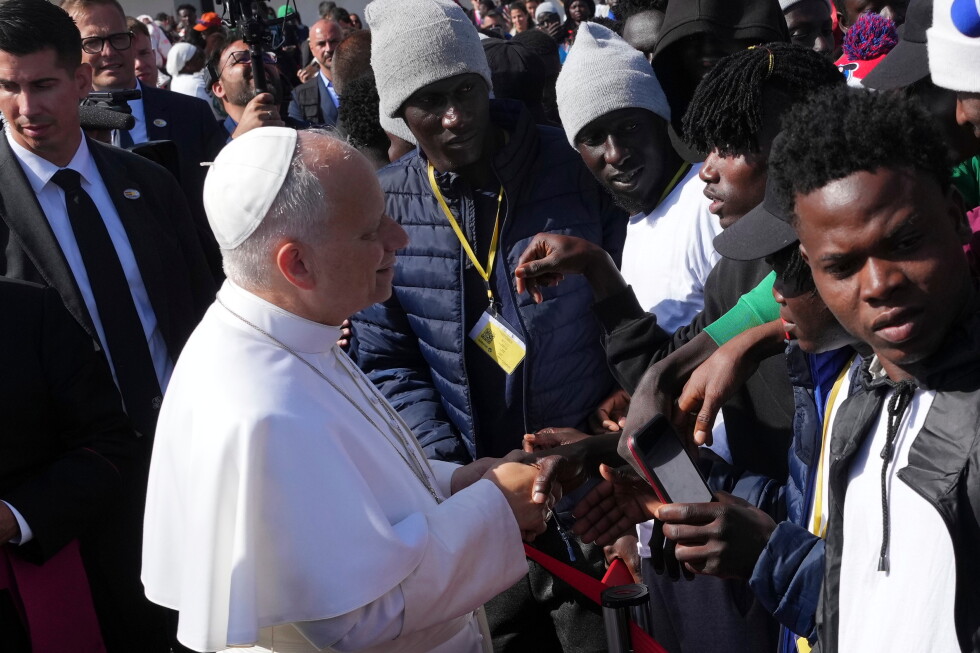
On the final day of his weeklong trip to Spain, Pope Leo XIV delivered a stark rebuke to human traffickers operating one of the world’s deadliest migration routes, issuing a call for repentance and warning that they will face divine justice for exploiting vulnerable people seeking a new life in Europe. The pontiff made the remarks Friday during a gathering with humanitarian aid groups in San Cristobal de la Laguna, on the Canary Islands, a Spanish archipelago that has long served as a primary entry point for migrants crossing the perilous Atlantic from West Africa.
Positioned just off the coast of Northwest Africa, hundreds of kilometers closer to the African continent than to mainland Europe, the Canary Islands have become the epicenter of one of the most dangerous migration pathways on Earth. Unlike the more heavily discussed central Mediterranean route, the vast expanse of the Atlantic Ocean and limited search-and-rescue infrastructure make this crossing far deadlier for migrants. Experts have documented entire boats drifting across the Atlantic to the Caribbean and Latin America, only to be found with all passengers dead after being pushed off course by trade winds and currents. Migrant arrivals to the islands peaked at nearly 47,000 in 2024, before dropping sharply to just over 3,000 in the first five months of 2026, a shift that has not eliminated the risk of deadly voyages.
Addressing the criminal networks that profit from this crisis directly, Pope Leo issued an unflinching appeal. “Break those chains and free those you hold in bondage,” he said, adding, “Stop. Repent. For every life lost, every family deceived, every body subjugated, every woman threatened, every worker exploited, you will have to appear before divine justice. Repent while there is still time, for God’s mercy can reach even the most hardened sinner, but it enters only through the narrow gate of truth, justice and conversion.” Smugglers operating the route typically charge thousands of euros per passenger, often trapping migrants in debt bondage by withholding identity documents and forcing them into exploitation such as sex work or illicit labor after arrival. Many migrants also travel on self-organized boats: a large share are former Senegalese fishermen left without livelihoods due to widespread overfishing off West Africa’s coast.
Leo’s visit to the Canary Islands fulfills a long-held wish of his predecessor, Pope Francis, who made migration advocacy a core priority of his 12-year pontificate, often clashing with right-leaning governments in the U.S. and Europe over restrictive border policies. As the first U.S.-born pope in history, Leo has positioned himself as a clear heir to Francis’ legacy, while adding his own public-facing style to the advocacy. The pontiff’s Canary Islands trip was designed to honor the thousands of migrants who have lost their lives attempting the crossing, a mission that comes amid rising anti-migrant sentiment across Europe and the Trump administration’s aggressive mass deportation campaign in the United States.
Shortly after arriving on the islands Thursday, Leo carried forward a symbolic tradition established by Francis: he tossed a bouquet of flowers into the ocean from Tenerife’s “Dock of Shame,” the port site where thousands of migrants were forced to live in squalid, overcrowded conditions during a 2020 arrival spike. The gesture mirrored a 2013 trip Francis made to Lampedusa, Sicily, another key migration flashpoint, where he first denounced what he called the “globalization of indifference” toward people fleeing conflict, poverty and climate disaster. In a moment that revealed Leo’s more casual, youth-connected style, he embraced a viral social media hand gesture popular with young people after hearing testimony from a former migrant, drawing loud cheers from the gathered crowd.
During his meeting with aid groups Friday, the pope also appealed to European host communities to welcome and integrate migrants, calling out the “silent shipwreck of abandonment” that leaves many survivors homeless and destitute on the streets after surviving their dangerous crossing. “A human conscience, and even more so a Christian conscience, cannot remain indifferent in the face of these graveyards of the sea, to the victims of shipwrecks and the lack of aid,” he said. “Every life lost on these routes is a failure for the human family.”
Leo reaffirmed the Catholic Church’s core teaching of “welcome the stranger,” noting that integration of migrants into local communities offers an opportunity to share faith without imposing it on people with different religious backgrounds. He also emphasized that while migrants have a right to flee dangerous conditions, their home countries bear a responsibility to create the economic and security conditions that would allow people to choose to stay rather than risk their lives at sea. During a visit to the Las Raíces migrant reception center, the pope met directly with migrants, hearing firsthand accounts of their journeys, and went off-script to address the crowd in French and English, drawing applause from attendees. One Senegalese migrant, Bousso Diouf, shared her story of desperation and trauma, asking that all migrants be treated with dignity and respect.
Leo’s trip to Spain wrapped up Friday, but his advocacy on migration will continue next month, when he plans to spend U.S. Independence Day on July 4 at Lampedusa, the site of Francis’ landmark 2013 address on the global migration crisis, to further amplify the call for greater global compassion toward displaced people.