In a small Chennai kitchen, 25-year-old Indian housewife Nagireddy Sriramyachandra straps a smartphone to her head, lifts a ripe mango, and begins slicing. Every movement is captured in first-person footage, destined to train artificial intelligence-powered humanoid robots to master everyday household tasks. For this hour of work, she earns just over $2, a rate that makes this side opportunity attractive even as the work she is doing could one day eliminate roles like hers entirely.
Sriramyachandra is not an anomaly. She is part of a fast-expanding workforce of thousands of AI data trainers across India, the world’s most populous country that has positioned itself as a global hub for the creation, processing, and annotation of the human-centric data that next-generation robots need to operate in real-world environments. Unlike the large language models that power generative AI chatbots and image generators, which train on massive troves of existing online data, systems built to navigate physical spaces require entirely new types of input.
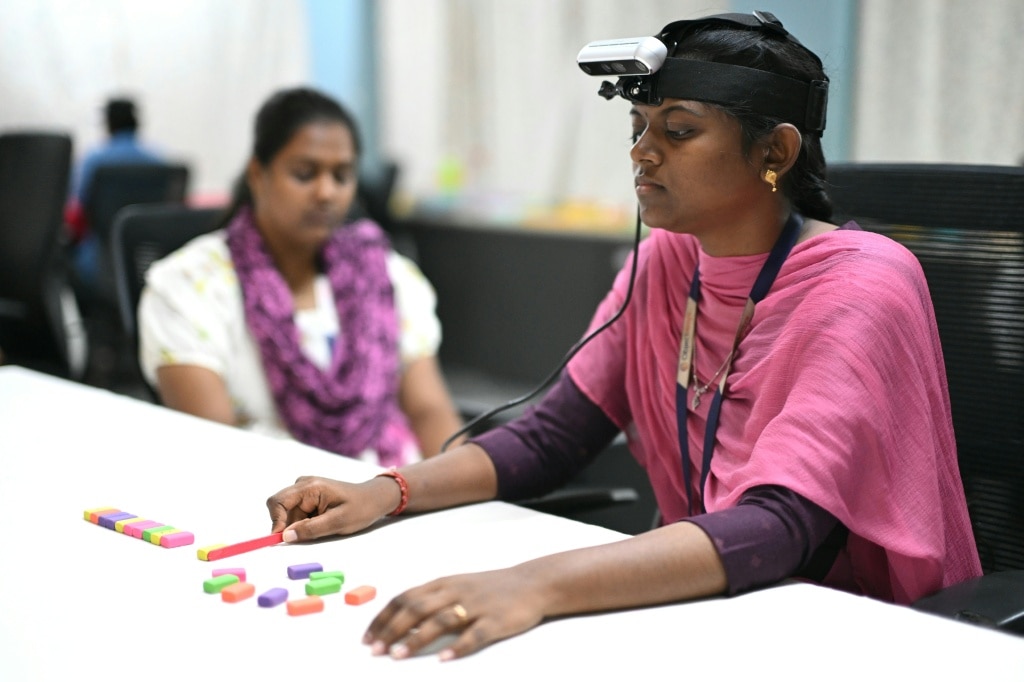
Industry developers have landed on a solution: collect “egocentric data” — first-person footage captured by workers as they complete routine tasks — to feed into specialized AI models, teaching robots to replicate human movement and decision-making in unstructured physical settings. Trainers work across a range of locations: some film from their own homes, others in commercial factories, and many purpose-built studios with staged living spaces. They use a variety of capture tools, from head-mounted smartphones to smart video glasses, motion sensors, and depth-sensing cameras.
For Sriramyachandra, the work fills a gap in her household income. “Who else will give you 250 rupees an hour just for doing housework?” she asked in an interview from her home in Tamil Nadu. When asked about the long-term impact of her work, she shrugged off concern, noting “I may get a robot myself in the future” to help with her household chores. Her recordings are sent via a custom app to Objectways, an AI data firm with offices in India and the United States that counts Fortune 500 multinationals among its clients and partners with Amazon’s machine learning platform SageMaker.
The global humanoid robot market is expanding rapidly, with investment bank Morgan Stanley projecting that more than one billion humanoid robots could be in use worldwide by 2050, primarily serving industrial and commercial functions. Ravi Shankar, founder and CEO of Objectways, outlined the wide range of tasks clients are seeking data for: “Folding clothes, coffee making… cooking a very specific thing, sandwich making.” For Shankar, AI and automation are not inherently a threat to workers: “Some jobs are supposed to be taken over, so humans can go and do better things.”
Right now, this growing demand for egocentric AI data is creating new, accessible employment opportunities across India, particularly in tech hubs like Tamil Nadu, where Shankar grew up and now hires most of his workforce. At a textile factory in Karur, for example, AFP found eight workers attaching labels to caps and ironing cloth bags while wearing head cameras and smart glasses supplied by Objectways, capturing their movements for AI training.
Digital labor experts expect this trend to accelerate. “It’s likely that these data collection services will increase,” noted Aditi Surie, a digital labor expert at the Indian Institute for Human Settlements in Bengaluru.
But the growing industry has also sparked urgent conversation about the long-term risks automation poses to India’s massive workforce, particularly the 490 million informal workers who make up the backbone of the country’s economy. As India aggressively expands its domestic AI industry, national leaders have acknowledged that automation brings major downside risks alongside its touted economic benefits.
A recent report from Indian government think tank NITI Aayog, released ahead of the country’s hosting of a global AI summit this year, points out a critical gap in mainstream labor analysis: most debates about AI and employment focus almost exclusively on white-collar professionals and their risk of job displacement, while ignoring the far larger population of informal workers who are most vulnerable to automation. The think tank has launched an examination of how AI will impact dozens of blue-collar and informal professions, from cobblers and sewer cleaners to small-scale farmers and street tea sellers.
Fifty-five-year-old Ponni, a street flower garland maker based in Bengaluru — India’s iconic Silicon Valley — has first-hand experience with this dynamic. For decades she has plucked and strung blooms by hand on a city sidewalk, and like Sriramyachandra, she has been paid to strap a phone to her forehead to capture her work for AI training. When asked about the future, she expressed clear concern for coming generations: “The next generation… who might have to do work similar to mine — they will face a problem.”
Inside Objectways’ purpose-built training studios, workers repeat simple mundane tasks hundreds of times a day to build up a robust dataset. The facility features fully furnished fake apartment rooms, where trainers film themselves doing household chores; after thousands of hours of filming, the team even changes the wallpaper to add visual variety for AI model training.
Twenty-one-year-old engineering graduate Rani N. is one of these full-time trainers, currently spending her days filming herself folding towels over and over. Each video runs roughly four minutes, and she films around 90 videos a day, repositioning herself across every spot on a bed to capture varied perspectives. She describes the job as “tolerable” but acknowledges the constant awkwardness of always wearing a camera. In other studio rooms, colleagues arrange everyday items like pencil sharpeners, water bottles, and crayons in different patterns, capturing the arrangements with depth-sensing cameras to build out AI spatial awareness.
Subcontractors like Qanat Consulting Services in Andhra Pradesh expand Objectways’ reach, supplying training data to roughly a dozen major AI firms. Qanat CEO Thaslim Pattan says the firm has 2,000 independent contributors, many of whom wear motion-sensor bands on their wrists, hands, and legs to capture more granular movement data. Other Indian AI data firms, like Bengaluru-based Humyn Labs, collect both video and audio data, having contributors hold recorded conversations on topics ranging from politics to entertainment to help train AI speech recognition models.
Manish Agarwal, founder of Humyn Labs, argues that fears of mass robot-driven job displacement are overblown. He believes the future of work will not be robots replacing humans, but “networks of humans and robots will work together” globally. “A welder in India could be managing a welder-robot in Prague,” he offered as an example of the new collaborative work models AI could enable.
For now, though, the paradox at the heart of India’s AI data industry remains: thousands of ordinary workers are earning much-needed income helping build the very automation that could one day eliminate their roles, creating a critical tension that policymakers and industry leaders will have to grapple with as the AI sector continues to expand.