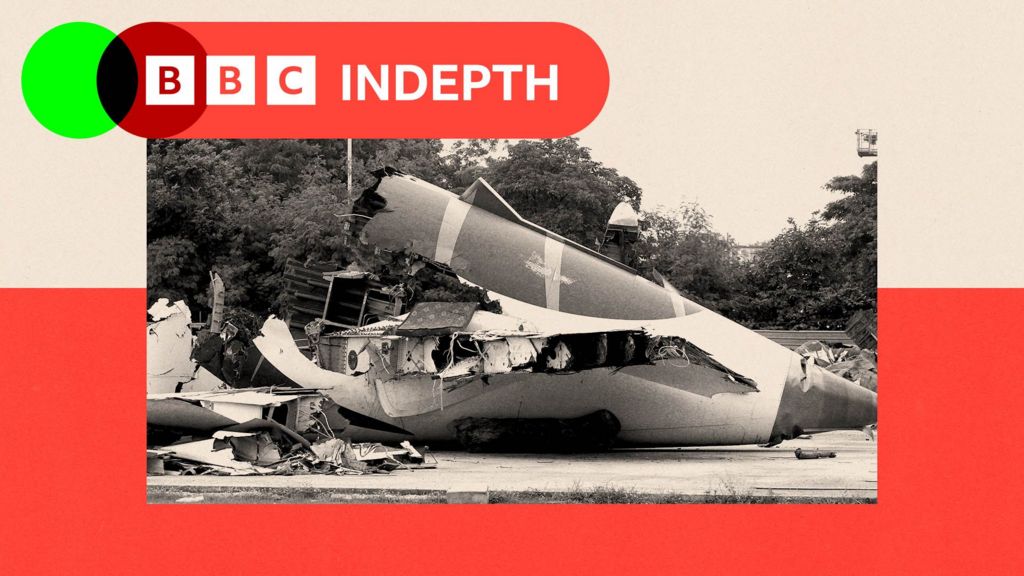
It has been exactly one year since one of the deadliest commercial air disasters in recent Indian history unfolded. On June 12, 2025, Air India Flight 171, a Boeing 787 Dreamliner bound for London carrying 230 passengers and 10 crew members, crashed just 32 seconds after departing Ahmedabad’s Sardar Vallabhbhai Patel Airport. All but one person on board perished in the crash, and an additional 19 people on the ground lost their lives, bringing the total death toll to 260.
Surveillance footage captured the jet’s final moments: the aircraft appeared to lift off normally, but failed to gain altitude, hovering briefly before gliding downward and disappearing behind a line of buildings and trees. Seconds later, a massive fireball and thick plume of black smoke confirmed the scale of the tragedy, but the footage offered no clear answers about what caused the crash.
Under the terms of Annex 13 of the Convention on International Civil Aviation, India’s Aircraft Accident Investigation Bureau (AAIB), a division of the nation’s Ministry of Civil Aviation, holds lead responsibility for the official probe. The U.S. National Transportation Safety Board, alongside technical experts from plane manufacturer Boeing, engine builder GE Aerospace, and the U.S. Federal Aviation Administration, joined the investigation as accredited representatives, a standard provision for international air accidents involving foreign-built aircraft.
The international agreement guiding the investigation clearly states that the sole purpose of air accident probes is to prevent future disasters, not to assign blame or liability. Yet the stakes for all involved parties could not be higher. Boeing is still recovering from years of high-profile safety scandals tied to its 737 MAX program, and the 787 Dreamliner, one of the company’s flagship products, had maintained a flawless safety record before this crash. For Air India, a struggling carrier recently acquired by the Tata Group, any finding of operational or maintenance failure would deliver a devastating blow to its already damaged brand. For the families of the 260 victims, the investigation is the only path to answers about their loved ones’ deaths.
One month after the crash, the AAIB released a 15-page preliminary report that did not draw final conclusions or issue safety recommendations, but two short paragraphs ignited a firestorm of controversy that still rages today. The report confirmed that flight data showed the aircraft’s two fuel cutoff switches – which control fuel flow to the engines – shifted from the “run” position to the “cutoff” position seconds after takeoff, a move that would immediately cut engine thrust. It added that cockpit audio recorded one pilot asking the other why he had flipped the switches, with the second pilot responding he had not touched them.
The vague wording of this disclosure sparked immediate international speculation that the crash was an act of deliberate pilot homicide-suicide. Multiple international media outlets cited anonymous sources naming veteran captain Sumeet Sabharwal as the person who had triggered the fuel cut. By the time the AAIB issued a statement condemning irresponsible, selective, and unverified reporting and warned against spreading premature narratives that undermined the investigation, the damage to the pilots’ reputations was already done.
Critics of the AAIB’s handling of the probe, including the Federation of Indian Pilots (FIP), which represents 6,000 Indian commercial pilots, have condemned the preliminary report as irreparably compromised. FIP president Capt. CS Randhawa argues there is a longstanding pattern of investigators shifting blame to deceased pilots to protect aircraft manufacturers and aviation authorities. The FIP, alongside Sabharwal’s 91-year-old father, have petitioned India’s Supreme Court to order an independent judicial probe into the disaster, arguing the national investigation lacks impartiality.
While some veteran aviation investigators, including former UK air accident investigator Tim Atkinson, support the pilot suicide theory – noting it removes blame from regulators, the airline, and the manufacturer, making it a convenient conclusion for powerful stakeholders – safety campaigners, pilots, and victims’ lawyers have vigorously pushed back against the narrative. They argue that a catastrophic, unreported electrical failure caused the crash, and point to multiple inconsistencies and anomalies in the AAIB’s preliminary findings to support their case.
The U.S.-based Foundation for Aviation Safety, led by former Boeing senior manager and whistleblower Ed Pierson, claims the crashed jet, delivered to Air India in 2014, suffered from repeated serious electrical issues throughout its service life. Documents reviewed by the BBC confirm a 2022 incident of burning in one of the plane’s main power panels. Air India says the damage was fully repaired per Boeing-approved maintenance standards and the plane was cleared for service before returning to operation. The preliminary report also confirms the aircraft was allowed to fly with a pre-existing fault in its core network, the central electronic system that connects the plane’s flight computers, often described as the jet’s central nervous system.
The alternative theory advanced by critics holds that a major electrical failure caused the plane’s flight computers to reboot seconds after takeoff. This, they argue, tricked the aircraft’s automatic safety systems into thinking the jet was still on the ground even as it climbed. The system automatically cut fuel flow to the engines to prevent a dangerous thrust surge on the ground, leading to the rapid loss of altitude that caused the crash. Under this scenario, the flight data recorder registered an electronic command to cut fuel, not a physical movement of the cockpit fuel cutoff switches.
Investigative journalist Rachel Chitra, who has published detailed technical analysis of the crash, has pointed out multiple inconsistencies in the AAIB’s account of engine performance after the fuel cut. Lawyers representing victims’ families have also highlighted discrepancies around the deployment of the Ram Air Turbine (RAT), the emergency power system that deploys to provide electricity and hydraulic pressure when main systems fail. CCTV footage shows the RAT deployed immediately after takeoff, but the preliminary report claims it deployed five seconds after the fuel switches were cut. Independent simulator tests shared with the BBC show the RAT would take 14 to 18 seconds to deploy after a fuel cut, suggesting the RAT activated while the plane was still on the ground, before any fuel cut occurred – evidence, attorneys argue, of a pre-existing electrical failure.
“This is a symptom of something that has gone wrong,” explained Mike Andrews, an attorney with the U.S. firm representing 135 victims’ families. “If the RAT deployed before the fuel cut, as our tests indicate, we have to ask why – the pilot suicide narrative cannot answer that question.”
The AAIB is required by international regulation to release either a final report or an interim update on the first anniversary of the crash, which falls on June 12, 2026. Most observers do not expect a conclusive final report to drop on this date, after India’s civil aviation minister stated in May that the probe was in its final stage and a full report would likely come a month later. Few expect any update will resolve the deep doubts that already surround the investigation, which are rooted in widespread perceptions that powerful corporate and national interests are protecting themselves from liability.
This controversy has reignited longstanding criticism of the global system for investigating air accidents, which has not been fundamentally updated since it was established in 1944. Critics note that assigning investigation authority to the nation where the crash occurs leaves the process vulnerable to political pressure, corporate influence, and local bureaucratic capture. Even when foreign experts participate, manufacturers’ representatives face overwhelming pressure to deflect blame from their companies.
The International Civil Aviation Organization (ICAO), the U.N. body that oversees global aviation, has acknowledged these conflict-of-interest risks and recently approved amendments to Annex 13 that will allow nations to delegate accident investigations to independent third parties and increase procedural transparency starting in 2028. But critics say these changes do not go far enough to address the systemic flaws of the current system.
“Whatever ICAO is trying to change and improve is only trying to reduce the symptoms, but global aviation, global manufacturers and global airlines demand a global answer,” said aviation safety consultant Eckhard Jann. Jann argues the only solution is the creation of a permanent, independent global air accident investigation authority with the power to enforce its safety recommendations.
Other aviation experts disagree on the need for a full overhaul. Atkinson, who supports the pilot suicide conclusion in the AI171 case, argues that existing systems can work if they embrace far greater transparency at the early stages of investigations, releasing more information to the public sooner rather than allowing leaks and speculation to shape the narrative. Even so, he acknowledges the current model of major accident investigations has fallen short of its core goal of preventing future deaths, with modern safety technology driving most improvements in air travel safety rather than post-crash probes.
One year on from the disaster that killed 260 people, the only point all sides agree on is that the current controversy surrounding the AI171 investigation has exposed deep flaws in how the world probes major air accidents – and that change is needed to ensure future investigations deliver the answers that victims’ families deserve and keep millions of air passengers safe.