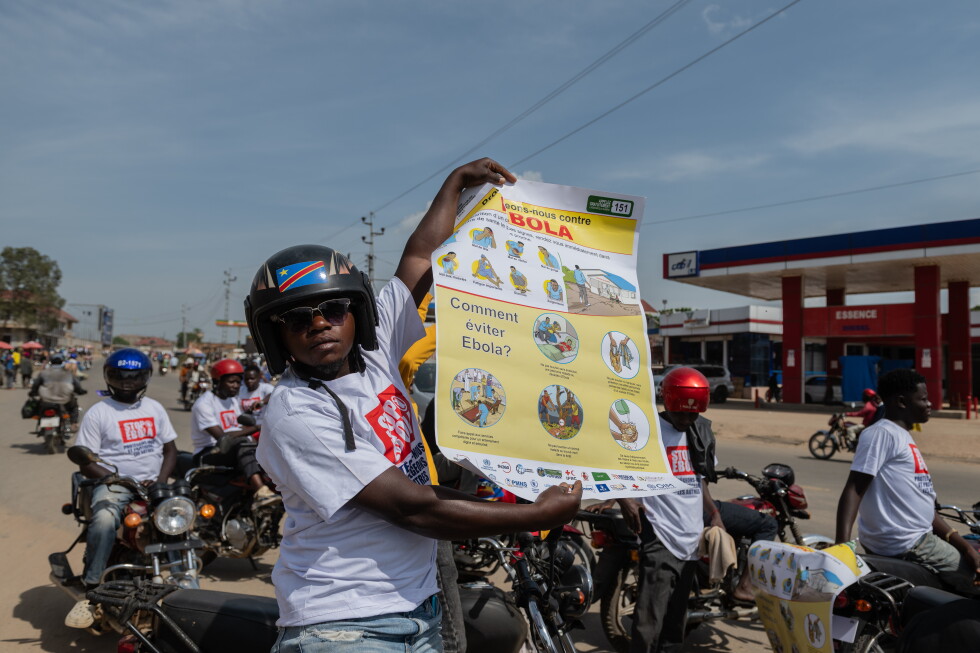
In the heart of the latest Ebola outbreak in the Democratic Republic of the Congo, dozens of local motorcycle taxi drivers have launched a community-focused public awareness caravan to combat dangerous misinformation that has fueled violent attacks on frontline health workers. The initiative, held Tuesday, unfolded in Bunia and Rwampara, two urban centers in Ituri province — the epicenter of the current outbreak which accounts for over 90% of all confirmed cases nationwide.
Clad in crisp white T-shirts emblazoned with the slogan “Stop Ebola”, the drivers paraded through city streets, displaying illustrated public health guides that outline key preventive measures for the viral disease. As of late Tuesday, Congolese health authorities had confirmed at least 598 cases of Ebola across affected regions, with 115 recorded deaths. Cases have also been documented in neighboring North Kivu and South Kivu provinces, and a small number of infections have been detected across the international border in Uganda.
What makes this outbreak particularly challenging for global and local health authorities is the deep-seated skepticism and rampant misinformation that has taken root in many local communities. Many residents reject the existence of the outbreak entirely, while others fiercely oppose the strict burial protocols health workers implement to limit viral spread after an Ebola death. This resistance has erupted into open violence: Marie Roseline Darnycka Belizaire, the World Health Organization’s emergency director for Africa, confirms that more than 520 separate incidents have disrupted health worker operations, including at least three targeted attacks on health centers in Ituri alone, sparked by resident demands for the return of deceased patients’ bodies.
Organizers of the awareness caravan say that engaging local motorcycle taxi drivers is a strategic response to this violence. These drivers are embedded in daily community life, regularly transporting both sick and healthy residents across towns and rural areas, making them trusted messengers for accurate public health information. “Response teams have been attacked in some areas, and that is one reason why we chose to involve motorcycle taxi drivers,” explained Jacques Maliro, WHO’s Risk Communication and Community Engagement Officer and a lead organizer of the campaign. “They are an important group because they transport both sick and healthy people, so they too need to be informed and engaged.”
Misinformation has discouraged residents from following life-saving public health guidelines and seeking early medical care, officials say. At the start of the outbreak, some local churches even told congregations that Ebola is a hoax, and that divine faith eliminates the need for professional medical care. For Josue Mbabona, one of the motorcycle drivers participating in the caravan, the outbreak is a devastating personal reality: he has already lost three family members to the virus. “Those who do not believe in it need to understand that it is real,” Mbabona said.
The outbreak response has been hampered by multiple overlapping crises beyond community resistance. Decades of ongoing conflict involving dozens of separate rebel and militant groups — some linked to neighboring Rwanda and the extremist Islamic State — have left many rural communities completely cut off from outside aid, leaving frontline health workers unable to access at-risk populations. Frontline workers also face grueling conditions, laboring for long hours with little pay and almost no rest. Critical supply shortages further complicate response efforts: this week, local residents and officials in Bunia reported widespread shortages of clean water for the frequent handwashing public health officials recommend to slow viral transmission.
Complicating matters further, the current outbreak is caused by the rare Bundibugyo Ebola strain, which lacks any approved vaccine or targeted treatment — a key difference from the more common Zaire strain that has caused most of the 16 previous Ebola outbreaks recorded in Congo. Currently, three vaccine candidates are in active development, and Africa’s top public health agency announced last month that it aims to roll out approved vaccines and treatments for Bundibugyo virus by the end of 2024. For residents in affected areas, the urgent need for a vaccine is clear: “The vaccine needs to be available so that we can protect ourselves, move forward, and return to normal life,” said David Kasimwa, a student who joined the awareness caravan. “This disease has disrupted many activities: We are no longer able to travel freely because we are afraid,” he added.
The outbreak has already triggered international policy shifts: multiple countries have implemented new travel restrictions and enhanced entry screening for travelers arriving from affected regions, though the World Health Organization has repeatedly declined to recommend broad, region-wide travel bans. On Tuesday, U.S. Secretary of State Marco Rubio called on European nations to tighten their own entry restrictions for travelers from affected African countries, warning that failure to act could result in stricter U.S. entry requirements for all travelers arriving from Europe — even during the upcoming FIFA World Cup. There are very few direct daily flights between Africa and the United States, but more than 300 direct flights connect Europe and the U.S. on a daily basis.