On Wednesday, Ukraine carried out a coordinated series of long-range attacks targeting key assets hundreds of kilometers inside Russian territory, a calculated escalation of Kyiv’s strategy to increase the military and economic cost of Moscow’s full-scale invasion for the Kremlin. The strikes hit deep behind Russian lines at energy facilities and defense manufacturing sites, according to Ukrainian President Volodymyr Zelenskyy, who outlined the scope of the operation in a public social media address.
Zelenskyy confirmed that Ukrainian forces used domestically developed FP-5 Flamingo long-range missiles to strike a key military industrial facility in Cheboksary, the capital of Russia’s Chuvashiya region. The site sits more than 900 kilometers (over 560 miles) from the active front lines in eastern and southern Ukraine, marking one of the farthest inland Ukrainian strikes to date. Zelenskyy noted the facility produces critical components for Russian attack drones and missiles, weapons Moscow relies on heavily for its ongoing campaign against Ukraine. Oleg Nikolayev, the regional governor of Chuvashiya, later verified the missile strike but declined to release further details on damage or casualties. Independent Russian outlet Astra News reported the target was the VNIIR-Progress plant, which manufactures antenna systems for Russian military drones.
Additional strikes hit a second key energy site in Russia’s Samara region, where local governor Vyacheslav Fedorishchev confirmed drone attacks damaged multiple industrial facilities and left three people injured. Though Fedorishchev did not publicly name the affected sites, Astra published photographs showing a massive uncontrolled blaze burning at the region’s large oil refinery. Zelenskyy added that Ukraine’s domestic security agency, the Security Service of Ukraine (SBU), carried out separate attacks on two more oil infrastructure sites in Russia’s Vladimir region, located roughly 700 kilometers from the front.
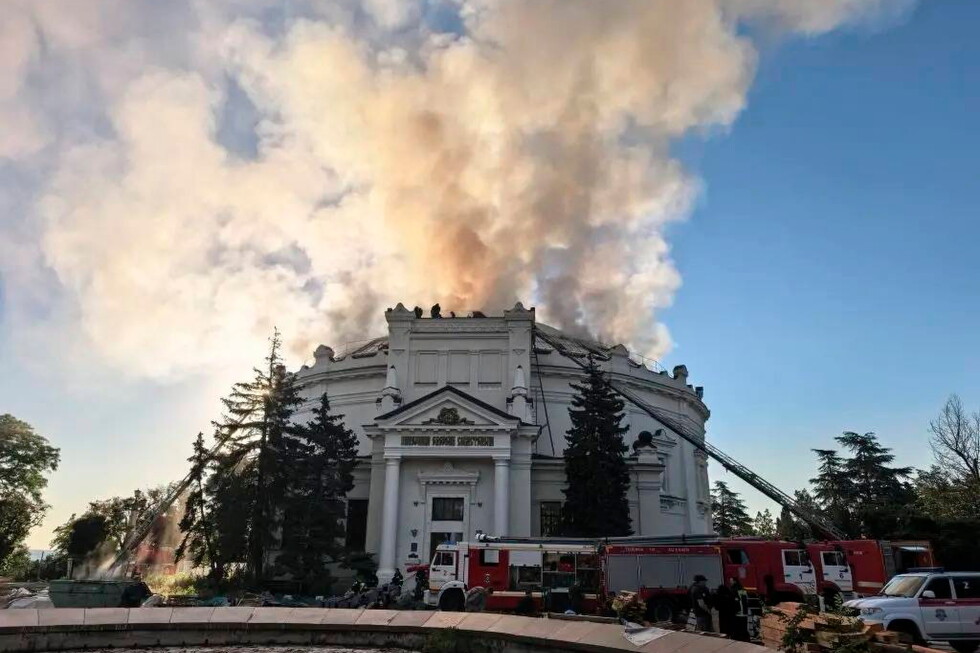
The long-range assault also extended to Russia-occupied Crimea, where a Ukrainian drone struck a historic landmark in the port city of Sevastopol: a building housing a massive panoramic painting by 19th century artist Franz Rubo that depicts the 1850s defense of Sevastopol during the Crimean War. Mikhail Razvozhayev, the Kremlin-appointed head of Sevastopol, claimed the artwork was completely destroyed in the strike.
The cross-border strikes come amid a prolonged period of stagnation along the roughly 1,000-kilometer front line, where both Moscow and Kyiv have been hampered by widespread drone use that prevents large-scale territorial advances. In response, both nations have increasingly turned to long-range strikes to weaken the opposing side’s military capacity and public morale. For Russian President Vladimir Putin, the deep and increasingly audacious Ukrainian attacks pose a direct political challenge, undermining his repeated public claims that Russia is gaining the upper hand in the war, which entered its fifth year in 2025.
The latest strikes follow just one week after Ukrainian attacks set fire to an oil terminal in St. Petersburg and struck a nearby Russian naval base, an incident that overshadowed Putin’s major annual economic forum held in his hometown. That disruption marked just one in a string of recent political setbacks for the Russian leader: just weeks before the St. Petersburg attack, Putin ordered significant cuts to Moscow’s annual Victory Day military parade over widespread security fears of potential Ukrainian drone strikes on the capital.
Russia did not leave the Ukrainian strikes unanswered. Overnight, Russia launched a massive wave of drone and missile attacks across multiple Ukrainian regions. In the northeastern region of Kharkiv, regional administration head Oleh Syniehubov reported that a barrage of 26 drones struck early Wednesday, injuring four people. Overall, Syniehubov said Russian attacks across Kharkiv killed one person and wounded 15 others in the 24-hour period ending Wednesday morning. In the southern Zaporizhzhia region, 10 people were injured in overnight Russian aerial strikes, according to regional governor Ivan Fedorov. In the Black Sea port city of Odesa, regional governor Oleh Kiper reported that Russian drone strikes damaged two residential apartment buildings, leaving a mother and her two children, aged 8 and 10, in need of medical care.
Ukraine’s Air Force reported that its air defense systems successfully intercepted 181 out of the 207 Russian drones launched in the attack. Russia’s Defense Ministry for its part claimed that its own air defenses shot down 326 Ukrainian drones overnight during the cross-border strike operation.