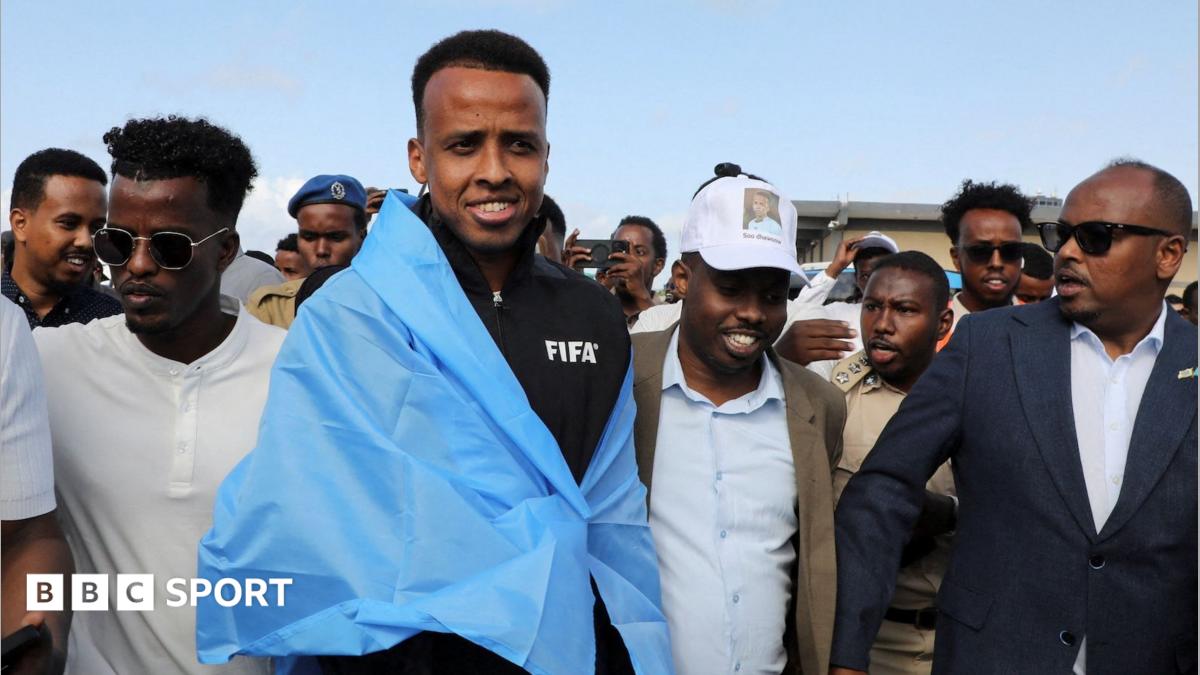
Somalia’s star football referee Omar Artan has returned to a jubilant, nationwide welcome in Mogadishu after being denied entry to the United States ahead of the 2026 FIFA World Cup, reaffirming his promise to reach the global tournament’s pitch at the 2030 edition.
The 34-year-old, who was named the Confederation of African Football’s Men’s Referee of the Year for 2025, made history as the first Somali referee ever selected for a World Cup finals. He was one of just 52 on-pitch officials chosen for the 2026 co-hosted tournament, which splits matches across the U.S., Canada and Mexico. All match officials are required to be based in Florida for pre-tournament training, preparation and security protocols, making entry to the U.S. non-negotiable for Artan to take up his place.
Despite holding a valid diplomatic passport and approved single-entry U.S. visa, Artan was detained for hours and subjected to an 11-hour immigration interview upon arrival at Miami International Airport on Monday. He was ultimately denied entry and repatriated, with U.S. authorities offering no public explanation for the decision. The move falls in line with a sweeping travel ban implemented by U.S. President Donald Trump in June 2025, which imposes a full entry ban on all visa holders from 12 countries, including Somalia.
The incident comes on the heels of inflammatory comments Trump made about Somalia just two months before the tournament, ahead of an immigration enforcement operation in Minnesota’s large Somali-American community. Trump dismissed Somalia as “barely a country” claiming “they just run around killing each other. There’s no structure,” and added that Somali immigrants should “go back to where they came from,” warning the U.S. would “go the wrong way if we keep taking in garbage to our country.”
Andrew Giuliani, head of the White House Task Force on the World Cup, defended U.S. Customs and Border Protection’s decision in an interview with BBC World Service, saying “While I can’t go into the derog [derogatory information] on that I can tell you it was the right decision by customs and border patrol and I support that decision.”
Artan arrived back at Mogadishu’s Aden Adde International Airport on Wednesday, where hundreds of supporters, senior government officials, Somali Football Federation representatives, fellow referees and ordinary residents gathered to greet him. Crowds carried pro-Artan banners, wore custom hats printed with his image, and social media creators streamed the welcome live to their online audiences. Hundreds more were expected to join a public reception at Mogadishu Stadium later the same day, where Artan planned to attend a domestic league match between Heegan and Dekadaha.
Speaking to reporters after his arrival, Artan expressed gratitude for the outpouring of support from his homeland. “Everything is pre-destined. Fifa supported me well and were in touch with me until I reached Mogadishu,” he said. “I promise you that I’ll be officiating you in the next World Cup. Somalia, everywhere, I’m letting you know.”
In a message to young Somalis, Artan urged the next generation not to lose hope or be demoralized by his treatment. “Let’s all defend Somalia’s honour. We all belong to Somalia whether it’s bad or good. That flag is ours and so is the passport – let’s defend it,” he said. “Despite this happening to me, I’ll still stand for my nation. I want to continue my journey from here and urge the youth to do the same.”
Artan, who has held FIFA referee credentials since 2018, has become a national icon in Somalia after his landmark selection to the 2026 World Cup squad. Supporters across the country have framed his rejection as an insult to Somali national dignity, even as the referee himself says he remains committed to pursuing his World Cup dream. The incident has also sparked broader questions about FIFA’s ability to manage logistics and protect its appointed officials ahead of the 2026 tournament, with critics asking how the governing body could allow a referee’s historic qualification to be derailed by U.S. immigration policy.